
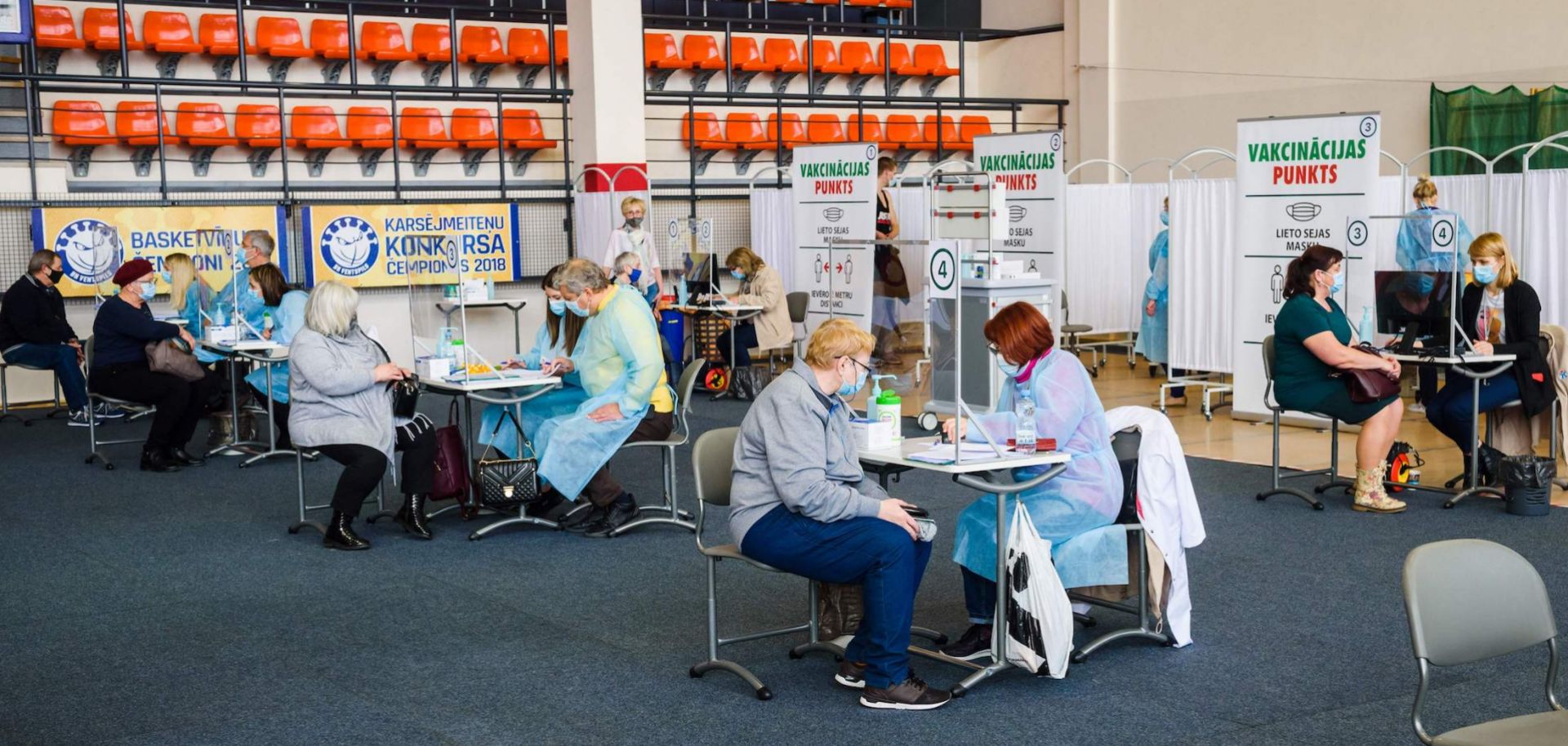
People wait to receive the COVID-19 vaccine at a community center in Latvia on March 30, 2021.
The European Union’s goal of reaching herd immunity by July will require a significant acceleration of its COVID-19 vaccination process. But variations in manufacturing and distribution capacity, along with public acceptance of the shot itself, mean that process — and the bloc’s subsequent rebound in economic activity — will be uneven. EU Internal Market Commissioner Thierry Breton told a French newspaper on April 5 that at least 70% of adults (the so-called “herd immunity” threshold where the virus can be easily controlled) in the European Union could be inoculated by mid-July as the bloc ramps up its vaccine rollout after a sluggish start. Breton said the European Union will begin distributing 100 million vaccine doses a month starting in April, after distributing 60 million doses in March and 28 million in February. But according to the European Centre for Disease Prevention and Control (ECDPC), as of April 4, only 14.2% of adults in the European Union had received at least one vaccine dose, which means that the vaccination process will have to increase significantly to meet the July goal. By contrast, more than 50% of adults in the United Kingdom have received at least one dose.
- The European Union started its vaccination campaign in late December but progress has been slow due largely to production delays and distribution inefficiencies.
- In January, the European Union approved export controls on vaccines manufactured in the bloc, which Brussels deployed for the first time on March 4 when it halted a shipment of 250,000 doses of Oxford-AstraZeneca vaccine to Australia. Brussels also recently threatened to halt vaccine deliveries to the United Kingdom.
- Vaccine hesitancy could also play a role in how fast EU countries reach herd immunity, and some countries will struggle more than others to convince their populations to get a shot. Surveys suggest that roughly half of France’s population and a third of Germany’s population, for example, are skeptical of the COVID-19 vaccine.
Infection and vaccination rates vary significantly across the European Union, which means that not every member state will reach herd immunity or lift their lockdowns at the same time. The 14-day case notification rate per 100,000 inhabitants, a key indicator of the epidemiological situation in every country, shows notable differences among EU member states. For example, Spain is currently at 160.7 cases per 100,000 inhabitants, while Germany is at 248.21 and France is at 703.99. Meanwhile, central and eastern European countries like the Czech Republic, Hungary and Estonia are all above 1,000 cases. The same applies to vaccinations: While around 25% of adults in Hungary have received at least one dose, only 7% have received one in Bulgaria. Countries with both high infection rates and low vaccination coverage are more likely to resume or extend stricter lockdown measures.
- While the European Medicines Agency (EMA) has only approved three vaccines, countries such as Hungary and Poland have signed bilateral agreements to purchase other vaccines from Russia and China. This has helped expedite Hungary and Poland’s vaccination campaigns despite the current delays in the distribution of Western vaccines.
Prolonged lockdowns will delay a significant increase in economic activity in the European Union until at least the second half of 2021. EU members have extended and/or tightened their lockdown measures since late 2020, which has likely resulted in GDP contractions during the first quarter of 2021. The impact of these restrictions has been strong in the services sector, with bars, restaurants, hotels and tourism hit particularly hard. The continuation of these measures into the second quarter suggests that economic activity will remain modest and that growth should only accelerate significantly in the third quarter. While furlough schemes in EU countries have kept unemployment rates stable in recent months, there is usually a lag between increases in economic activity and reductions in unemployment, which means that the European Union’s job market will probably remain below pre-pandemic levels for the foreseeable future. Moreover, the lifting of furlough schemes could lead to temporary spikes in unemployment.
- On March 23, Germany extended its lockdown until at least April 18. On April 1, the Italian government extended the lockdown measures at least until April 30. Then on April 4, France entered its third national lockdown, which is expected to last for at least four weeks.
- In March, the European Commission announced plans to create a “digital green certificate” with information about people’s vaccination status, COVID-19 tests, and past infections. Aimed at accelerating activity in the bloc’s crucial services sector, the certificate is still a work in progress and should only be available by July at the earliest.
- On April 6, Eurostat reported that the unemployment rate in the eurozone was 8.3% in February, stable compared with January and up from 7.3% in February 2020.
