
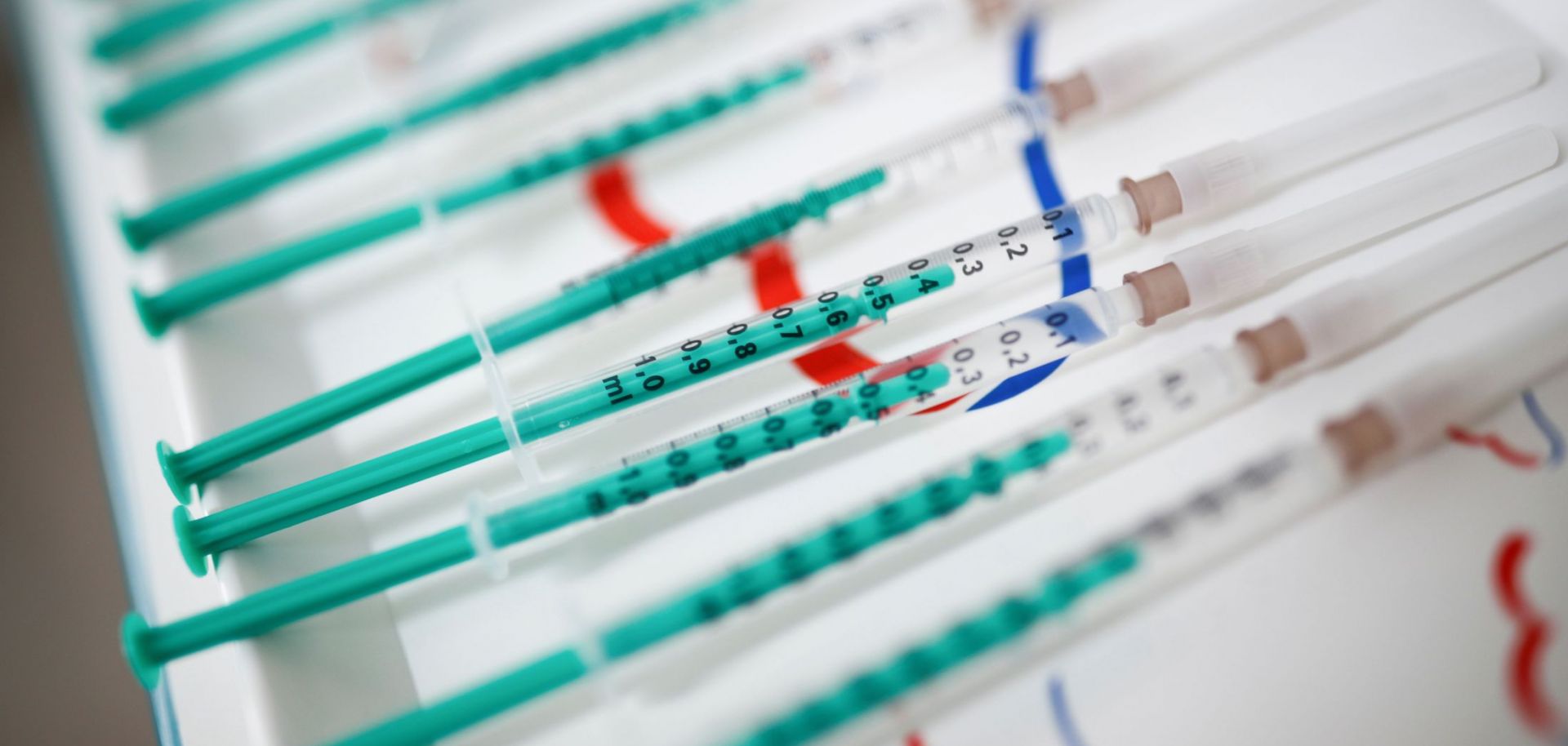
Syringes are seen on a table at a COVID-19 vaccine distribution site in Senftenberg, Germany.
Recent moves by EU member states to purchase COVID-19 vaccines unilaterally underscore the limits of the European Union’s centralized inoculation efforts. Such actions will risk complicating the bloc’s ability to generate EU-wide “health certificates” to help boost economic activity within the Continent. They will also open the door for external players like Russia and China to cement their bilateral relations with EU countries — something Brussels will be mostly powerless in stopping. In late 2020, the European Commission signed contracts with several pharmaceuticals to secure hundreds of millions of doses of COVID-19 vaccines. However, the distribution of vaccines has been slower than expected due to production and logistical problems with the pharmaceutical companies. In recent days several EU member states have announced their own plans to acquire additional COVID-19 vaccines, arguing that the plan crafted by the European Commission is too slow. This is not the first time that EU member states have acted against the commission’s recommendations: Since the beginning of the pandemic in early 2020, Germany and other countries have introduced border closures despite Brussels advising against it — a reminder that EU member states still make national security decisions based on their own priorities.
- So far, the European Medicines Agency (EMA) has only authorized the BioNTech/Pfizer, Oxford/AstraZeneca and Moderna vaccines.
- On March 1, Polish President Andrzej Duda talked with his Chinese counterpart, Xi Jinping, about buying the Chinese Sinopharm COVID-19 vaccine.
- Also on March 1, Slovakia received 200,000 doses of the Russian Sputnik V vaccine, the first batch of an order of 2 million.
- Hungary has signed contracts to receive some 600,000 doses of the Sputnik V vaccine and 500,000 doses of the Sinopharm vaccine. On Feb. 28, Hungarian Prime Minister Viktor Orba posted a photo of him receiving the Sinopharm vaccine on social media.
- On March 2, the Croatian government expressed interest in purchasing the Sputnik V vaccine.
- On Feb. 28, Czech Prime Minister Andrej Babis said his country could use Russia and China’s vaccines, even without EMA approval.
- Austrian Chancellor Sebastian Kurz, who recently called the EMA “too slow,” and Danish Prime Minister Mette Frederiksen will visit Israel on March 4 to discuss an agreement to produce vaccines.
Greater availability of vaccines could help the European Union speed up the process to reach their goal of having at least 70% of the population vaccinated by the end of the year. But it could also undermine efforts to introduce a bloc-wide “health passport” to help the tourism, hospitality and entertainment sectors. Countries in southern Europe including Greece, Cyprus and Spain, which are all heavily dependent on tourism, are calling for the European Union to release a “health certificate” to allow vaccinated people to travel within the bloc. The European Commission has said it will present a proposal on this issue by the end of March. But the fact that several countries are using vaccines that have not been approved by the EMA will make it difficult for Brussels to come up with a plan. In the meantime, countries will start making unilateral moves to protect their tourism sectors.
- On March 1, Spain’s Tourism Minister Fernando Valdes announced that his country was in conversations with the United Kingdom to create a “health corridor” so that vaccinated British travelers could visit Spain.
- On Feb. 8, Israel, Greece and Cyprus announced a plan for people with COVID-19 vaccination certificates to travel freely between the three countries. Greek Prime Minister Kyriakos Mitsotakis described the deal as a “trial run” for what Athens plans to do with other countries.
The European Commission’s lack of credibility regarding the COVID-19 vaccination campaign has made it possible for Russia and China to secure political, reputational and economic wins in the Continent. This is happening along pre-existing geopolitical fault lines. Russia already had a good working relationship with Hungary before the pandemic, while Poland (which has tense ties with Moscow) opted for China instead. Nationalist governments in central and eastern Europe, which have often tense relations with Brussels, are also using their vaccination decisions as a part of their euroskeptic rhetoric. Still, this presents political challenges for the governments acting unilaterally, as they could result in opposition from pro-EU political parties and voters. It also presents logistical challenges for China and Russia, which may not be able to honor their vaccine commitments to European countries at a time when they are also signing contracts with countries in other parts of the world. There’s little Brussels can do to push back against these events aside from warning about the risks of using vaccines that have not been endorsed at the EU level, as EU member states have the power to authorize the domestic use of vaccines during emergency situations even if they haven’t been approved by the EMA.
- In 2020, China sent face masks and other protective gear to countries hit hard by the first wave of COVID-19 infections. This, coupled with the ongoing contracts to provide countries with the Sinopharm vaccine, is a part of Beijing’s efforts to improve its global image after accusations that it covered up the early spread of the virus.
- Hungary, Poland, the Czech Republic and Slovakia are all members of China’s Belt and Road Initiative, as well as the 17+1 cooperation format between China and central and eastern Europe.
- Russia’s relations with the European Union have worsened in recent months because of The poisoning and jailing of Russian opposition activist Alexei Navalny have further strained the European Union’s relations with Russia in recent months, with Brussels imposing sanctions on Russian officials. To some extent, Moscow’s vaccination diplomacy is also meant to improve its image in Europe.
- Two junior members of Slovakia’s ruling coalition have criticized the government’s decision to purchase the Sputnik V vaccine. Members of both parties have not ruled out exiting the coalition because of this.
