
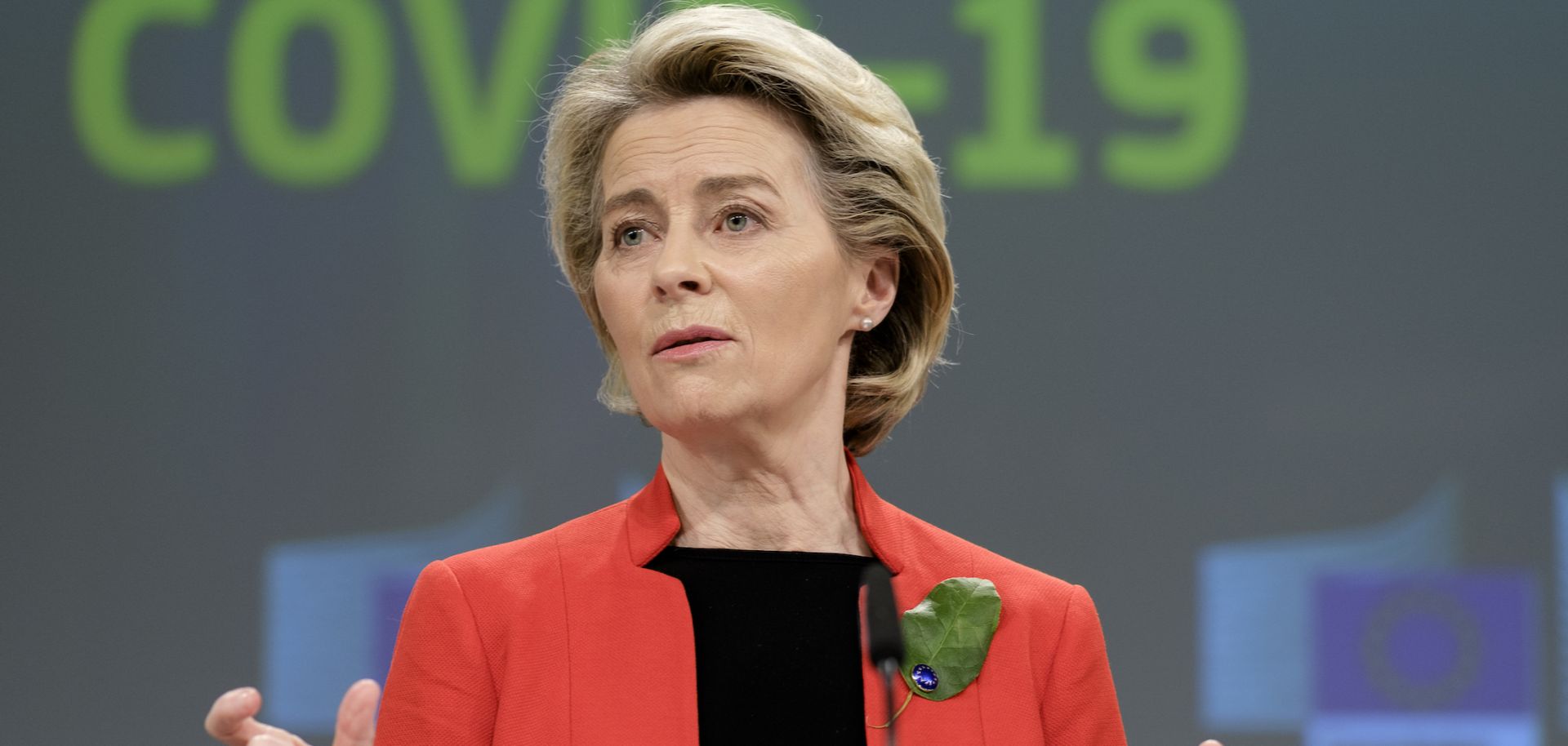
European Commission President Ursula von der Leyen discusses the bloc’s proposed Digital Green Certificate during a press conference on March 17, 2021.
The European Commission’s proposed Digital Green Certificate will have a modest impact on the European Union’s tourism and hospitality sectors in the short term. But lingering questions on how COVID-19 immunity works and data privacy issues could complicate the implementation process. The European Commission unveiled on March 17 a plan to create a Digital Green Certificate with verified information on people’s COVID-19 status. If approved, the certificate will be proof that a person has been vaccinated against COVID-19, received a negative test result, or recovered from the virus. The certificate will be available in digital or paper format and will include a QR code to ensure its authenticity.
- The commission has promised that this certificate will be available to all EU nationals, regardless of whether they have been vaccinated against COVID-19. This explains why, in addition to information about vaccination, the certificate will also include polymerase chain reaction (PCR) information and data from other tests, as well as whether a person has been infected in the past.
- All EU member states will be obliged to recognize the digital certificate as proof of vaccination for the vaccines approved by the European Medicines Agency (EMA), but individual member states will also be free to recognize other vaccines, such as the Russian and Chinese ones (which some member states are already using). With this, Brussels is recognizing that individual member states have taken unilateral decisions regarding what vaccines to use.
- The decision to create a “certificate” (which includes health information) instead of a “passport” (which determines who can travel and who cannot) shows that Brussels wanted to avoid the perception of discrimination against people who have not been vaccinated.
This certificate leaves travel-related decisions in the hands of individual member states, which means that the reopening of national borders will still happen at different speeds and unevenly across the bloc. But as long as infections remain high, the travel and hospitality sectors will continue to struggle regardless. The future of tourism in the European Union will depend on the evolution of infections and social distancing measures, and less so on the existence of a common health certificate. Brussels is looking for ways to help Europe’s tourism and hospitality sectors, which have been hit hard by the COVID-19 pandemic. The commission believes that a homogeneous health certificate that is recognized across the bloc will make it easier for member states to make decisions on how to open their countries to foreign travelers. But the announcement of the certificate happens at a time when several EU countries are tightening their social distancing measures amid rising COVID-19 infections.
- According to the European Commission Vice-President for Values and Transparency, Vera Jourova, the proposed certificate “offers an EU-wide solution to ensure that EU citizens benefit from a harmonized digital tool to support free movement in the European Union.”
- Italy introduced tighter lockdown measures in half of the country’s regions on March 15 to fight against the spread of the COVID-19 virus. The government said the entire country will be under a severe lockdown during the Easter holidays.
- The French government said on March 17 that it will impose tougher restrictions for some regions, including Paris, to counter the accelerating spread of COVID-19 infections,
- On March 12, the Greek government announced the closure of all schools across the country and put three more regions under strict lockdown. The Greek government said it plans to reopen the country to tourists in mid-May.
Questions about how COVID-19 immunity works could result in countries applying different criteria when using the certificates, while issues connected to data privacy could complicate the ratification of the commission’s plan. Because the virus and the resultant pandemic are relatively new, studies remain ongoing to gain information on how long vaccines are effective, the length of natural immunity and whether or not vaccinated individuals can pass on the virus. The current uncertainty could result in individual EU member states making different decisions on who to accept in their territories, depending on the date of vaccination or past infections. Before this plan is implemented, the European Council and the European Parliament must approve it. During this process, member states and members of parliament could raise questions about the certificate’s impact on data privacy. While this certificate will be voluntary and contain a reduced amount of information, EU legislators have demanded stricter norms about where the data will be stored and how it will be used that could delay implementation.
- According to the European Commission, “the period of the relevance of certificates depends on scientific evidence and will be determined by the verifiers following their national rules. As new scientific evidence is emerging, the periods for which certificates are relevant for waiver of applicable public health requirements could be adjusted.”
- The commission has also said that all personal health data will be kept in the country that issued the certificate and will not be retained by the visited countries.
- Since the beginning of the COVID-19 pandemic, EU member states have taken unilateral measures on issues such as border crossings, travel restrictions and vaccination campaigns. This behavior is likely to continue when it comes to reopening their countries to international travel, which means that most countries will rely on bilateral or multilateral agreements to boost their tourism and hospitality sectors.
