
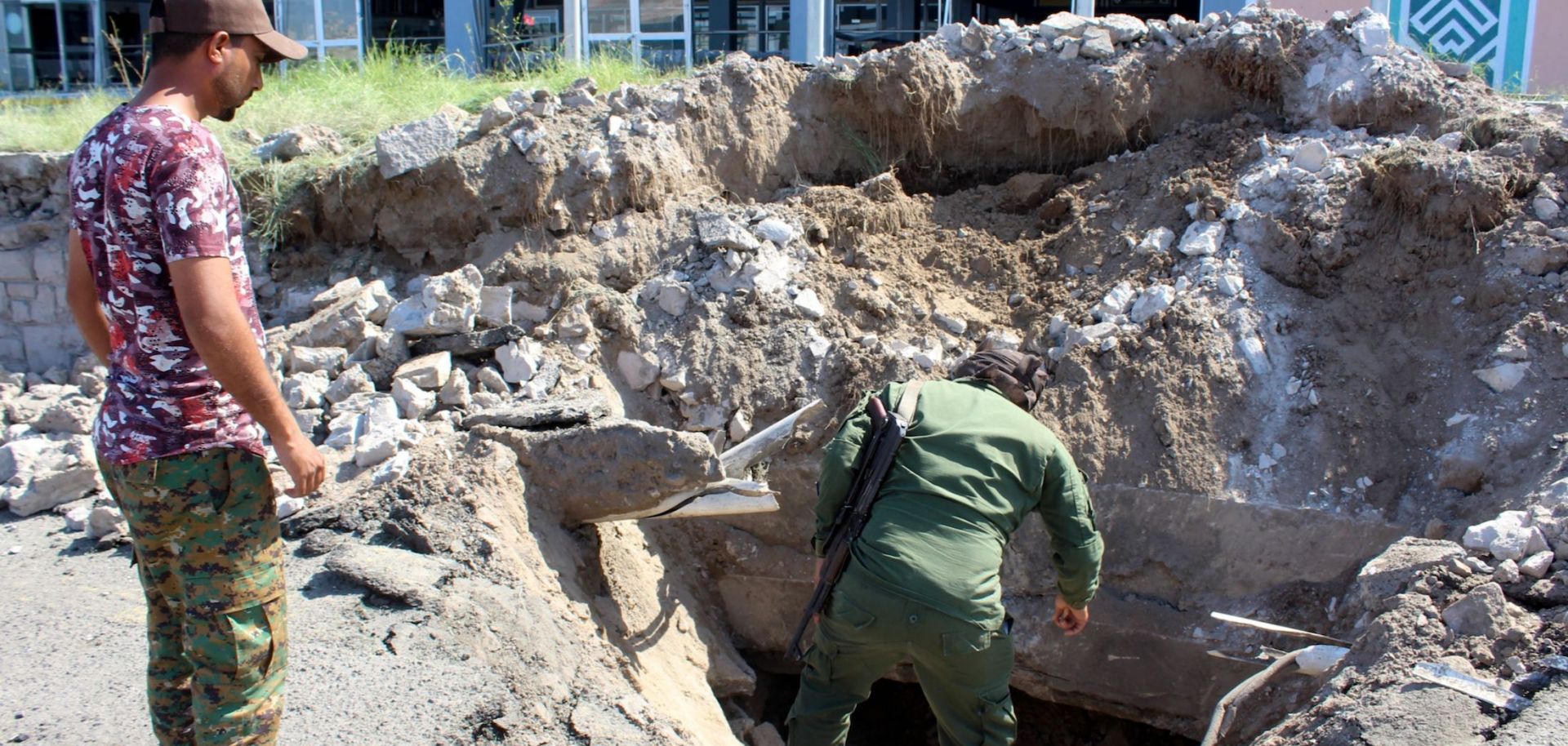
Fighters with the Saudi-backed coalition assess the damage outside the airport of Yemen's southern city of Aden on Dec. 31, 2020, a day after explosions rocked the building, killing or injuring dozens of people.
The new Yemeni government's ability to effectively govern will face threats from security risks and internal fractures, but the unity Cabinet will hold together in the coming months despite attacks targeting it such as the deadly explosion at Aden International Airport. The Dec. 30 explosion at the arrivals terminal of Aden International Airport killed 22, including some lower level officials, and injured at least 60, mostly civilians who were welcoming the new Yemeni unity government that had landed moments before. The government blamed the Houthi rebels for the attack, though culpability remains unclear. The new government's ability to function in the long term depends not only on easing ongoing internal feuding between north and south, but also on its ability to tamp down threats like the dangerous militancy on display in the attack.
The Dec. 18 formation of a unity government in Yemen eases one of the biggest conflict fault lines in Yemen by bringing feuding northern and southern politicians into a unified Cabinet. The establishment of the Cabinet of Prime Minister Maeen Abdulmalik Saeed represents a significant victory in bringing together northern and southern Yemeni officials in equal representation. The new unity government also enjoys significant political backing from the Gulf Cooperation Council, which will help shore it up in the near term.
- It has taken a year of political negotiations to build the new government, which fulfills a key step of the November 2019 Riyadh agreement that stipulates north-south power sharing as a fundamental component to easing the civil war.
- Aden has operated as the temporary capital of the Yemeni government in recent years since Houthi rebel forces took over the official capital Sanaa in 2014. Returning to Aden to rule is a highly significant symbol of unity.
- Historically, northern and southern Yemen were different countries, and have fought occasional civil wars for autonomy and greater territorial control.
The Aden airport attack will not fracture the new unity government, but the Cabinet will struggle to control the unstable security situation in the country — which is plagued by numerous groups with plausible motivation to attack the government. The attack was a clear demonstration against the new government, given that the first explosion on Dec. 30 was perfectly timed with the arrival of the new government and was followed by explosions near the city's presidential palace. Based on current information, including historic attack patterns and known missile and rocket capabilities, the Houthis are the most likely perpetrator of the Aden airport attack, which the Yemeni government concluded Dec. 31 to have been carried out with missiles. Numerous parties could have carried out the attack including the Houthi rebels who have been engaged in conflict for over five years with the Yemeni government, such as al Qaeda and Islamic State jihadist forces scattered throughout the country, as well as rogue southern militant secessionist elements potentially dissatisfied with the unity government.
- Both northern and southern officials, including the Yemeni information minister and the Southern Transitional Council, have blamed Houthi rebels for the attacks. The unity government poses a threat to the Houthi rebels by unifying feuding pro-Yemeni government officials around a common purpose of governing the country and resolving the Houthi conflict.
- While uncommon because they lack significant territory near Aden, Houthi attacks do occur as far south as Aden. For instance, the Houthis launched and claimed a deadly missile attack on a military parade in Aden in August 2019 that killed 36.
- Al Qaeda and the Islamic State have not conducted high-profile attacks in years in Yemen but maintain recruitment and training activities, especially in central and southern Yemen. Al Qaeda claimed to launch a rocket at an LNG facility in Shabwah governorate, central Yemen, as recently as Dec. 16.
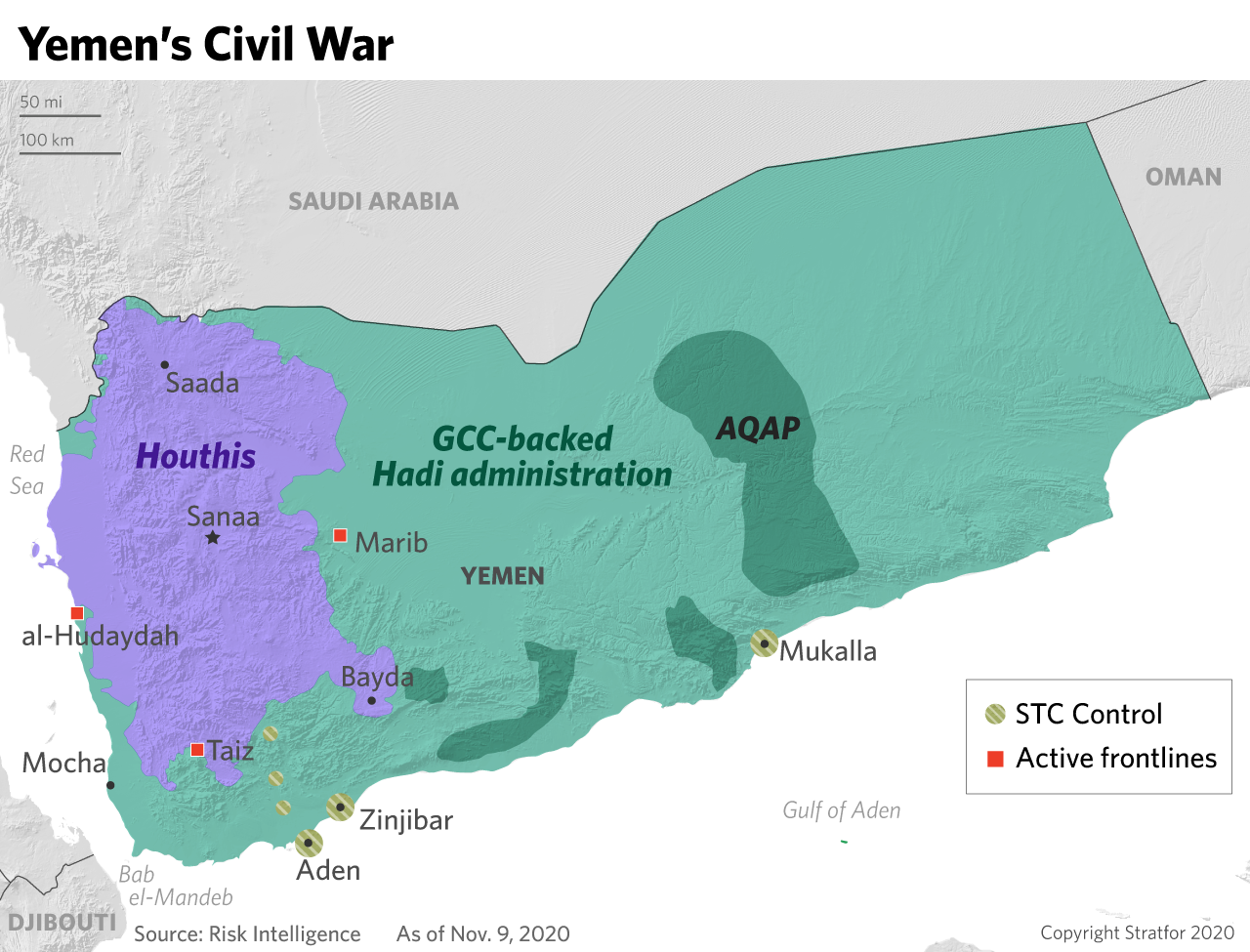
Internal fractures and mistrust within the new unity government will still complicate its long-term success. Rogue secessionists may be less likely than Houthis to be the perpetrators in this particular attack, but anti-government sabotage by a southern or northern element unhappy about the government's formation will remain a security risk in the coming months. One of the major sources of violence and political instability in Yemen over the last two years has been frequent fighting between southern and northern Yemeni forces for control of Aden and its environs.
- The pro-southern autonomy Southern Transitional Council claimed territorial autonomy over portions of Aden as recently as April 2020.
If the security environment deteriorates in Yemen, Saudi Arabia will be drawn further into a conflict from which it wants to pull back. The formation of the unity government is intended to strengthen the Yemeni government to help Riyadh withdraw from such a prominent role, but if the unity government is compromised by internal fighting or security risks and violent attacks, it will struggle to be self-sufficient. Moreover, Saudi Arabia's primary national security concern driving its Yemen policy isn't just supporting a Riyadh-friendly government, but also reducing the threat posed by the Houthis against the kingdom.
- Saudi Arabia is the primary backer behind the aptly-named 2019 Riyadh agreement, which lays out steps for deescalating the conflict both between the northern and southern elements and between the Houthis and the Yemeni government.
