
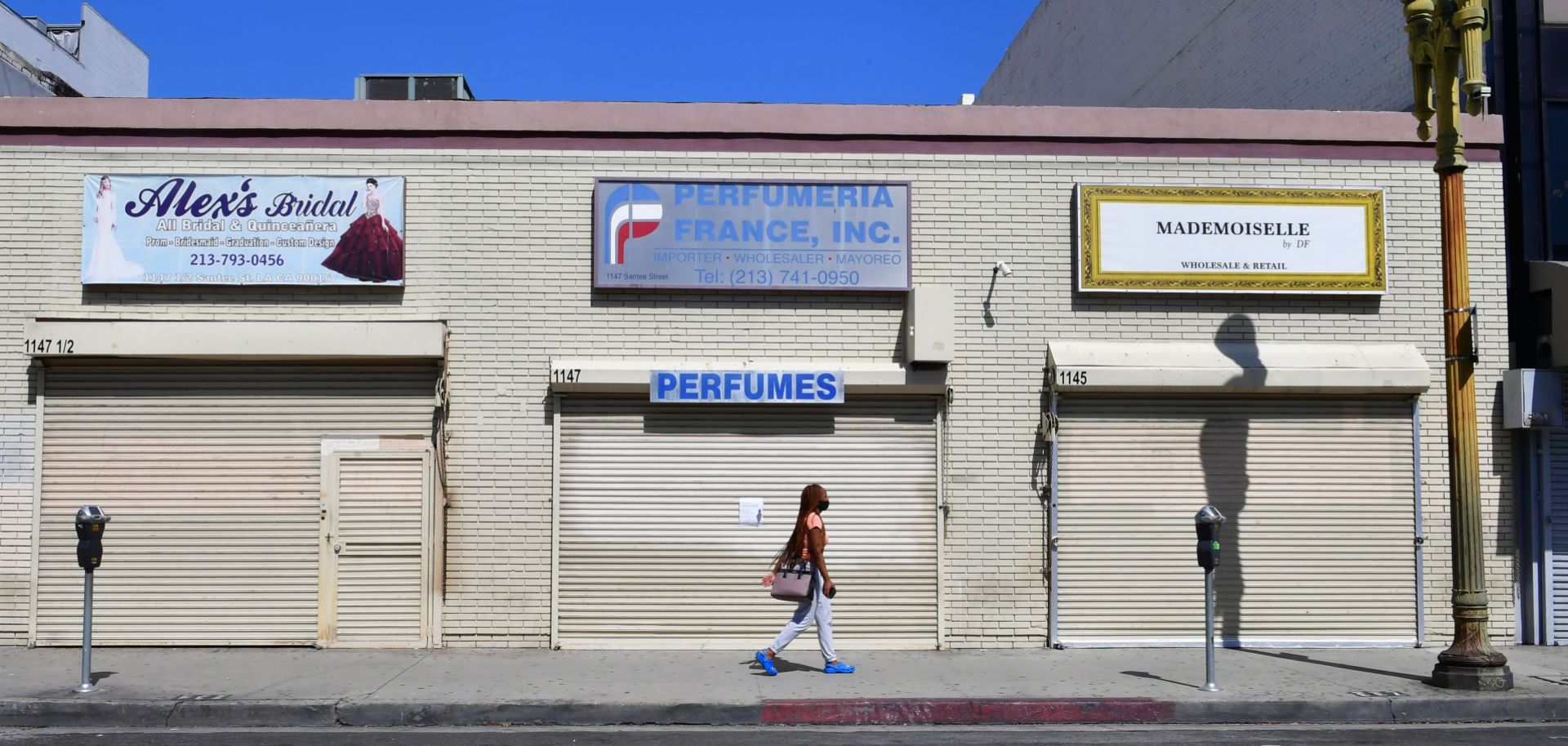
A woman walks past closed shopfronts in what would be a normally busy fashion district in Los Angeles, California, on May 4, 2020. The U.S. economy has lost roughly 20 million jobs since the onset of the country’s COVID-19 outbreak in February.
The United States and other governments around the world face difficult policy decisions on fiscal stimulus amid great uncertainty regarding the course of their economies in light of the global COVID-19 crisis. But as evidenced by the conflicting data in the latest jobs report released by the U.S. Bureau of Labor Statistics (BLS), it's proving difficult to find numbers and models that are both timely and use reliable data in order to gauge when economies will begin coming out of recovery on their own. Economic forecasts will be increasingly put under the microscope, making it important to understand what these predictions do and don't tell us.
The Risk of Relying on Employment Numbers
The exact timing of the trough of a recession says nothing about the duration or strength of recovery (e.g., whether it is "V-shaped" or some other alphabetical shape), but the speed of recovery is important when determining where and how to inject more stimulus into the economy. The Business Cycle Dating Committee of the National Bureau of Economic Research (NBER), a private research institution, says the U.S. recession began in March when the BLS's employment survey fell from its February peak of 152.4 million, thus ending 128 months of consecutive expansion — the longest in U.S. history.
The NBER recession declaration, however, is unusual in that it was based almost entirely on employment data without waiting for the release of more traditional, retrospective national income and product data for the second quarter of 2020. In the United States, the slowdown is due entirely to lockdown measures associated with the COVID-19 pandemic and not the effects of economic policy. Yet, there is a question of whether the U.S. economy is now in recovery as lockdowns increasingly ease and people return to work, particularly in high-contact service industries such as restaurants and personal services.
It's unorthodox to define recession solely by using unemployment data. The May unemployment rate for the United States fell to 13.3 percent from 14.7 percent in April, which by an unemployment measure alone suggests the trough of a short-lived recession occurred in either April or early May. Non-farm payrolls fell in March and April, but improved by a net 2.5 million in May. Given the unprecedented nature of the current global situation, however, there are considerable difficulties with the data as reported, which may understate the amount of continued unemployment.
- The BLS defines unemployment as those who aren't working but are actively seeking employment. Some states, however, have waived the requirement for recipients of unemployment benefits to be looking actively for work, which would ordinarily put them out of the workforce per the BLS definition.
- The BLS's household survey may have also misclassified about 5 million people as employed, but absent from work rather than unemployed or temporarily laid off.
- It's unclear whether workers receiving benefits from the U.S. Coronavirus Aid, Relief, and Economic Security (CARES) Act were counted as unemployed.
- Response rates to the household and establishment surveys were down, which affected sample-based estimates.
Moreover, the data in the latest U.S. jobs report conflicts not only with itself, but also with other alternative real-time measures of economic activity.
- The BLS reported that nearly 21 million people were unemployed in May. But it also reported that in the week covered by its surveys nearly 30 million Americans were getting unemployment benefits.
- Despite dropping in May, weekly claims for new unemployment are still extraordinarily high, which suggests many people are continuing to lose jobs.
Given the severity and suddenness of the COVID-19 lockdown in the United States, traditional GDP data substantially lags other indicators. Alternative, high-frequency data continues to show a mixed picture for the U.S. economy.
- In the most recent weekly report, same-store sales (those by chain retailers) were down by 7.5 percent, albeit that compares with an 8.5 percent drop the previous week.
- Restaurant bookings are increasing slowly.
- Mortgage demand has recovered and is nearly back to pre-COVID levels.
- Electricity demand is down overall, even as residential demand increases in some regions.
- Public transit use is slowly rising, but still down from earlier in the year.
- The number of active oil rigs drilling for oil is down by two-thirds since the beginning of 2020.
Making Decisions With Murky Data
As the U.S. government looks to make decisions about future stimulus, it will be forced to rely on either delayed data or data with gaps and deficiencies. Most economists think it's too early to declare an end to the U.S. recession, which would be among the shortest on record. The consensus view among economists is that additional government support will continue to be needed, especially as there is not yet information indicating whether many of the current job losses are permanent or if business bankruptcies will increase. Private investment, which had declined for three previous quarters in 2019, is almost certain to have suffered further this year, which will not only affect long-term growth trends but also points to the need for extended stimulus, even after the economic recovery begins.
Republican lawmakers, however, have been quick to say that new fiscal stimulus should be restrained based on the latest jobs data, and the U.S. Senate is not expected to take up additional measures until July when many CARES Act benefits expire. Whether or not the lack of a timely and large fiscal stimulus will prolong the economic slowdown and further retard recovery remains to be seen. But the United States, of course, will not be alone in making such decisions, as countries everywhere will be forced to act in the face of insufficient and uncertain information.
