
A local business in Detroit, Michigan, closes shop following the state’s three-week “Stay Home, Stay Safe” order to slow the spread of COVID-19. As of April 2, Michigan had 10,791 confirmed cases of the virus, including 417 deaths.
As the COVID-19 crisis grips the United States, states and cities are leading the charge in the most significant containment measures, with the federal government playing a supporting role. This means that neither lockdown measures to contain the virus, nor the outbreak itself, will end on the federal government’s schedule. But Washington will still be held liable for helping bail out the growing number of citizens and states struggling to make ends meet in an indefinitely quarantined economy.
Putting Its Fate in the States
The United States is a federal republic that allows its states, counties and cities significant leeway in governance. As a result, local powers have historically managed the country’s public health emergencies rather than the national government. Cities and states took the lead against the infamous influenza pandemic in 1918-20, during which cities such as St. Louis enacted strict lockdowns while cities such as Philadelphia carried out virtually none. Prior to the emergence of vaccines for polio, measles and other once-endemic diseases, quarantine and other containment measures also most often came from local authorities.
The new COVID-19 crisis is unlikely to break this historical precedent. U.S. cities and states will continue to be at the frontlines of piecemeal containment strategies carried out across the country. That’s because cities, counties and states have potent public health authority to conduct quarantines, stay-at-home orders and other measures often described as "lockdowns" to keep people from traveling or congregating, and thus spreading the virus. And Washington's ability to both prevent states or cities from implementing public health measures, or to end them once they’re in place, is also limited by the 10th amendment of the U.S. Constitution.
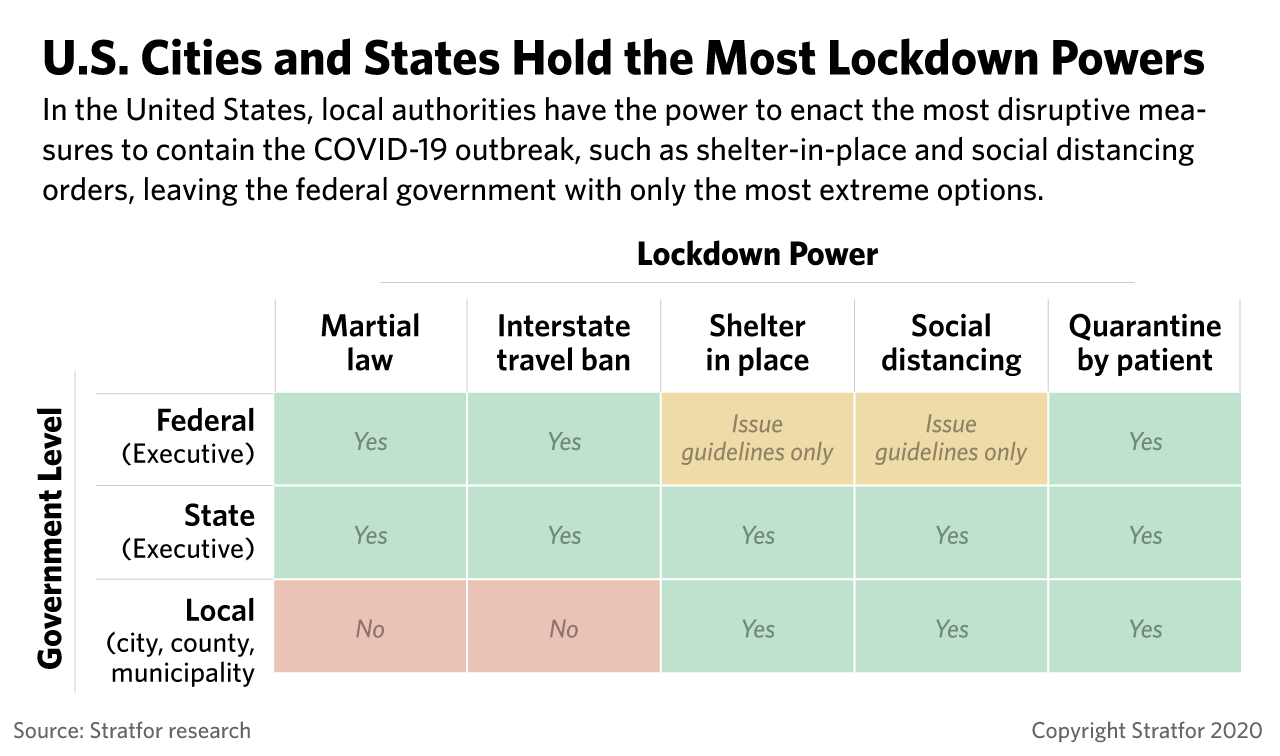
As a result, there is no single national strategy to contain the COVID-19 outbreak. And the strategies that are being enacted are being influenced by local politics and national politics in an election year. Officials of all stripes are attempting to push the political risk off of themselves (and preferably onto their partisan opponents). And this political risk varies widely from place to place, depending on varying demographic, economic and social factors.
Seattle, New York City and San Francisco saw some of the first U.S. outbreaks of the virus. The states that are home to those densely populated and connected cities — Washington, New York and California, respectively — were, in turn, pressed to be proactive early on, resulting in near-immediate lockdown measures. Other states that saw later waves of COVID-19 cases, meanwhile, were able to take a slower approach. Texas and Florida, for example, left cities and local authorities to respond to the crisis rather than immediately implementing statewide measures to avoid the political backlash of shutting down economic activity before the public was willing to accept such measures. An ideological angle also explains the slower response rates of Republican-led cities, states and counties. The authorities in these areas are more apt to take the guidance of U.S. President Donald Trump, who favors a smaller government approach to disease control. Their Democratic counterparts, on the other hand, hold the opposing view and thus have tended to act more assertively with containment measures.
No Clear End in Sight
That means that lockdowns are happening at different rates and scales — and these same factors will cause them to end at different times, too. As the COVID-19 outbreak “peaks” in terms of cases, states and cities will have greater allowance to consider easing restrictions — but the timing and severity of that peak will differ from place to place. The eventual and potentially staggered easing of restrictions does not mean the virus ease along with it, however. In fact, the lack of a coherent national strategy will likely enable the virus to more easily move from one part of the country to another, potentially resurging in places that prematurely ease up on lockdown measures before the virus is fully contained.
The U.S. government is unlikely to use its federal powers to control state borders to completely contain the movement of people able to spread the virus, as Washington prioritizes commerce and economic links. That will also increase the likelihood that hotspots move from one city and state to another, sparking another wave of economically disruptive lockdown measures designed to control the spread. The final result is ongoing rounds of lockdowns, rather than a single one, after the presumed infection peaks pass in April and May 2020.
The Feds on the Hook
While its hands will be somewhat tied on measures to contain the outbreak, the U.S. government will be almost entirely responsible for keeping the country’s economic engine poised for recovery, potentially for the rest of 2020. The estimated 9.88 million mass layoffs seen in late March is just the beginning. The mass amount of unemployed workers in retail, restaurants, bars and other businesses that have been deemed “non-essential” will pose a tremendous challenge for an economy reliant on its behemoth service sector. Washington will, in turn, face immense pressure to reopen these businesses as soon as possible. But constitutional limits will leave the federal government little choice but to wait for states and cities to make the first move in lifting those restrictions.
In the meantime, the U.S. government estimates that the country’s catastrophic unemployment rate may temporarily spike to up to 32 percent. Because of the risk of multiple waves of lockdowns, Washington will likely have to carry out stimulus measures more than once to ensure that this drop in workers doesn’t crater the country’s consumption, cause mass evictions and homelessness, and damage businesses’ belief that the lockdown’s economic effects will end once the health emergency passes. This means that the recently passed $2.2 trillion CARES Act stimulus bill will probably be one of several designed to boost individual workers’ place in the now virus-wracked U.S. economy. In addition, the government will also be forced to consider other economic efforts, such as delaying federally-backed debt repayments and supporting homeowners affected by the coronavirus-induced economic crisis, possibly by subsidizing mortgages and rent.
To fund these measures, Washington will rely on the Federal Reserves’ willingness to print money to maintain liquidity in financial markets. In addition, densely populated cities, such as New York City and Los Angeles, will be most likely to experience another wave of COVID-19. And their large share of the national economy will mean that even if less populated areas are able to lift restrictions, they will still be affected by new lockdowns enacted in the economic centers of the United States.
