
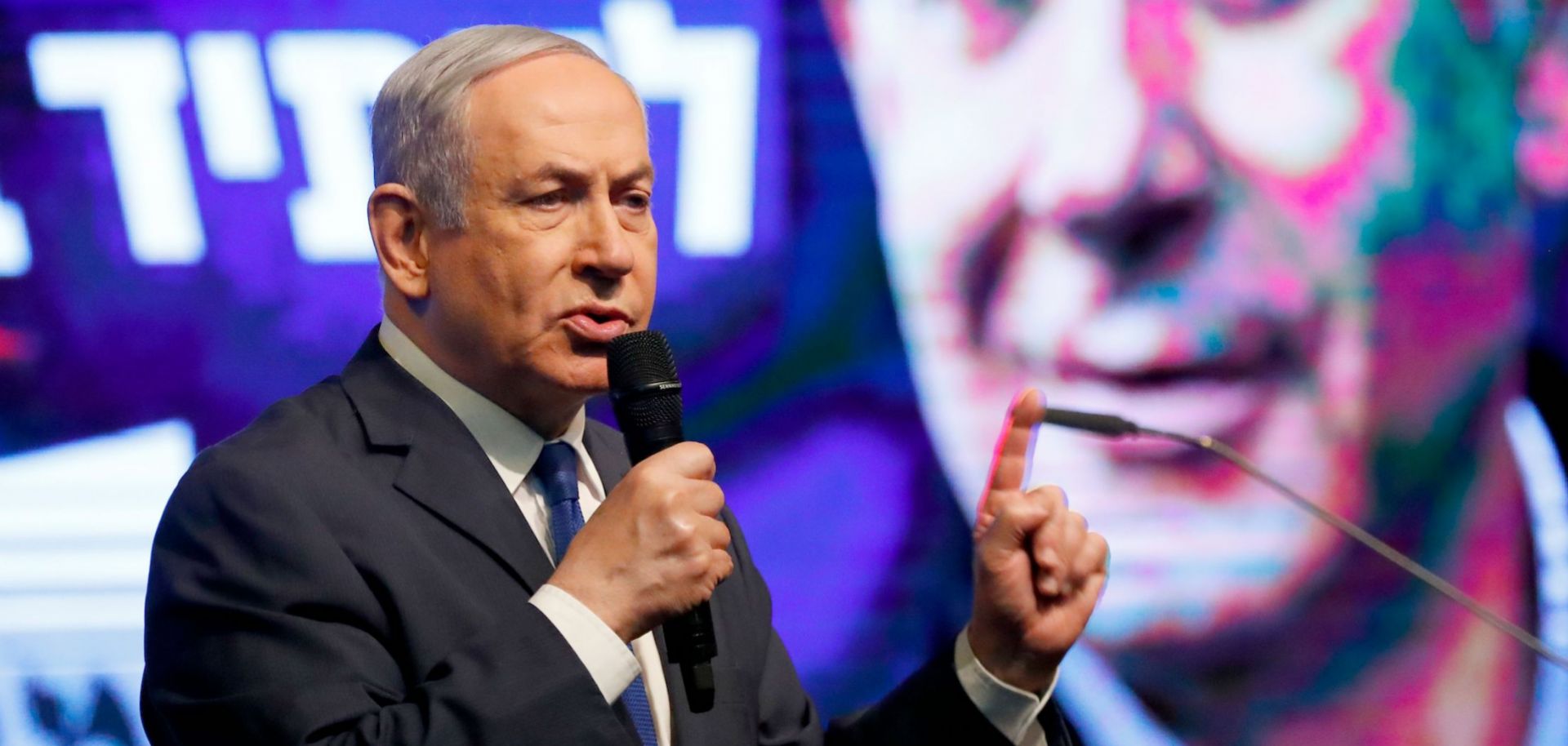
Israeli Prime Minister Benjamin Netanyahu addresses Likud party supporters during a Feb. 29, 2020, political rally in Ramat Gan. In elections held March 2, Netanyahu fell just short of securing the parliamentary majority needed to form a government.
Israel Prime Minister Benjamin Netanyahu has emerged out of Israel's third election in a year stronger than before — but just shy of securing the parliamentary majority needed to actually form a government. Now the question of his political survival takes precedence over pressing domestic reforms, while abroad Israel's now-normalized caretaker government will continue its strategies against Iran and the Palestinians.
Oh So Close
Netanyahu's center-right coalition of secular nationalists, right-wing settlers, and Haredi and ultra-Orthodox religious parties is projected to win 59 seats in parliament while the center-left Blue and White alliance led by Benny Gantz is projected to capture 39 seats. With the Netanyahu coalition two seats short of a majority, domestic political paralysis is the most likely result of the March 2 election, at least for the time being.
Israel has settled into an informal, oxymoronic, political norm — paralysis without serious consequence, a state with a permanent caretaker government. Now over a year old, Netanyahu's caretaker government has proven capable of addressing core Israeli foreign policy issues, including waging an anti-Iran campaign, in particular against Iran's proxies in Syria, Iraq and Lebanon; lobbying the United States to further support Israel's Palestinian strategy; and maintaining an unstable, though politically effective, deterrence with Hamas in Gaza.
Thus, if Netanyahu fails to form a government, as seems the most likely outcome given his lack of a parliamentary majority among his likely allies, the functions of the Israeli state will continue on the geopolitical level. Israel will carry on preparations for annexations within the West Bank as it pursues a strategy of permanently weakening Palestinian factions. It will continue to improve ties with the Gulf Arab states. It will strike against Iranian targets it sees as a threat to Israel itself — including, as the year goes on, considering attacks on Iran proper, should Iran's nuclear program develop to the point where Israel sees an imminent atomic threat.
Domestic Reforms Await a Functioning Government
But looming over Israel's political paralysis are increasingly necessary domestic reforms. Politics is pushing back long-awaited reforms like the status of the ultra-Orthodox in the military — an issue that has long-term implications for Israel's security as the share of young ultra-Orthodox are expected to become an ever-bigger part of the population throughout the decade. Other issues, like education and infrastructure, must also await a functioning government. Israel has notable education gaps among its growing Haredi and Bedouin populations; without a government, there are no reforms to address that growth, potentially leaving Israel with a large number of underskilled, unemployable youth. Israel also needs to reform its infrastructure strategy as well — a long-term investment that needs stable domestic politics.
To break the impasse, how individual personalities behave increasingly matter, from Netanyahu to Avigdor Lieberman to even individual Knesset members. Netanyahu goes on trial on corruption charges on March 17, a process that could see him convicted and removed from power — which could finally allow Israel to move on from its current Netanyahu-centered political universe. Conversely, Netanyahu may survive the trial, meaning other politicians will have to decide if they want to keep on fighting round after round of elections or if they are finally prepared to compromise with the center-right to form a government. Lieberman and Gantz have the power to join such a coalition, but so too do individual Knesset members of their parties, who, if just a few defected, would tip the scales to another government led by Netanyahu's Likud party.
What is clearer, however, is that the center-left — and more distantly the left — is a spent political force, unable to compete with the center-right in recurrent elections. An increasingly right-wing electorate, anchored by nationalists and religious voters, appears to have staying power — and surveys indicate that Israel's youth vote makes up a sizable part of this base. Even higher turned out did not change the outcome this time, as Israeli Arabs and centrists were offset by right-wing voters. How the center-left adapts remains to be seen, but Israel's ideological nature is clearly moving away from them.
