
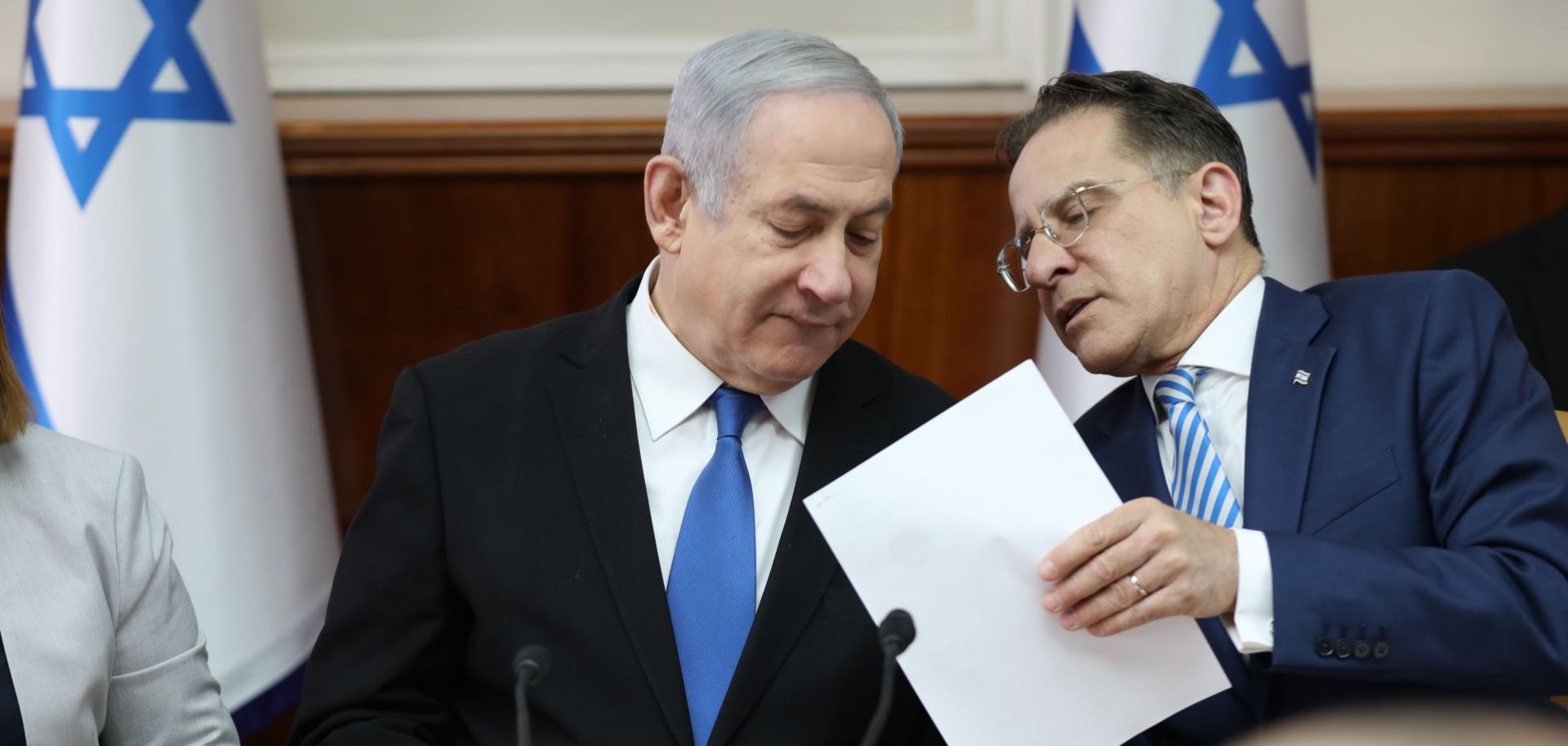
Israeli Prime Minister Benjamin Netanyahu, left, speaks with Cabinet Secretary Tzachi Braverman during a weekly Cabinet meeting in Jerusalem on Dec. 1.
Editor's Note: This assessment is part of a series of analyses supporting Stratfor's 2020 Annual Forecast. These assessments are designed to provide more context and in-depth analysis of key developments over the next quarter and throughout the year.
Israel's past year of political pandemonium shows no signs of abating in 2020. Two national elections have failed to yield a viable government. And now, longtime Prime Minister Benjamin Netanyahu is refusing to step down in the face of corruption indictments. In this prolonged power vacuum, formerly radical policies are increasingly slipping toward the fore, as opposing right-wing and centrist parties jostle for the nationalist vote needed to form a government.
But while Israelis are seemingly more politically and culturally divided than ever, the perceived existential threat of Iran and its nuclear program nonetheless remain a uniting force among voters. Thus, no matter what government finally emerges from the fray in the coming year, Israel's regional security focus on Tehran will stay largely undeterred, even as its political situation at home remains in disarray.
Israeli Politics Upended
Israeli politics historically have spanned the traditional left-to-right gamut, with economically-minded centrists periodically bridging the divide. But changing Israeli demographics and ideologies have since thrown off this balance. The country's more social and economically liberal left is much smaller and less organized than it used to be. The left's once-dominant guardian, the Labor Party, has since been reduced to a minor factor in ongoing coalition talks, while its coalition of Arab parties lacks the unity needed to be a major political force.
For nearly a decade, Netanyahu and his ruling Likud party have exploited the left's waning influence to maintain delicate but viable coalitions between religious and secular factions on the right. The ties binding these groups together, however, are quickly fraying as well. The growth of the ultra-Orthodox voting block has strengthened the religious right in recent years. But the secular right still remains a potent political force with often diametrically opposed worldviews to their more conservative religious counterparts.
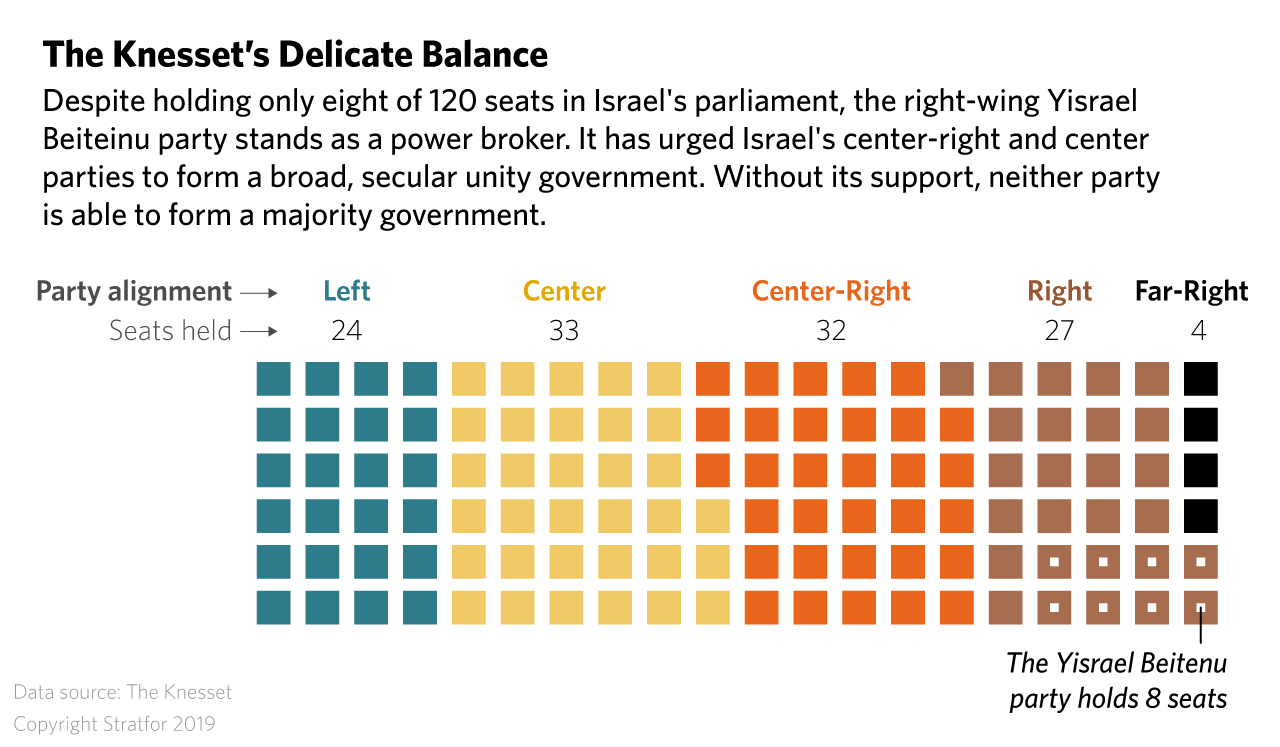
As the right has split along these lines, the secular Yisrael Beiteinu party has become the new Israeli swing vote, forcing politicians to cobble together unusual ideological groups to end the current power vacuum. In pandering to these more security-minded and nationalist voters, both the ruling Likud party and its chief challenger, the centrist Blue and White alliance, are promising long-held dreams, such as the formal annexation of parts of the West Bank. Both parties have also hinted that they would take a harder line against the occasional violent flare-ups on the Gaza Strip.
Internal Implications
But despite Likud and the Blue and White's attempts to woo secular voters to their respective sides, neither has been able to secure enough support to form a coalition government, meaning Israel could hold yet another election in the coming months. But even if a coalition can be formed before then, the current political climate will continue to hobble the Israeli government throughout 2020. With the weakened and fragmented left unable to provide a viable counter, the secular right could feasibly collapse any future Israeli government that either fails to firmly respond to Gaza or resists other right-wing demands, such as annexing the West Bank. The need for the nationalist vote also means Israeli political leaders will continue to be incentivized to drift toward the one-state solution with the Palestinians and a hard-line strategy in Gaza.
Long seeing the country's judiciary as the block to its policy demands, the secular right will capitalize on the current political melee to pressure its coalition allies to roll back the Israeli Supreme Court's powers of judicial review. As long as Netanyahu remains in power, the right will try to find a way to shield him from the judiciary's corruption charges as well. Such actions, however, will obscure Israel's rule of law and invite future politicians to try to do the same for their own benefit — plunging the country deeper into political uncertainty.
All Eyes Remain on Iran
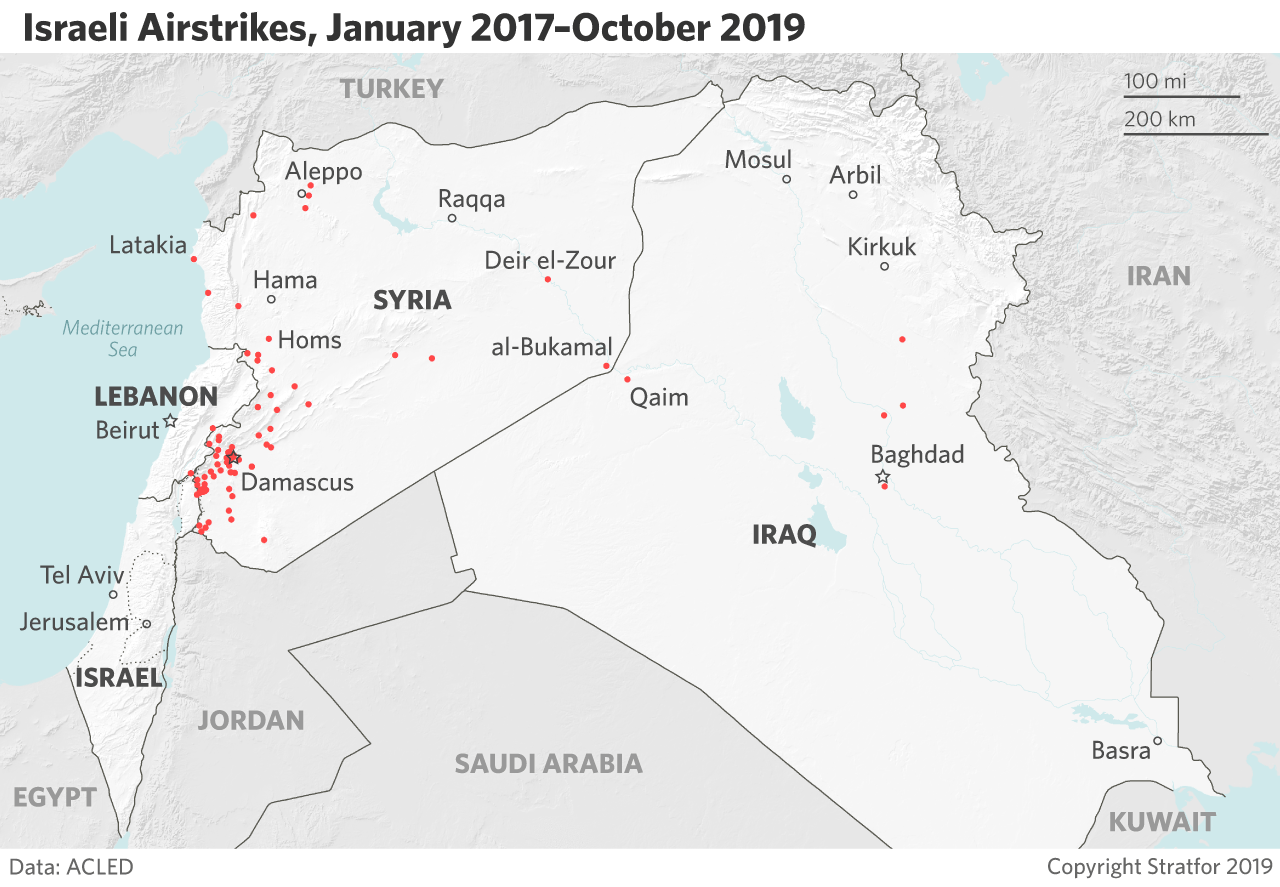
But even as this quagmire unfolds, Israel's anti-Iran strategy will nonetheless stay the course. Not only has the Israel Defense Forces (IDF) maintained its strikes against Iran in Syria over the past year, but it has expanded them to Iraq while renewing action in Lebanon. The decisions to ramp up efforts in Iraq and Lebanon, in particular, occurred over the summer, when Israel had a caretaker government and no independent defense minister — proving the IDF's ability to keep the pressure on Tehran despite the political chaos at home.
Israel's next government, while politically weak, will also have a strong mandate to strike Iran and its allies wherever its leaders see fit. Israeli voters have shown time and again that they are willing to absorb any kinetic blowback of such a hard-line strategy against Iran without punishing the government in power. Indeed, Israelis widely support both the U.S. sanctions strategy against Tehran and the option to strike Iran should it come close to developing a nuclear weapon. And with Iran steadily eroding its commitments in the Joint Comprehensive Plan of Action nuclear deal, there's a growing chance that Israel could, in fact, opt to conduct such a strike.
The United States has displayed clear resistance to escalating its fight with Iran to military action. This will, in turn, leave Israel's next government to decide how long it will stand idly by as Iran gradually ramps back up its nuclear activities. Israeli leaders will also be closely watching the leadup to the U.S. presidential election in November 2020. If a presidential candidate who favors a softer line on Iran appears likely to enter the White House, Israel may decide to preemptively accelerate its own military timetable against Iran's nuclear program while Tehran still clearly remains far away from developing such a weapon.
The perceived pace of Iran's nuclear weapon development will thus define Israel's most consequential regional behavior in 2020. In the meantime, Israel's volatile political climate will continue to test the strength of its democratic institutions at home, as various parties scramble to fill the vacancy in government.
