
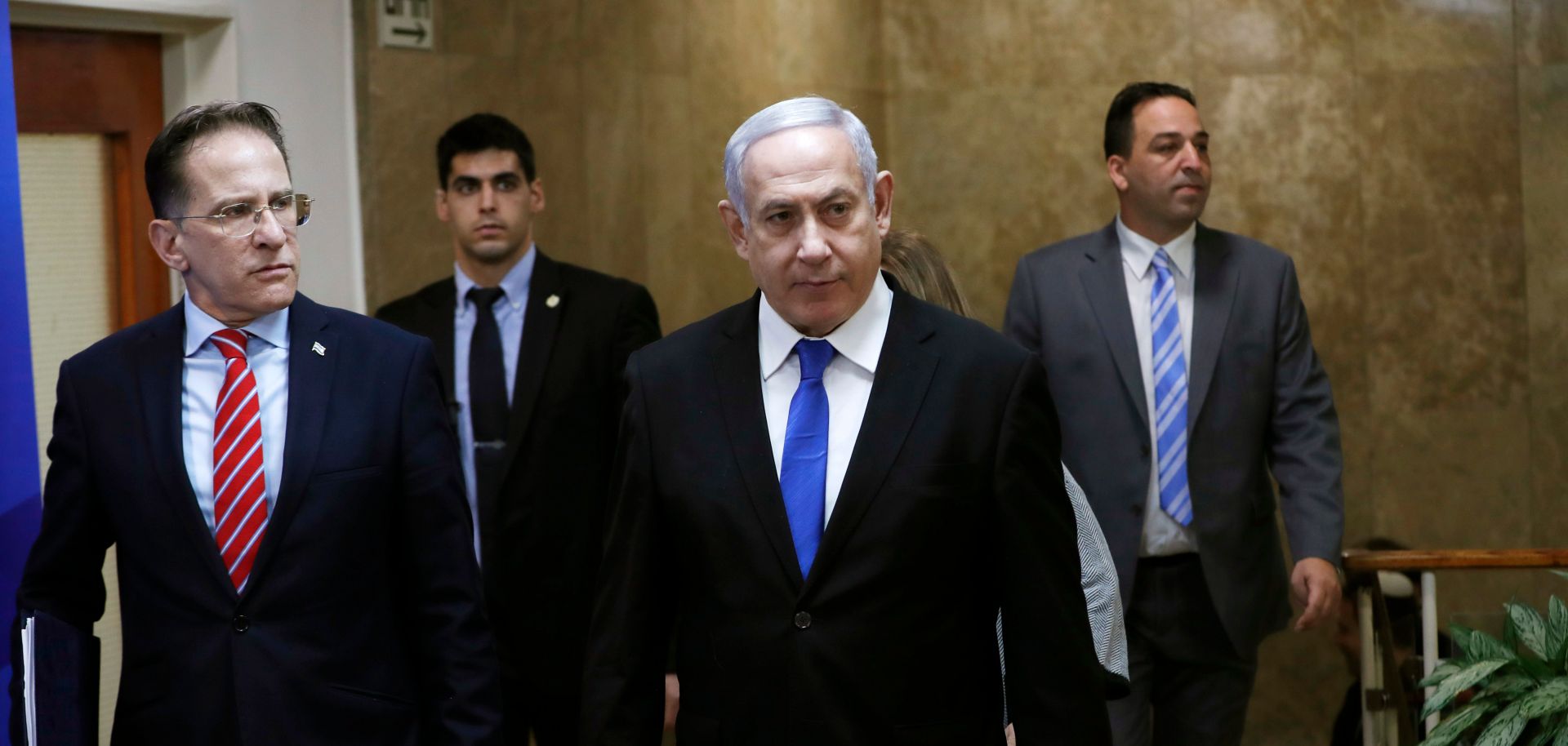
Israeli Prime Minister Benjamin Netanyahu (C) arrives at a weekly Cabinet meeting in Jerusalem on Dec. 8.
After negotiations to form a last-minute government alliance broke down ahead of a Dec. 11 deadline, Israel's Knesset has, once again, dissolved itself — meaning Israelis will once again head to the polls in March 2020 for the third time in less than a year. But barring a major event that either forces the country's leaders to come together or drastically changes the way voters view them, this next election is unlikely to grant any more political clarity than the previous two.
The Search for a Government Continues
Israel's continued failure to form a government is the product of a unique disparity between divisive domestic politics and cohesive foreign politics. When it comes to the country's dealings abroad, Israelis are generally on the same page, especially on matters regarding Iran and its nuclear program. This security and foreign policy consensus, combined with the Israeli military's demonstrated ability to attack Iranian assets across the region, has given politicians breathing room to instead focus all their time and effort on more contentious domestic issues, such as the secular versus religious debate. As a result, polarized culture wars have taken center stage in Israeli politics, with lawmakers (and their constituents) refusing to budge on sensitive matters related to the future of Israel's identity.
Within this context, two national elections over the past year have now produced similar, inconclusive results — that is, a set of right-wing parties strong enough to govern if they were united, but hopelessly split by arguments over the future of the ultra-Orthodox as a cultural force in Israel; a set of left-wing parties too small to form any government, and also divided over the future of Arabs in Israel; and a political center under the banner of Benny Gantz's Blue and White alliance, which has twice tried (and twice failed) to lure the secular right to its side.
Third Time's a Charm?
For the third election to prove any different than the last two, the previous dynamic must change, which could occur in the following ways:
- Public support changes in a big way. Current polling indicates a third election would yield yet another split that mirrors the first and second elections. A change in these numbers could, of course, make room for a coalition by shifting the balance more decisively toward a particular political camp. But this would require voters having a sudden change of heart on polarizing cultural issues in just a few short months. And given the country's highly divisive political climate, it remains highly unlikely that any events or arguments will compel enough Israelis to switch sides before March 2020. Indeed, Prime Minister Benjamin Netanyahu's corruption indictment announcement didn't even move the needle in a substantial way.
- Netanyahu's own party ousts him. One of the biggest hitches standing in the way of a Likud-Blue and White alliance has been the corruption charges shrouding the Israeli prime minister. On Dec. 26, Netanyahu will compete against Likud Knesset member Gideon Sa'ar to retain his place as the head of the party. Should Sa'ar win the primary contest, it could clear a path to a coalition government by making Netanyahu's corruption charges no longer an issue in the March 2020 election. But such an outcome also remains a long shot as Likud is, in many ways, still Netanyahu's party, and removing him from power would be a radical change to the group's core identity.
Avoiding a Fourth Election
If neither of these scenarios occurs in the coming months, the March 2020 vote will likely yield even more split results. But there are ways in which Israel could still feasibly break out of its paralysis and form a government without calling for yet another election:
- An emergency forces unity. In the past, Israel's factions have overcome deep differences to deal with extreme emergencies. The country, for example, formed a unity government ahead of the Six-Day War in 1967, as well as during the south Lebanon crisis in 1984. If Iran moves closer to developing a nuclear weapon (or if Israeli intelligence simply believes that it is), or if a regional conflict with Iran appears imminent, Israel's political leaders will put aside their differences to put forth a strong war leader. The March 2020 vote will happen well before an Iranian nuclear breakout is viable. But such a threat arising in the latter half of 2020 that forces Israel to come together is entirely possible.
- Israel's political leaders finally bridge their differences. To avoid a fourth election, Israel's leaders could also strike a unity deal that would likely include some combination of a rotating premiership between rivals, a watered-down immunity bill for Netanyahu for his corruption charges, and/or a legislative compromise that satisfies both the nationalists and the religious parties on their sharp cultural differences. This is perhaps the most probable scenario in warding off another election, as leaders were reportedly close to reaching a similar compromise ahead of the last Dec. 11 deadline.
A New Normal
But if all else fails and none of these scenarios occur, Israel will head toward a fourth election after the March 2020 vote. As things currently stand, this is still the most likely outcome. In this, Netanyahu will remain as the country's prime minister, meaning he'll run yet another election campaign while fighting off indictment charges.
At this point, Israelis are tired of their leaders' inability to form a government. But unless they translate that frustration to the ballot box, Israel's politicians will be content with political stalemates for the foreseeable future — leaving a caretaker government to attend to outside threats while they clash over their opposing visions of Israel's future at home.
