
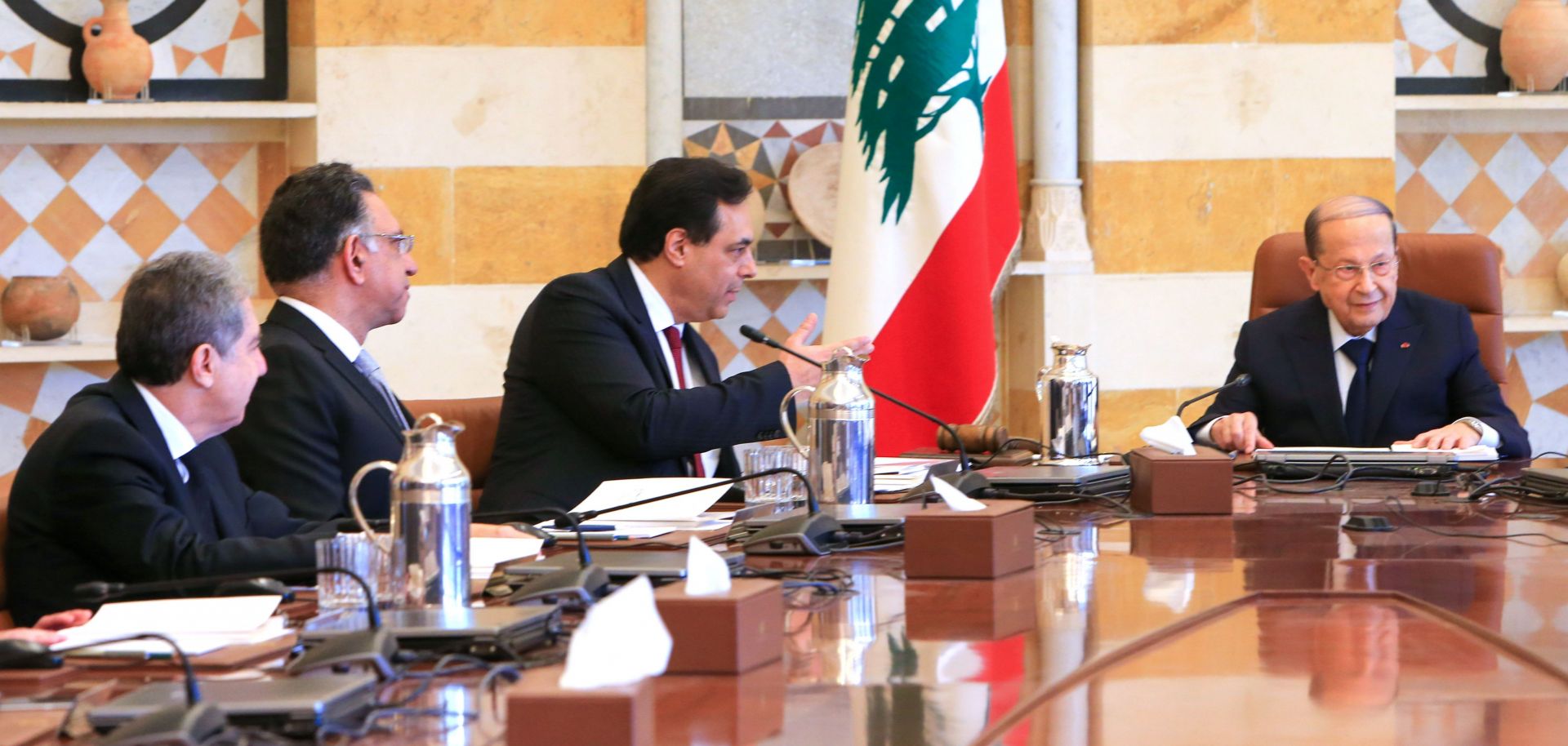
Lebanese President Michel Aoun (R) heads the first meeting of Prime Minister Hassan Diab's (C) newly constituted government in Beirut on Jan. 22, 2020. Lebanon's woes extend beyond changing the people at the top.
Lebanon finally has a new government but still no particular path out of its predicament. Prime Minister Hassan Diab, named his Cabinet on Jan. 22, but major hurdles remain, especially as the country's poor economy and security issues are unlikely to improve any time soon. Domestically, the new government must face down a persistent protest movement while avoiding blowback from the rivals it chose to exclude from power. And externally, the country is now facing potential sanctions and cuts in military aid from the United States, as well as likely diplomatic isolation at a time when its economy needs all the help it can get. Given such obstacles, it is unclear how long the new government will last. And more worryingly for the region, Lebanon's economic and political contagion could infect neighboring countries that rely on Beirut’s economic linkages, particularly Syria.
New Faces, Old Affiliations
On the surface, Diab's new Cabinet ticks all of Lebanon's sectarian boxes, boasting members from the country's diverse array of ethnic and religious communities. At the same time, however, the Cabinet upends many of Lebanon's political customs. For one, it is uniquely reliant on the March 8 alliance, the grouping of pro-Syrian and pro-Iranian parties that includes Hezbollah. Although many of its ministers come from academic or non-political backgrounds, most have connections with key players in the March 8 alliance or rely on them for their power. Foreign Minister Nassif Hitti, for instance, is a well-regarded diplomat with experience at the Arab League, but to maintain his position, he will have to adhere to March 8's pro-Syrian, pro-Iran line. The same goes for Defense Minister Zeina Akar, who, though a fresh face, remains dependent on March 8 for her political backing and allies.
The influence of March 8 has upset many in Lebanon's protest movement, who wanted a greater political change than that offered by Diab. With their demands unmet, they will continue to protest — and may even escalate their tactics further. Diab's exclusion of members of the anti-Syria, anti-Iran March 14 alliance (which includes ex-Prime Minister Saad al-Hariri) adds an extra political dimension to Lebanon's current predicament, as March 14 may attempt to capitalize on popular discontent to try to position itself for the possible eventual collapse of March 8 or, more distantly, early elections.
In the absence of any representation from March 14 in Diab's Cabinet, some international observers have already declared the new government a Hezbollah-dominated administration. Outside powers looking to roll back Hezbollah, especially the United States, will have plenty of reason to try to isolate the new government and even sanction it with the hope of bringing it down early.
Last year, the United States gave Lebanon around $162 million in aid, much of it for security, but it delayed some assistance in the fall, reportedly to pressure the government and Hezbollah; unsurprisingly, it's a tactic that Washington could consider again in 2020. Additionally, the United States could consider expanding its sanctions list to include parts of the Lebanese state after imposing measures on banks with alleged links to Hezbollah in the country. Lebanon might try to reach out to France — which has often opened its checkbook for its former mandate in the past — but it is not certain that it would step in as a security aid supplier this time. And beyond that, Paris and others in the CEDRE conference, which brings together countries that have offered funding to Beirut, have made it clear that they still expect Lebanon to implement painful economic reforms before they'll agree to part with any of the $11 billion they have earmarked for the country.
Security Headaches
Meanwhile, Lebanon's security is likely to deteriorate as anti-government protests continue in Beirut and elsewhere in the country, raising the possibility of more violence, more road blockades, more vandalism and more disruption — as well as a more forceful crackdown by security forces. With the formation of a new Cabinet, powers within the government could have greater incentive to end the disruptions, which have exacerbated the country's economic problems.
And while Diab's new government will not raise the risk of another Israel-Hezbollah conflict, the prospect of such a battle will remain a persistent, high-impact risk that would have a profound effect on both Israel and Lebanon. Moreover, the threat of a wider Iran-U.S. conflict will also cast a shadow over the new administration, given the unlikely — yet still plausible — possibility that Tehran could deploy Hezbollah as a weapon against Israel in the event of a serious escalation between Washington and the Islamic republic.
Economic Woes
One of the Diab government's key priorities will be to stabilize the economy, which has lurched from crisis to crisis over the last year. The Lebanese economic crisis is so deep, in fact, that its woes could spread to neighbors with whom Lebanon has financial links, like Syria. Without question, the possibility that new U.S. sanctions against Iran's regional allies, like Hezbollah, will have a spillover effect on the rest of the Lebanese economy creating headaches for Diab, given the heavy pro-Hezbollah composition of his Cabinet. But regardless of the Cabinet's composition, the government's more pressing dilemma — whether to take measures to reduce debt or to rely on it further to import staples — will be one with no easy answers.
In trying to walk a fine line, the new government will need to make rapid decisions on a couple of key economic issues. First, the government must decide whether to move forward with a recent central bank proposal to ask Lebanese bondholders to swap their eurobonds that will mature in the coming months for notes with a longer maturity date. This would reduce some of the strain on government finances by extending the payback deadlines for Beirut's lines of credit and could eventually transform into a demand that foreign bondholders also swap their notes (foreigners held 40 percent of Lebanon's December eurobond). Relatedly, the new finance minister, Ghazi Wazni, and his team have to decide what to do with the escalating pressure on Lebanon's currency peg. Wazni admitted on Jan. 22 that the officials might need to revise the current currency peg so as to slow any future drawdown of the country's valuable foreign exchange reserves.
Given the severity of the current protests, the government will try to lean toward prioritizing solving the most obvious sign of the country's financial crisis, namely, that Lebanese businesses and citizens face severe difficulties accessing dollars to make purchases, as well as a black-market currency exchange rate for Lebanese pounds that has ticked higher and higher. The unofficial rate is now roughly 2,500 Lebanese pounds to the dollar, a two-thirds increase over the official rate — a reality that makes it harder to obtain physical goods at an affordable price. Capital controls imposed in recent months have slowed consumption and business activity in the country, and anecdotal reports of increasing unemployment have worsened economic sentiment and anxiety.
The stronger the protest movement is in reaction to Diab's government, the greater the demand will be for near-term solutions to import necessary goods and ease day-to-day economic grievances. Such a move, however, will make it harder for Lebanon to pay back its profound debts, $2.5 billion of which will mature in 2020 alone and will push Lebanon to have to take on yet more debt. Not only does this place Lebanon on shaky financial ground for the long term — to say nothing of deterring foreign investment — a default could spark greater social instability that could spread around the region.
