
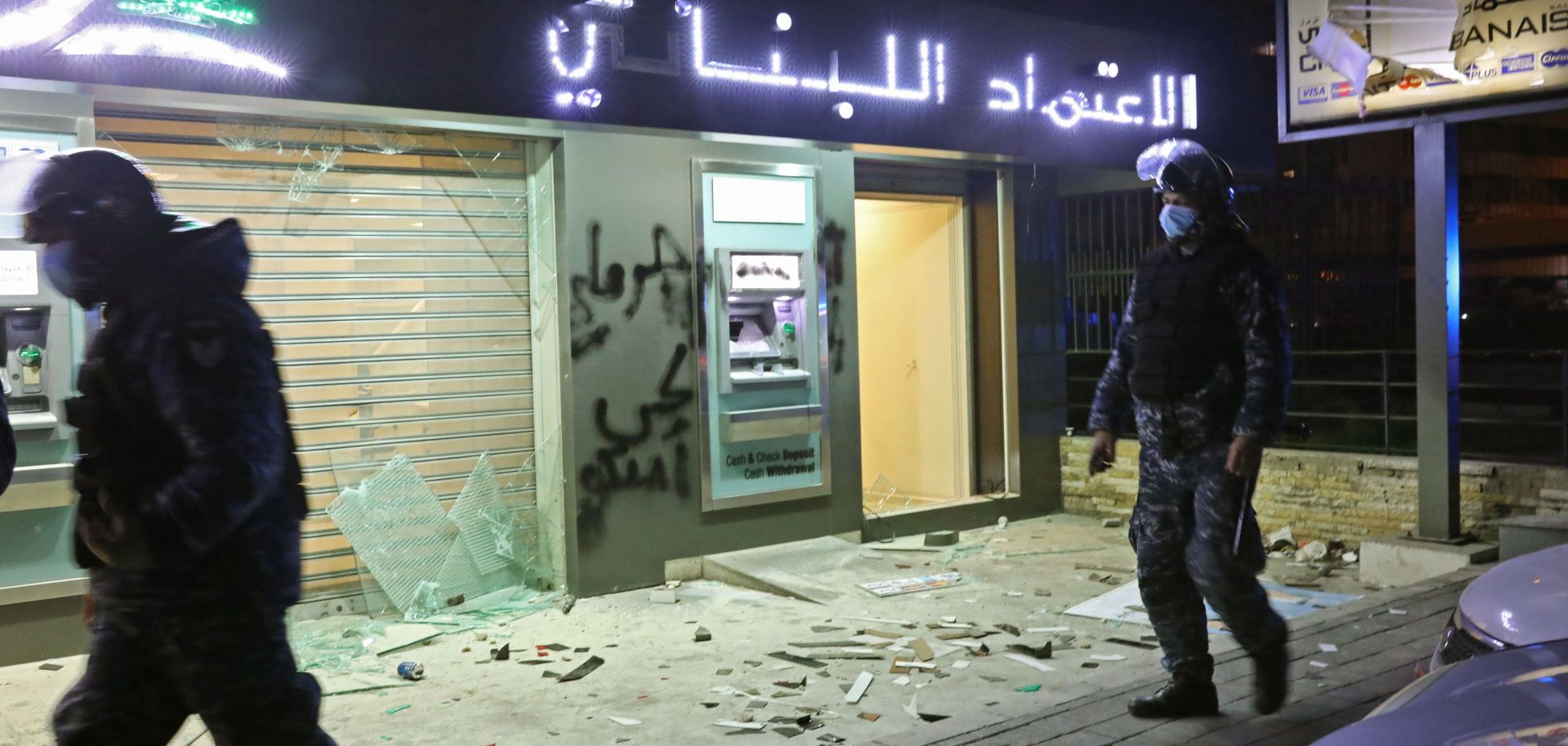
Lebanese riot police walk past the branch of a vandalized bank in Beirut after anti-government protesters took to the streets on Jan. 16. As the violence grows, so will the odds that armed sectarian factions will confront the demonstrators.
As anger over an underperforming economy grows in Lebanon, the tactics used by its pan-sectarian protest movement are becoming more violent and disruptive. The development, in turn, is increasing pressure on the country's political factions to find a counter. With Lebanon under a caretaker government until Prime Minister-designate Hassan Diab can form his own, there is little chance the country's recession, a major driver of protest anger, will ease — nor will corruption be addressed. That could trap Lebanon in a spiral in which acts of vandalism and violence may increasingly become the outlet for the frustrations of ordinary Lebanese of all sects — leaving its sectarian politicians who don’t want to give up their power and privileges to increasingly entertain employing force to counter the protests.
Bashing Banks and Building Frustrations
Beirut experienced a spate of violence on Jan. 14 centered on Hamra Street, a hub of the capital's financial and economic activity, as protesters vandalized ATMs, smashed bank windows and battled security forces. The actions, which significantly disrupted financial activity and left 50 members of the security forces injured, marked a notable uptick in aggressive behavior compared with a late 2019 surge in protest activity. This surge of violence marked the beginning of what protesters have called a "week of wrath," a series of planned protests.
Lebanese banks are under pressure by the central bank to capitalize themselves and help cut down on further downgrades to the country’s credit rating, but to do that, they have imposed controls hurting their customers' ability to access deposits and conduct everyday business. In addition, exchange rates on the currency black market have risen prohibitively as Lebanese attempt to access dollars for purchases. Many lower- and middle-class Lebanese have faced payroll interruptions and problems with buying consumer goods as long-term economic uncertainty grows.
Riskier Tactics in Play
As the economic pressure on them builds, many Lebanese are resorting to more extreme measures to express their anger with the ruling class. Lebanon’s sectarian system typically has channeled such frustrations along religious lines, but these protests have transcended ethnic and religious backgrounds to target leaders across every sect. Moreover, many of these leaders have ridden out the crisis in relative comfort, their wealth often untouched or stashed abroad, further angering the population.
With the first deadlines for international bond payments approaching in March, the economic crisis appears set to worsen. Without international aid or new favorable debt repayment terms, the government will not be able to meet those obligations, a development that will significantly worsen economic conditions. Intensifying economic misery would almost certainly increase popular anger across the country. But with few peaceful options left to express their desire to change the system, more violence can be expected. As of yet, the government has not seriously considered holding early elections that might funnel some of that passion into an electoral process.
With no other outlet for festering anger, the continued economic decline and political paralysis likely will manifest in even more extreme protest tactics that more fully spread across the country. Banks and other commercial institutions would likely bear the brunt of those outbursts, but other targets may include the assets of the political elite and political headquarters and offices. Both private and public employees appear likely to experience payroll interruptions, and they will have reason to blame their employers, whether politically linked corporations or politically dominated public institutions, for their problems. Meanwhile, as banks impose further controls on their account holders, it's likely that more Lebanese working abroad will avoid sending home the remittances the country relies on — exacerbating the country's foreign currency crisis as reserves are used up.
Unpalatable Choices
The country’s political factions will thus face a difficult choice. They can finally decide to work together, whether under Hassan Diab or another prime minister, to set the country on the path toward fiscal reform that likely would include austerity, in some sort of new, updated political compromise. But that seems unlikely to happen. While that path ultimately would be the best for Lebanon’s economy, in the meantime, austerity measures would be painful for all involved. The ordinary citizens who will bear the burden of austerity will blame Lebanon’s politicians for making that choice.
The political elite, as they have done in the past, could also simply draw out the crisis further, hoping that the international community, especially allies like the United States, France and the Gulf Arab states, will ride to the rescue with a new aid package that will soften austerity. But the odds of that occurring are low: International donors want Lebanon to restructure its state spending. The United States, meanwhile, is increasingly willing to gamble Lebanese stability as it seeks to squeeze Hezbollah, a Lebanese political party that also serves as Iran’s main proxy in the country. Additionally, as Iraq, Syria and Yemen have all become hotter, more high-stakes arenas of proxy competition, the importance of Lebanon as a battleground for influence between Iran and its U.S. and Gulf states adversaries has slipped.
So Lebanon's political parties, faced with an increasingly assertive protest movement, will strongly consider Lebanese versions of a crackdown to remain in power. Because the government is so fractured, the state's power to deploy much of the Lebanese military or formal security forces is limited. But individual political factions, notably but not limited to Hezbollah, are armed and will defend the assets of their parties should protesters physically target them. The resulting clashes could undermine Lebanon’s security situation, causing further economic damage by discouraging tourism, deterring investment and dissuading remittances. Lebanon's escalating protests thus risk creating a new security challenge for the country.
