
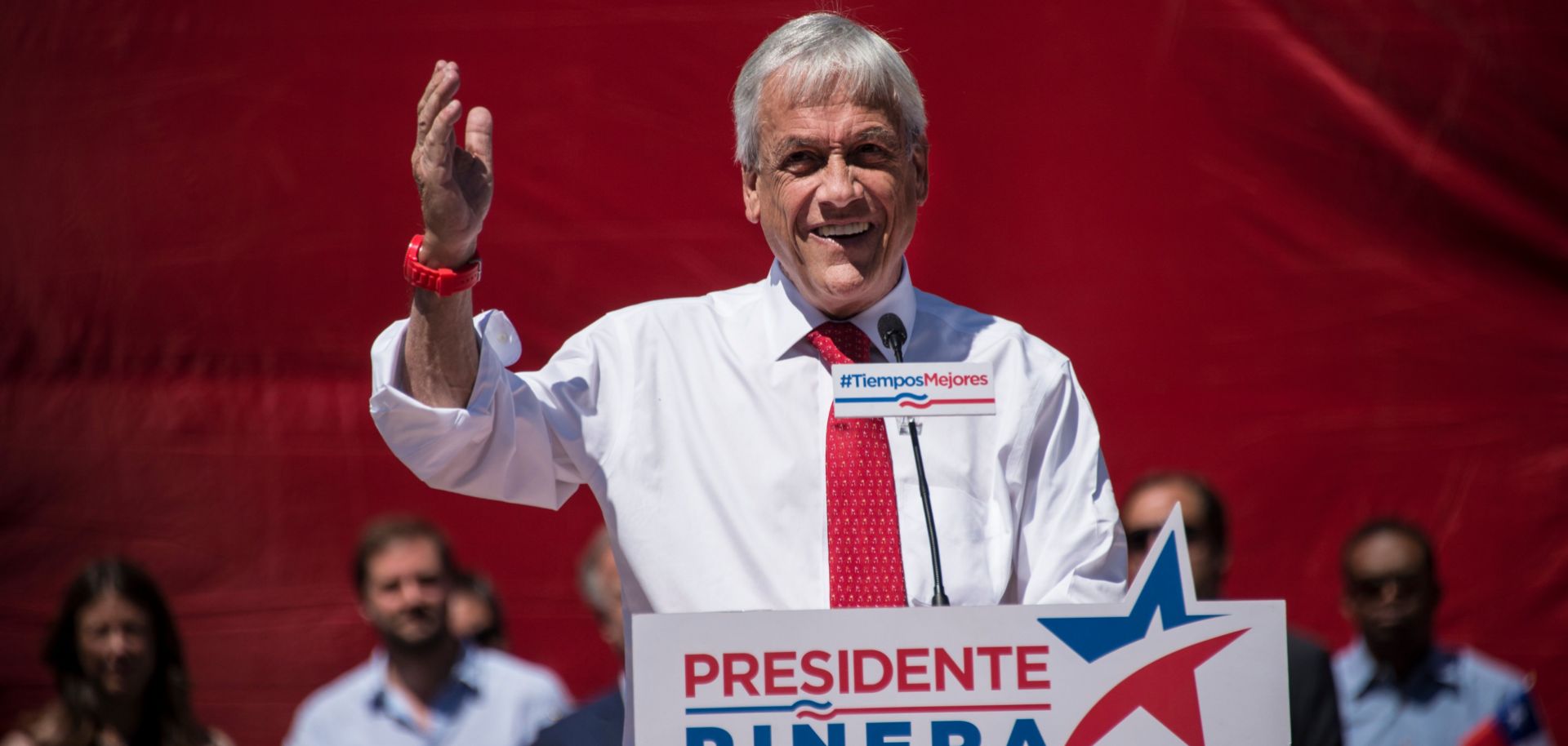
Division on the left has created an opportunity for center-right candidate Sebastian Pinera to return to the presidency in Chile.
For decades, Chile has thrived as one of Latin America's most politically stable and business-friendly places. Voters in the six presidential elections held since democracy was restored in 1990 have chosen leaders who have largely pursued policies promoting fiscal conservatism and open trade. Over the past three decades, Chile has signed more than 50 free trade agreements, the most in South America. However, continued low prices for copper, the country's most important export, have battered Chile's economy, creating conditions fueling increasing debt. The struggling economy will be only one of the issues that the country's next president, who will take office in March 2018, will inherit. A pair of major ongoing trade negotiations and the resolution of a border dispute with Bolivia at the International Court of Justice will also require the new leader's attention.
Voters go to the polls on Nov. 19 to decide who will succeed President Michelle Bachelet. A split in her center-left ruling New Majority coalition has left a crowded field of candidates for the election's first round. If no candidate captures more than 50 percent of the vote, a second-round election pitting the two candidates who received the most votes will be held Dec. 17.
A series of disagreements over labor, education and abortion reform fractured New Majority, which had united a broad swath of left and center-left parties and social movements. The coalition broke up after the Christian Democratic Party decided to back party member Carolina Goic for president instead of Alejandro Guillier, who has the support of the coalition's remnants. Another coalition of left-wing parties, including some that also had belonged to New Majority, is offering another candidate, Beatriz Sanchez. The division on the left has opened the door for Sebastian Pinera, who has the backing of center-right forces, to return to the office.
Pinera, who was Chile's president from 2010 to 2014, has criticized Bachelet's economic policy, especially her decision to increase the corporate tax rate by about 3 percent. Pinera has proposed reducing corporate taxes from 27 percent to around 24 percent. According to the latest opinion polls, no candidate is expected to win the office on the first ballot. Pinera has the most support, about 44 percent, followed by several left-wing candidates: Guillier (19.7 percent), Sanchez (8 percent), Marco Enriquez-Ominami (4.6 percent) and Goic (3.9 percent). If a second round of voting becomes necessary, it's possible that supporters of the center-left could once again unite to counter Pinera, assuming he will be one of the second-round candidates. However, voters on the left whose favored candidate is eliminated could choose to stay home, depressing turnout and increasing Pinera's chances. Since 2012, when voting was made voluntary, low turnout has been endemic in Chile. A poll conducted by think tank Centro de Estudios Publicos in September, for example, found that only 43 percent of registered voters plan to cast a ballot for president on Nov. 19.
Finding an Answer to a Growing Deficit
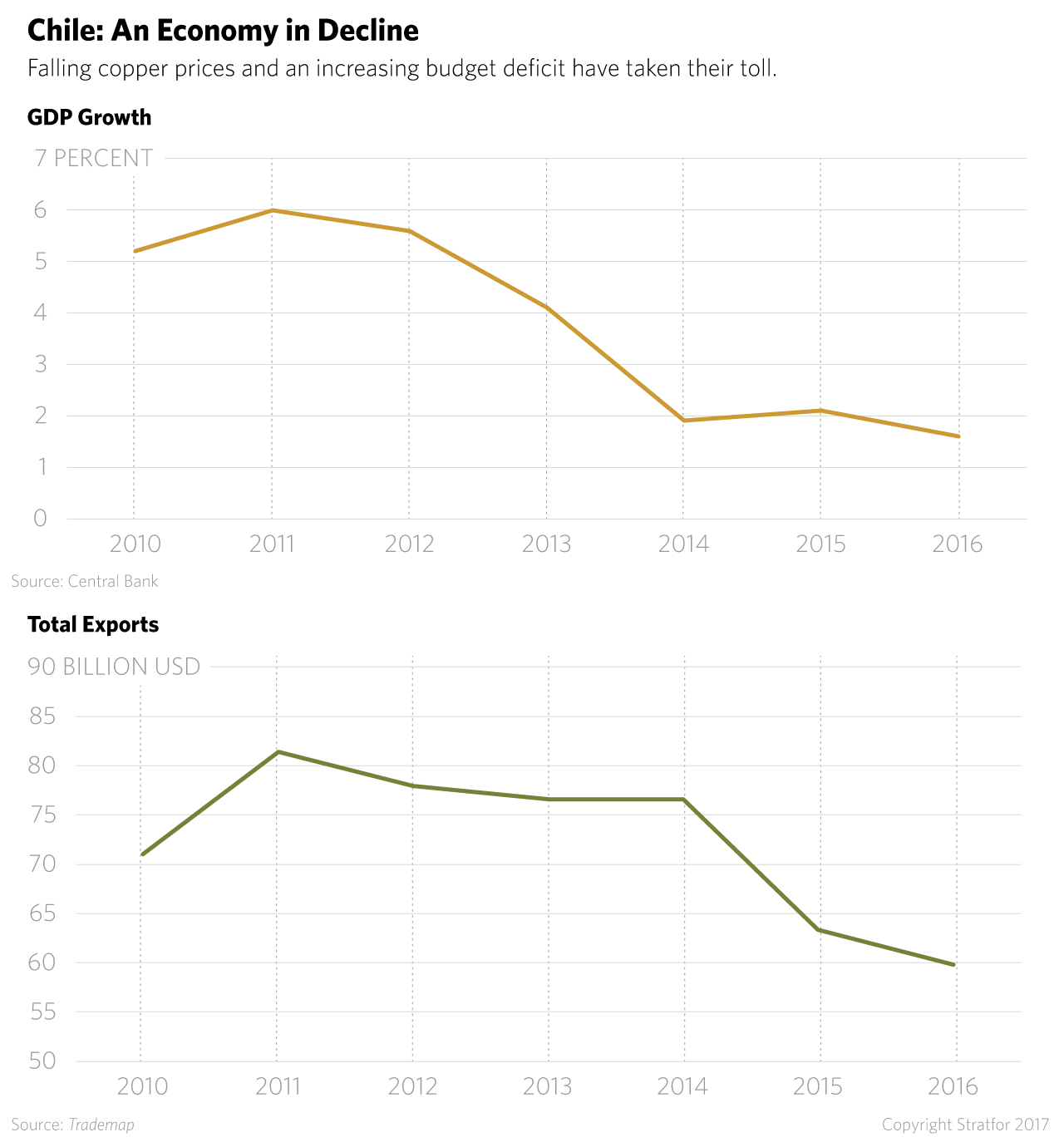
The downturn in copper prices has weakened Chile's economy, presenting a problem for the next leader. Taxes on copper production provide about a quarter of the government's tax revenue. As global demand for copper waned over the past three years, the value of Chilean exports has fallen by about 25 percent. So as its trade revenue dropped, the country's fiscal deficit grew. Bachelet's government responded with the tax increase, which had the effect of reducing both consumption and investment. Despite the effort to raise more revenue, Chile's fiscal deficit in 2016 reached 2.8 percent of gross domestic product (GDP) and is projected to increase to more than 3 percent this year, the highest it has been since 1993. These factors, combined with corruption scandals involving Bachelet's inner circle and the gridlock that has slowed legislation in the Chilean National Congress, have weakened business confidence in the country.
The economic issues led ratings agency Standard & Poor's to downgrade Chile's sovereign debt this year, the first time this has happened since the 1990s. Chile still possesses Latin America's most stable economy by far, and S&P still recognizes it as the region's highest-rated debt holder. But Chile's economy has continued to trend downward. GDP growth has declined from an average of more than 5 percent from 2010 to 2013 to less than 2 percent from 2014 to 2016. Moreover, the International Monetary Fund predicts an anemic 1.4 percent growth rate for Chile's economy in 2017.
Guiding Foreign Relations
The next president also will have to deal with the repercussions of Chile's ongoing border conflict with Bolivia, which is being adjudicated by the International Court of Justice. A final ruling on the dispute is expected by the end of 2018, and depending on the result, the two countries may negotiate a resolution over their remaining issues. Bolivia has blocked natural gas exports to Chile over the disagreement, but if it loses the decision, it likely would try to strike an agreement that could involve restoring the natural gas supplies in exchange for some sovereign access to a Chilean port. Bachelet's administration has been trying to normalize relations with Bolivia, but the negotiations with La Paz could fall to the next president. Among all the Chilean presidential candidates, Pinera would likely take the toughest line in a negotiation with Bolivia. During his previous stint as president, his relationship with Bolivian President Evo Morales deteriorated considerably in 2013, when both sides suspended dialogue over the border dispute.
Chile's next president also will take a strong hand in talks over foreign trade. Latin America's largest trading blocs, the Pacific Alliance and the Common Market of the South (or Mercosur, as it's known by its Spanish acronym) have been engaged in talks over a trade convergence. Chile, a member of the Pacific Alliance, and Argentina, a Mercosur member, have been leading the talks. Chile's presidential candidates all agree on the importance of that convergence and of forging closer trade ties between their country and the rest of the Pacific Alliance. Additionally, Santiago has also led trade talks between the Pacific Alliance countries and Australia, New Zealand, Singapore and Canada.
With the approach to foreign trade largely set, the biggest policy difference among Chile's presidential candidates continues to be how to shrink the country's expanding deficit. With copper prices not expected to rebound significantly, it's a situation that is unlikely to reverse itself over the next year. Whatever approach the next leader takes to Chile's domestic economic woes, however, it's almost certain that the country's open foreign trade policy will remain a mainstay of its economy.
