
Like many Latin American countries, Chile is dependent on commodities to drive its economic growth. Chile is the top producer of copper in the world, yielding 5.7 million metric tons of the metal per year, more than 30 percent of global output. Roughly 20 percent of government revenue comes from copper, and copper and copper products made up 47 percent of the country's exports in 2014.
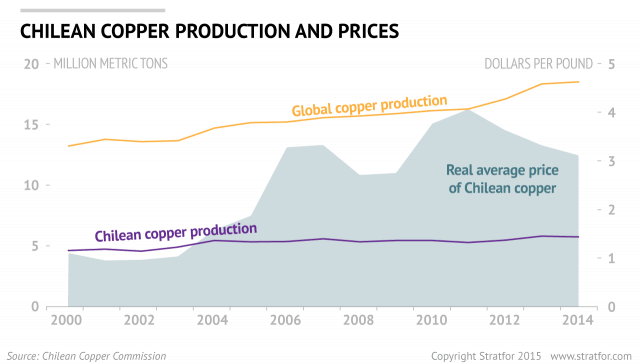
The country's copper boom coincided with the wider Latin American commodities boom of the 2000s and higher Chinese demand for commodities such as oil, iron ore, copper and soybeans, spurring growth in Latin American economies. As Chinese demand for commodities increased, the average price of copper skyrocketed, growing from $1.87 per pound in 2005 to $4.05 per pound in 2011. However, a decline in Chinese and broader global demand over the past three years caused prices to drop to $3.11 in 2014, taking a toll on Chile's economy and public finances. Chile's GDP growth slowed considerably to 1.4 percent in 2014 after averaging more than 5 percent growth from 2010-2013.
Entrenched Inequality
Decreasing demand and lower commodity prices are not the only things inhibiting Chile's mineral production and broader economic growth. Chilean President Michelle Bachelet's planned labor reforms are equally problematic. Though Chile achieved consistent growth over the past decade because of strong copper exports and fiscally conservative economic policies, inequality has proved a persistent issue. In fact, Chile is one of the most economically unequal nations in Latin America.
This inequality has contributed to social instability and protest. The end of Augusto Pinochet's dictatorship in 1990 heralded a period of notable social mobilization, mostly orchestrated by students and anarchists, though workers' unions later became active organizers too. Protests in Chile are relatively mild compared to many other Latin American countries, but the social demands have led to the introduction of labor and education reforms in the country.
The labor reform, initially submitted to the Chilean Congress on Dec. 29, contains clauses that would prevent firms from hiring additional labor during strikes and would expand the right for workers to bargain collectively. Lawmakers have proposed changes to more than 70 articles in the draft reform, but Bachelet's government hopes to pass a final version of the bill in the third quarter of this year. Yet the goal may be unrealistic. The reform has become controversial among businesses, which worry how the changes will affect wages and negotiations.
In a period of weak economic growth, private businesses and opposition politicians are less likely to agree to measures that could threaten future investments. Some mining companies say the reforms could cost companies a total of $3 billion over five years. State mining firm Codelco even said it could end up paying $253 million more on various bonuses for workers if the proposals pass.
Balancing Business and Labor
At the same time, several of Chile's copper mines are preparing to close between 2014 and 2025, cutting copper production by a highly debated estimated 1.2 million metric tons per year. To compensate, Codelco and private mining firms are expected to expand exploration and activities in the coming years, requiring substantial investment. Codelco announced that it would invest a total of $25 billion over the next five years, largely to maintain production in existing mines. However, the planned reforms could compromise mining firms' ability to fund such investment.
Bachelet, meanwhile, is struggling to respond to inequality in the country while also preserving output and growth in Chile's crucial copper mining sector. But a major Cabinet reshuffle following a May corruption scandal has also made the situation more difficult. The changes included new appointments to the Finance and Labor ministries, but led to a decline in Bachelet's popularity. Shortly after the reshuffle, the Finance and Labor ministries decided to slow down labor reforms and proposed that the legislation be reviewed again in a joint commission to avoid creating further uncertainty in the business environment.
The ministries' change in tone complicates things for Bachelet. In her annual state of the union address May 21, the Chilean president promised again to reduce economic and social inequality and said that the labor reform bill should be approved later this year. However, she gave no specific details about the reform and also repeatedly alluded to the government's concern about the economic slowdown and the need to revitalize growth. Chile's economic slowdown and the need to maintain investment and copper production will stall promised labor reforms past the planned launch in the third quarter, squeezing Bachelet between business interests on one hand and social and political interests on the other.
