
Venezuela’s political opposition is nearing a critical juncture. Faced with the prospect of descending into political irrelevance as Venezuela devolves into a one-party state, the main opposition coalition, the Democratic Unity Roundtable (MUD), has thrown its weight behind nationwide protests. The current wave of demonstrations began in earnest during the first week of April, though smaller protests have cropped up sporadically since the supreme court's March 29 ruling intended to disband the National Assembly. Already, several thousand people have joined daily demonstrations in Caracas, and persistent (albeit smaller) protests have occurred in other cities and in the capital's poorer western neighborhoods, which historically have been bastions of support for the ruling party.
The demonstrations are a last-ditch measure to increase pressure on President Nicolas Maduro's administration, which at this point remains relatively secure in power. After all, the government still retains tight control over the supreme court and the country’s security forces. But even if it manages to fend off the latest wave of protests, steadily deteriorating economic and social conditions will raise the risk that Venezuela continues to be beset by regular, often violent unrest for years to come.
Dueling Shows of Force
The opposition’s strategy is twofold: First, with the government attempting to move toward a one-party state, the MUD leadership hopes to spur an international backlash against its consolidation of power. Second, the opposition intends to expand domestic support for the protests by invoking Article 350 of the Venezuelan constitution, which allows the citizenry to rebel against governments that ignore democratic guarantees laid out in the charter. The opposition's underlying goal is for demonstrations to proliferate across the country, intensifying pressure on the government through a sheer show of force. It also hopes to channel anger at the government over the country’s endemic food shortages and loss of economic opportunity — issues that have also brought people into the streets — toward its cause.
To contain the spread of the protests, Maduro's administration has numerous tools at its disposal. Its main advantage is its control over the country's security forces — particularly the substantial domestic security apparatus devoted to detecting and putting down social unrest. The National Bolivarian Intelligence Service, for example, is well-equipped to surveil and arrest potential dissidents and protest leaders. The state also enjoys significant security assistance from the Cuban military, particularly a detachment stationed at a military base on the island of La Orchila. Ahead of demonstrations, authorities typically shut down local metro and bus lines, forcing would-be protesters to walk to the rally sites and limiting the size of the crowds. When mass demonstrations do get underway, the Venezuelan National Guard and National Bolivarian Police are frequently deployed to box in and disperse demonstrators through violent confrontation.
Nonetheless, social unrest will remain a threat to the government in the months ahead, since the country’s economy has deteriorated to the point where the opposition's calls to protest are attracting support from a broader segment of society. Economic risks will rise beginning in the fourth quarter of 2017, when Venezuela faces a financial default that could stall the country's all-important oil production. Paradoxically, poor social conditions have helped to contain the protests, with food scarcity in particular limiting the willingness of many people to join the demonstrations. Part of this stems from the state’s control of food distribution networks, which has stoked fears of being blacklisted and cut off from food supplies. The onerous task of obtaining food in Venezuela is also a deterrent; one cannot easily protest if stuck in food lines all day. But the government cannot rely on these factors, since hyperinflation will make even staple food items increasingly unaffordable for a majority of the population.
What to Watch
In the months ahead, there are several areas to watch for evidence that protests are beginning to spiral beyond the state’s ability to control them — particularly if demonstrations begin to involve parts of society that aren't traditionally associated with the political opposition.
Food scarcity has been more acute outside of Caracas, which is generally given priority when it comes to food distribution. Rural states such as Bolivar, Delta Amacuro, Apure and Anzoategui have long contended with this problem but are generally too peripheral to the power struggles in the capital for even violent protests to influence the government’s decisions. More important would be growing unrest in economically influential states such as Zulia, Falcon and Miranda. In Caracas itself, sustained mass protests in historically pro-government neighborhoods would likewise signal a more serious turn. If demonstrations start to be accompanied by regular episodes of violence targeting officials or state assets, it would suggest that the unrest is heading toward a broader insurrection.
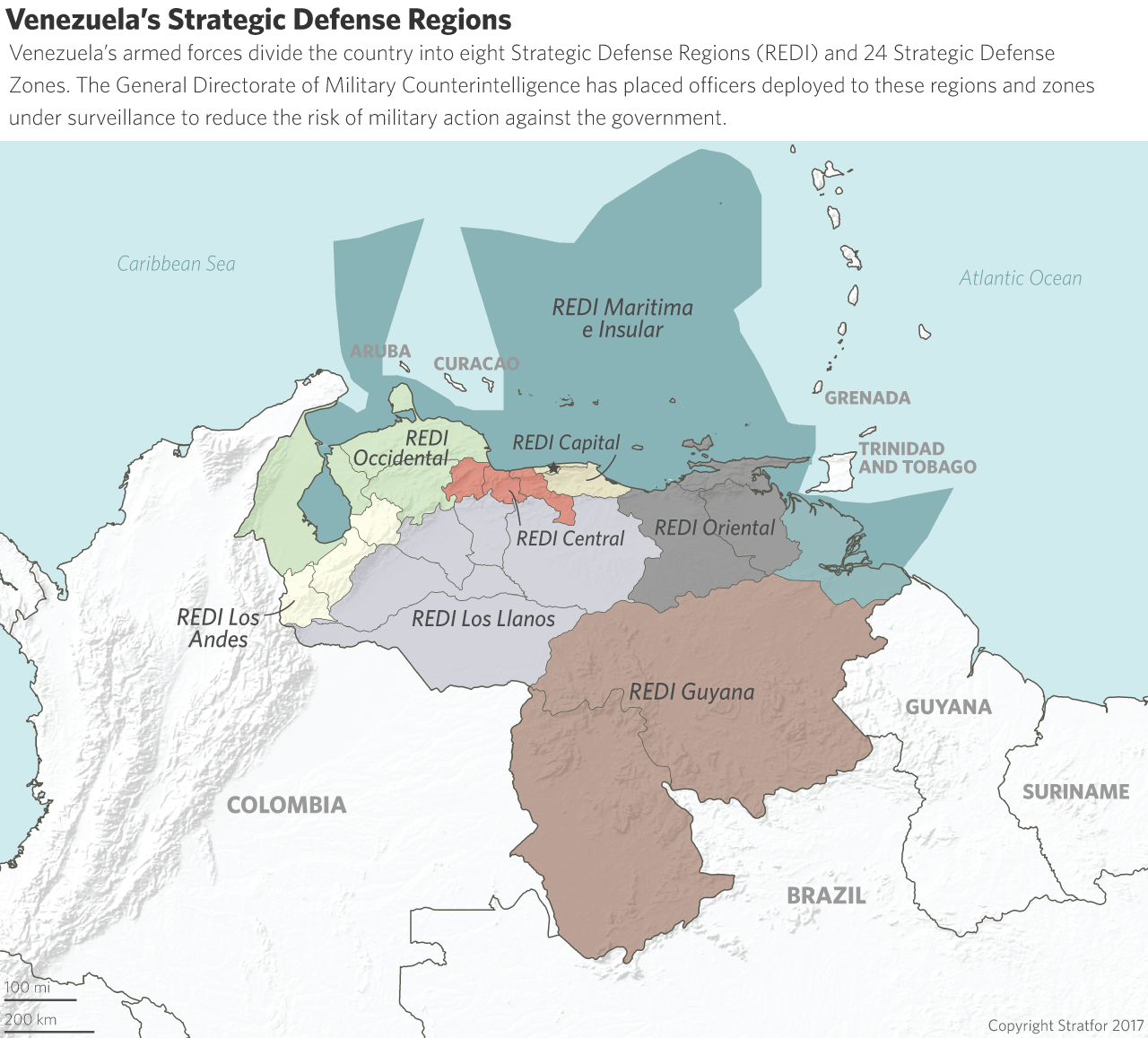
If protests escalate in size and intensity to the point that the National Guard and Bolivarian National Police are unable to control them, the army will be called upon to exercise public security duties. How the military would react to such a scenario is uncertain. The armed forces have so far stayed vocally loyal to Maduro — a natural position, given their broad control of the country’s economy. But military loyalty to any single individual has its limits. If violent crackdowns lead to the threat of U.S. sanctions on Venezuela's economic entities, particularly state energy giant Petroleos de Venezuela, the top brass may break with the government and effectively grant a greater degree of legitimacy to the opposition movement. Absent the threat of outside sanctions, however, the military leadership is likely remain loyal to Maduro — with lower-level commanders kept under close surveillance.
But such relief does not appear imminent, and oil revenues will steadily decline over the coming years, as will imports of food staples and other essential consumer goods. This state of affairs more or less ensures that simmering social unrest will persist. The municipal, gubernatorial and presidential elections could ease some of the tension among disaffected Venezuelans, since a change of president and regional authorities would give citizens the impression that a shift in political direction is possible. Any new authorities, however, would still have to contend with the country’s ongoing economic decline and its effects on the population.
