
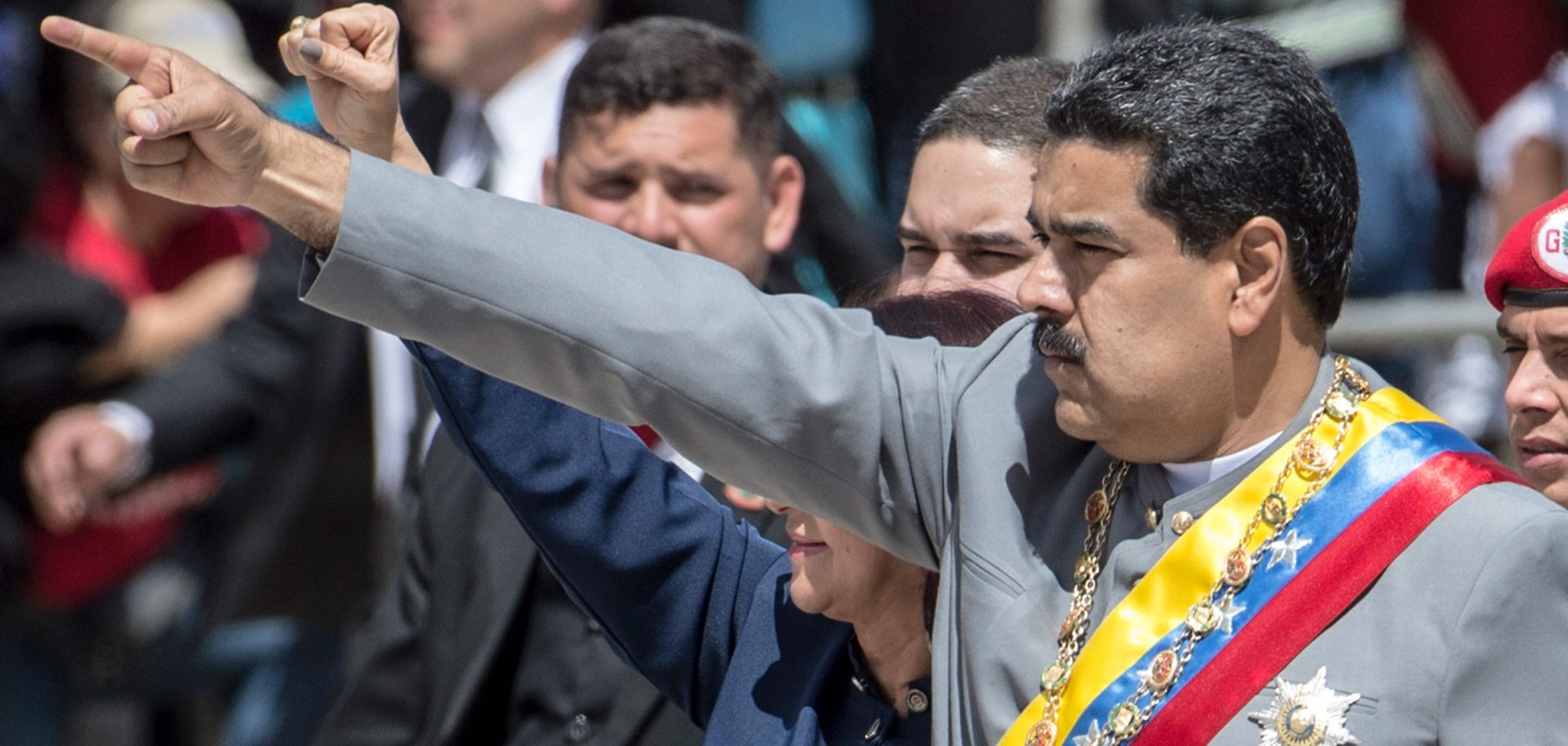
Venezuelan President Nicolas Maduro is transforming a pro-government group into a militia that he can directly control in the event of a national crisis.
Over two years into a deep economic crisis that shows no sign of abating, the Venezuelan government is preparing to save itself — and the ideology it stands for — by any means necessary. After all, "socialism of the 21st century," as former President Hugo Chavez dubbed Venezuela's particular brand of political philosophy, can survive only if the parties that advocate it do too. And with its approval ratings plummeting alongside the economy, the ruling United Socialist Party of Venezuela (PSUV) cannot afford to gamble with its future ahead of approaching regional and presidential elections.
As it stands, only a third of Venezuelan voters can be counted on to support the current government at the polls. President Nicolas Maduro's administration has managed to delay gubernatorial elections since mid-2016, but pushing them off any longer would invite the risk of international sanctions — particularly from the new administration in Washington. The PSUV is still struggling to figure out just how and when to hold the vote, but in the meantime it has begun to hedge its bets by bending the country's political landscape in its favor and reducing threats to its rule from within.
Watching and Removing Challengers
The ruling party's strategy for staying in power is threefold. First, it plans to shrink the pool of potential competitors. On March 31, the country's Supreme Court moved to disband the National Assembly for allegedly disobeying prior orders that included the expulsion of three opposition lawmakers whose appointment would have given Maduro's rivals a two-thirds majority. The court's decision was reversed April 1 after Attorney General Luisa Ortega criticized its unconstitutionality. But the measure had been expected for months, though the government appears to have been willing to pursue it only after it had received assurance that it probably wouldn't be booted from the Organization of American States.
Maduro is also seeking to clear the playing field by forcing political parties to re-register with the National Electoral Council. Though the rule sounds simple enough, it requires parties to obtain the signatures of 0.5 percent of the registered electorate in 12 states to get a spot on the ballot — a benchmark that smaller organizations such as Copei and the Communist Party of Venezuela will have trouble reaching before regional elections.
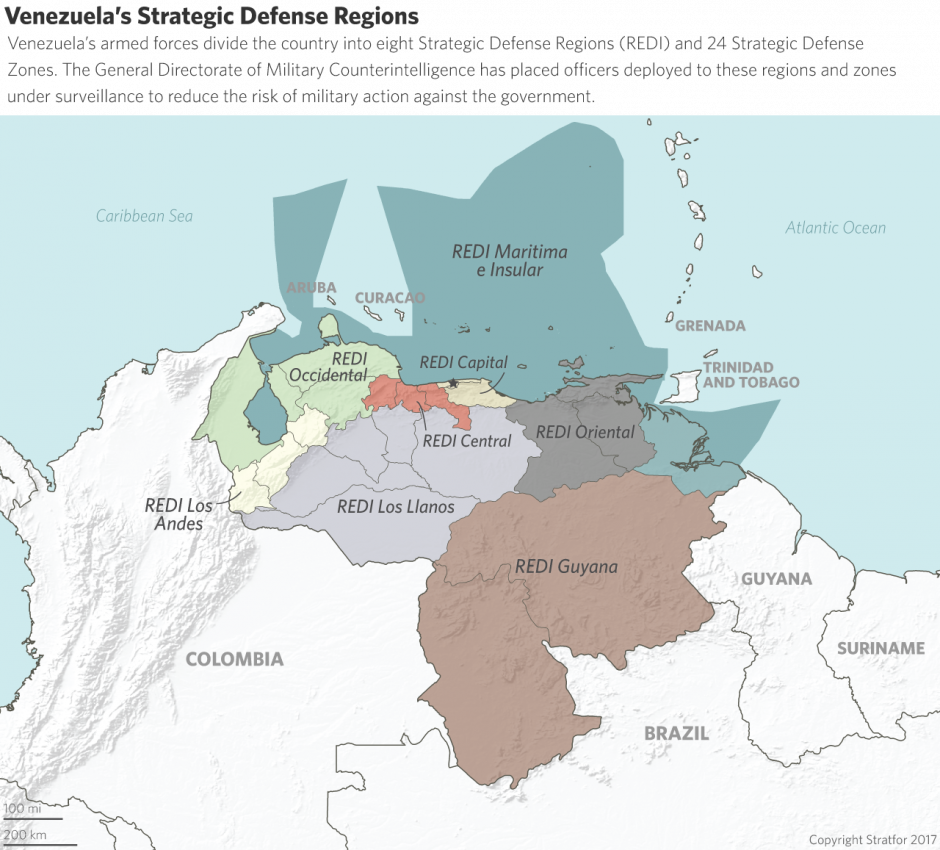
The second part of the PSUV's plan targets the country's military, rather than civilian, leaders. In hopes of minimizing the risk of rebellion, Caracas has begun to monitor the military through the General Directorate of Military Counterintelligence — a body heavily influenced by Cuba and no doubt operating with Havana's help. In fact, its surveillance efforts have only increased in the past year and are unlikely to let up anytime soon. (The country's civilian leaders are subject to similar observation through the National Bolivarian Intelligence Service.)
Building a New Layer of Protection
The third aspect of the government's survival strategy is less well known. Faced with mounting threats at home and abroad, the Venezuelan government has begun to form a new militia. On March 13, former Libertador Mayor Freddy Bernal announced that the PSUV would transform its existing patronage networks, known as the Bolivar-Chavez Battle Units (UBCH), into a new organization: the Combatant Corps for Integral Defense. Multiple Stratfor sources have since confirmed the mayor's statement.
Formed in 2013, the UBCH comprises some 14,000 members nationwide. The units, historically commanded via Venezuela's governors, have helped to organize and distribute patronage perks to government supporters for years. Some have even been deployed to break up opposition protests as many of Caracas' colectivos have, though the UBCH is a separate entity. It is also a civilian organization; as of now, its members possess no military training or weapons.
But it's unclear whether that will stay the case for much longer. Maduro's decision to transform the group into a militia will shift its chain of command into the military hierarchy, where it will function as an auxiliary branch of the armed forces that the president can directly control in the event of a national crisis. The Combatant Corps for Integral Defense will be led by an as-yet-unknown major general, though its ideological leanings will be heavily influenced by the Frente Francisco de Miranda, a wing of the PSUV that closely identifies with Cuba and holds sway over the UBCH in its present form. The faction currently controls three ministries and the vice presidency, though it has a relatively small presence in Maduro's Cabinet compared with his own allies and former military leaders.
Over the next few months, Caracas will likely move to see its vision for the Combatant Corps for Integral Defense realized, perhaps even expanding the ranks of the UBCH by offering new members access to the country's increasingly scarce food supplies through the Local Committees for Supply and Production. Though the formation of the new militia will not be foolproof protection against coups or widespread social unrest — especially since its members have little to no military experience — it will add another layer of security to the Venezuelan government as it struggles to cope with the consequences of the country's severe economic crisis over the next few years. Perhaps most important, the corps will provide Caracas with the manpower to counter demonstrations in the streets, fending off domestic threats to the government's grip on power as Caracas grapples with the risk of new sanctions from its adversaries abroad.
