
The Irish have many reasons to be optimistic. The country has left the worst years of its financial crisis behind: Unemployment is dropping, and its economy grew by an impressive 6.9 percent in 2015, by far the fastest rate in the European Union. According to Eurostat, Ireland will continue to see robust growth rates in 2016 and 2017 as its per capita gross domestic product slowly returns to its pre-crisis levels. But Ireland's problems are far from over, and the decisions made by governments before and during the bailout program, in place from 2010 to 2013, will affect voters' behavior in general elections on Feb. 26 and beyond.
The Politics of More Spending
In many of the countries that have received financial assistance since the beginning of the European crisis, economies and politics are moving in different directions. While most economies are growing again, their populations are punishing traditional parties and supporting new, often anti-establishment political forces. Mainly, voters are pressuring their leaders to resume public spending after years of austerity.
The clearest example is Spain, where the economy is growing again and unemployment is finally declining but where people have abandoned traditional parties and elected a fragmented parliament that is struggling to form a ruling coalition. The next Spanish government will have to slow the pace of reform and probably even reverse some of the measures introduced during the height of the crisis. Something similar happened in Portugal, where the conservative party that introduced the policies requested by creditors won the election but lost control of the government to a coalition of left-wing forces that promised to increase public spending.
The situation is not as dramatic in Ireland, where a large protest party has yet to emerge. But recent opinion polls show that the traditional parties are either stagnating or losing popularity, since voters are supporting small new parties or are still undecided. The ruling Fine Gael party of Irish Prime Minister Enda Kenny will probably win the election but with fewer votes than last time. The situation is particularly difficult for Fine Gael's junior coalition ally Labour Party, which has seen its support drop by half since the last election.
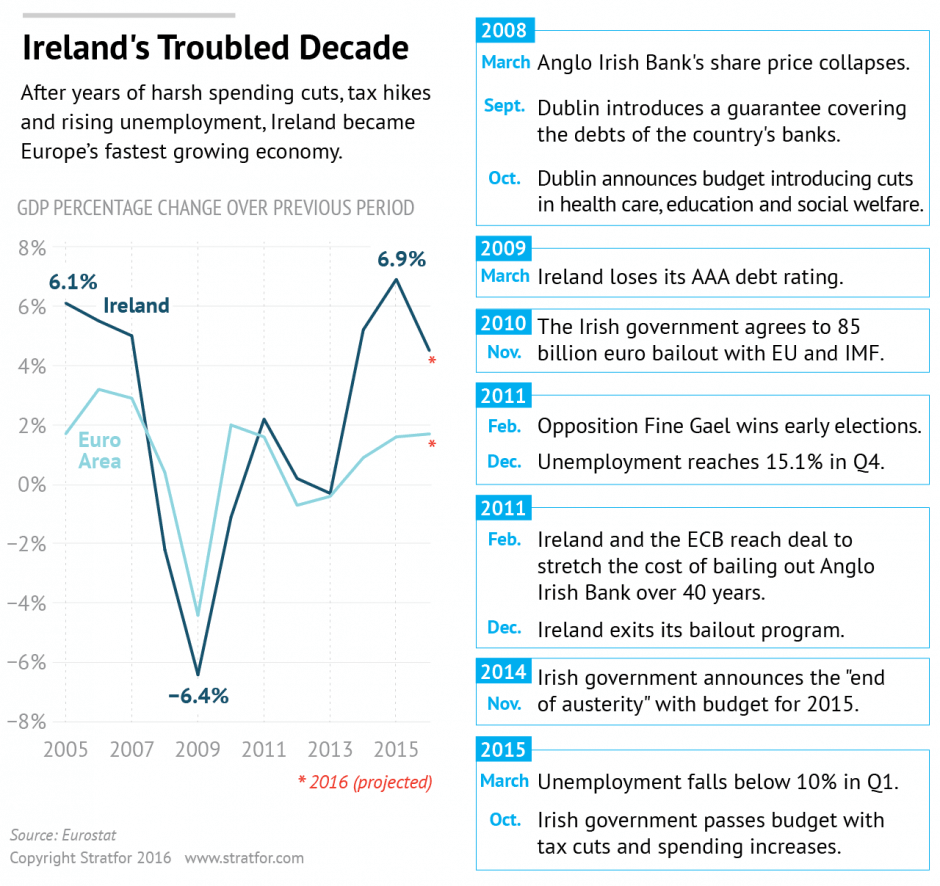
Ireland's government parties are facing the political cost of spending cuts and tax hikes made during the bailout years. The country's GDP per capita is still below its pre-crisis levels, and, while the recovery has been particularly strong in Dublin and other urban areas, it has been much weaker in rural areas. For example, unemployment in Dublin and its surrounding areas is around 8 percent, while in the southeast and the Midlands it tops 12 percent.
Main opposition forces are suffering a similar fate: Fianna Fail, which was in power when Ireland requested the bailout, and Sinn Fein, which has a left-wing and anti-establishment stance similar to that of Spain's Podemos and Greece's Syriza parties, are stagnating in polls. In the meantime, small parties, including the Independent Alliance, the Social Democrats, Renua Ireland and the Workers' Party, are currently attracting one in five votes. It is not enough to challenge the establishment but serves as a reminder that many voters are unhappy with the traditional politics of most parties.
Surveys also show that many Irish want to see more spending on social services. According to a recent opinion poll, the Irish are more worried about health services, unemployment and affordable housing than about the stability of the economy. The next administration in Dublin, regardless of what coalition is formed, will have to slow the pace of fiscal austerity.
The Economy Beyond Upcoming Elections
Doing so might have immediate political gains for Dublin, but the next government — and governments to come — will have to walk a fine line between politics and economics to keep Ireland stable. In recent years, Ireland and many economies in Southern Europe benefited from low oil prices, dropping bond yields and a weak euro. However, some specific features make Ireland different from its southern peers. Before its banking and real estate bubbles burst, Ireland had spent two decades building an economy based on exports, foreign investment, pharmaceuticals, technology and agriculture.
Ireland was able to mitigate some of the pain that austerity measures caused to domestic demand by increasing exports, while the country's low corporate tax rates continued to make it an attractive destination for foreign companies. Unlike Greece, which suffered a structural crisis of its economic foundations, Ireland had a banking crisis, and its fundamentally diverse and stable economy recovered relatively quickly.
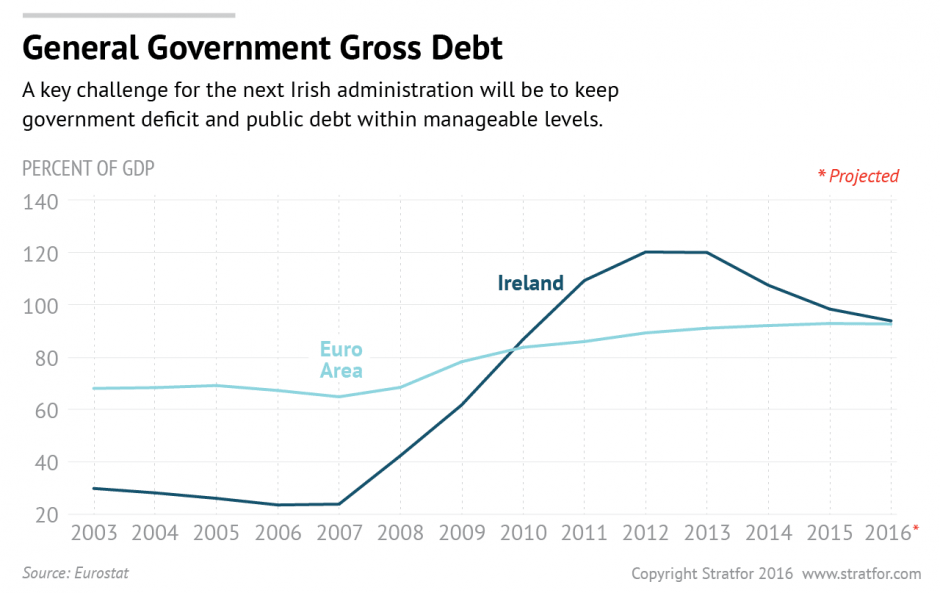
But Ireland does share a common problem with Southern Europe: high levels of public debt. The next Irish administration will have to keep government deficit and public debt levels manageable. Ireland's robust economic growth and fiscal discipline have reduced its deficit notably, from 3.9 percent of GDP in 2014 to 1.8 percent in 2015. Strong growth also reduced public debt, which fell from 107 percent of GDP in 2014 to around 98 percent in 2015. The maturities of Ireland's public debt are mostly long term and carry low interest rates, which reduce financial risks.
Giving in to public demands to increase public spending could lead to higher deficits that would, in turn, force Dublin to increase its debt. On the back of exceptionally good tax intakes, the Irish parliament passed a supplementary budget in October allowing extra spending, mostly on health and social protection. In addition, private debt levels are still high, and so are nonperforming loans in Irish banks (around 18 percent of total loans, according to the World Bank). Ireland will have to continue its efforts to reduce the debt burden for the private and public sector.
Dublin will also have to protect Ireland's corporate tax regime and resist calls from the rest of the world to change it. Politicians in the United States and in several EU member nations accuse Ireland of being a tax haven for multinational companies. Potential tax evasion by U.S. companies has even been discussed during the U.S. presidential campaign. Meanwhile, the European Commission in 2014 opened formal investigations involving corporate tax deals in Ireland, Luxembourg and the Netherlands, the results of which should be announced later this year. Brussels is also considering plans for the harmonization of EU tax rules, a move Ireland will oppose.
The United Kingdom's referendum on EU membership will be an issue as well. Dublin wants to keep Britain in the continental bloc, so it will support London in its negotiations with the European Union. Ireland has diversified its export markets since it joined the European Union in the early 1970s, but the United Kingdom remains its most important export destination, receiving roughly 16 percent of Irish exports. Should British voters decide to leave the European Union in the referendum in June 2016, Ireland will attempt to protect its trade deals with London and push EU members to sign a free trade agreement with the United Kingdom. Any new EU tariffs on trade with Britain would seriously harm the Irish economy.
Finally, future Irish governments will have to handle the demographic consequences of massive emigration. During the crisis years, Ireland saw many of its young workers leave. Ireland's Central Statistics Office reported that the Irish population aged 20 to 24 decreased by 34 percent over the past seven years, while the 25-29 cohort fell by 27.5 percent. Moreover, 17.5 percent of people born in Ireland are now living abroad, according to the Organization for Economic Cooperation and Development.
Emigration did have the benefit of lowering unemployment, given that there were fewer people competing for jobs. But in the long run, the loss of so many workers will create fiscal and labor problems for Ireland. Fewer young workers means less tax revenue to finance government programs, pensions and health care systems for its aging population. And though the economic recovery has caused emigration rates to drop, Ireland still has to find ways to attract immigrants or make its expatriates return home. Ireland's demographic profile is healthier than that of most other European countries, but falling birthrates will compound the problems caused by its dwindling workforce. Dublin could ensure the availability of affordable housing and child care and boost the standard of education and health care systems to attract workers. But such policies could raise deficits and public debt.
Whichever parties win the elections, they will have to protect the country's economic recovery. Managing a recovery might seem easier than handling a crisis, but with uncertainty returning to the global economy, it will not be a minor task.
