
The fall in global commodity prices has slowed the Colombian economy — and economies across Latin America. The price collapse of Colombia's primary export, oil, has slashed growth estimates as well as budget revenues for the government. While the waning economy is still likely to see moderate growth this year, it could complicate political endeavors such as the implementation of controversial tax reforms and important post-insurgency programs with the Revolutionary Armed Forces of Colombia, or FARC, next year.
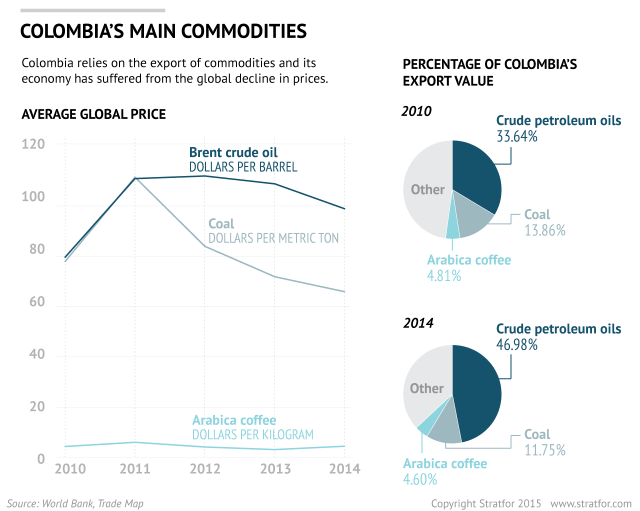
Colombia depends on its commodities to drive economic growth. The country produces an average of 1 million barrels per day of crude oil, most of which is also exported, accounting for over half of total exports and making up around 20 percent of government revenue in 2014.
The drop in global oil prices by nearly 60 percent over the past year has understandably hurt Colombia's economy. Oil exports fell 47 percent in value in the first six months of 2015 compared to the same period last year, declining further in August. Overall, Colombia's exports dropped from around $28 billion in the first half of 2014 to less than $20 billion this year. Consequently, Colombia's external debt has grown to nearly 33 percent of GDP, compared to 25 percent of GDP last year. The Colombian peso decreased by over 40 percent in value since August 2014, and the country's GDP forecast for this year has been revised down from 3.1 percent to 2.8 percent. The inflation rate, though at a manageable 4.5 percent, is still above the government's target of between 2 and 4 percent for the year.
Projections for 2016 do not offer Colombia much relief either. The government announced that it expects to receive $1.1 billion in oil revenue next year, far below the $6.7 billion it made in 2014. Colombia's finance minister has said that the peso's depreciation will raise the cost of the country's foreign debt by 10 percent in 2016. The prices of Colombia's other major commodity exports, including coffee, nickel and coal, have also tumbled and are unlikely to rebound in the near term.
These trends are likely to have political consequences. Colombian President Juan Manuel Santos' administration had planned an ambitious tax reform agenda for 2016, with the Colombian tax and customs authority being bolstered to increase tax receipts. The government also prepared significant cuts in public investment into the housing, agriculture, mining and energy sectors. Such measures were aimed at combating tax evasion in the country to counter ongoing and anticipated revenue losses from oil exports.
While financially prudent, raising taxes and cutting public investment risks igniting political opposition in Colombia. Former Colombian President and current Senator Alvaro Uribe Velez has criticized the government for its proposed tax measures, and he is capable of mobilizing the business sector and rural segments such as coffee planters and cattle ranchers against Santos. There have been several national rural strikes against Santos over the past two years that blocked roads and caused food prices to increase by more than 100 percent. These strikes included left-wing peasants backed by the Polo Democratico party as well as right-wing farmers backed by Uribe. Such strikes could certainly resurface in a more difficult economic environment.
Colombia's economic slowdown could also influence negotiations with the FARC. The long-held peace talks have entered a potentially decisive phase, though sensitive hurdles, including granting amnesty to FARC's militant leaders, remain. But even if negotiators finalize an agreement, funding post-insurgency programs such as work programs for former militants and infrastructure development in rural areas of Colombia might be more difficult to implement under poor economic conditions. Recent estimates suggest that about 5 percent of the 2015 national budget would need to be devoted to the programs over several years, though not annually. If Bogota were unable or unwilling to deliver on the programs, it would not necessarily derail a peace deal, since some funding would likely come from external donors. However, it could destabilize relations between the central government and Colombia's rural constituencies, as occurred in Ecuador and Peru.
What is clear is that Colombia's economic slowdown will be difficult in the year ahead. The decline in the peso's value brought about by the loss in oil exports will likely create a trade imbalance and reduce the country's foreign reserves and budget revenues. Such a development could make the government politically vulnerable as it plans to implement contentious tax reforms and overcome a decades-long insurgency.
