
Mercosur, the customs union consisting of Brazil, Argentina, Uruguay, Paraguay and Venezuela, may soon heighten its efforts to craft a trade deal with the European Union. Mercosur's next summit, to be held July 16-17 in the Brazilian capital, comes amid increasing conflict within the bloc over negotiating trade deals with external parties, particularly with the European Union. However, the second half of the year could see greater movement toward a free trade agreement between Mercosur and the European Union, with Brazil playing a more active role in expanding Mercosur's trade prospects and relationships.
Mercosur's upcoming summit will include several notable components. One will be a transfer of the bloc's rotating chairmanship from Brazil to Paraguay. Another will be the potential confirmation of Bolivia's membership in the bloc, although the Paraguayan and Brazilian parliaments still need to grant formal approval. But perhaps the most important, and certainly the most controversial, agenda item will be the discussion of increased flexibility for Mercosur in negotiating free trade agreements with third parties.
The topic has been a source of significant dispute among Mercosur member states, particularly in the context of negotiating a free trade agreement with the European Union. The blocs — two of the four largest trade unions in the world — have held free trade talks regularly since 2010. But not all Mercosur members are aligned: Argentina is concerned that EU goods might undermine its own domestic industry, while Uruguay is eager to expand its export markets and has thus advocated to accelerate negotiations. Mercosur law stipulates that its members must negotiate any free trade deals as a bloc rather than individually (except free trade deals with Mexico), so such internal disagreements have hindered progress toward a deal with the European Union. But Uruguay has pushed for a revision to the law, favoring instead a two-speed process in negotiations with the European Union that would allow some Mercosur members to proceed in trade talks more quickly than others.
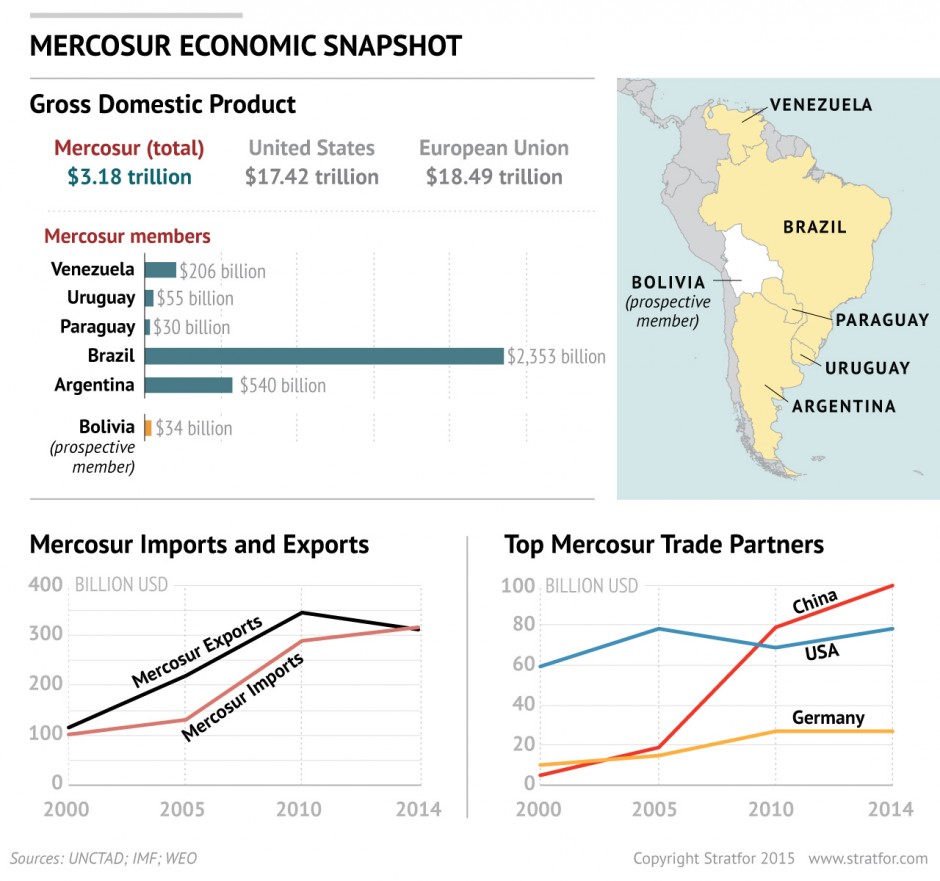
Brazil — by far the largest economy in Mercosur, with a gross domestic product of $2.35 trillion out of the total $3.5 trillion in the bloc — has traditionally taken a moderate position between that of Argentina and Uruguay. Until recently, it had resisted the idea of a two-speed negotiation process so as not to upset relations with Argentina. However, Brazil's major economic slowdown — growth was only 0.1 percent in 2014 and the economy is expected to contract by 1 percent in 2015 — has forced Brasilia to reconsider its position. At the beginning of 2015, a new economic team appointed by Brazilian President Dilma Rousseff established a return to fiscal health and an expansion of the country's exports as major priorities for the administration. The government designated the European Union as a major target market, and Brazilian Trade Minister Armando Monteiro went so far as to call for the complete repeal of Mercosur's 32/2000 rule (the specific regulation that stipulates free trade treaties be negotiated as a bloc) in order to expedite trade talks with the European Union, though any treaty change would require unanimity among Mercosur members.
However, at the Mercosur-EU summit in June, Rousseff clarified and softened Brazil's stance, saying that her country respects Argentina's position and would not attempt to break the current bounds of Mercosur in striking a deal with the European Union. Rousseff acknowledged the sensitive timing of the issue for Argentina, which is approaching a presidential election on Oct. 25, in which President Cristina Fernandez de Kirchner unable to run because of term limits. At the same time, Rousseff said Brazil would continue to push for a deal as soon as possible — a nod to Uruguay's more market-friendly position.
Argentina's stalling tactics as well as a lack of concrete commitments from the Europeans made the June EU summit a disappointment for Uruguay and Brazil. However, there may be significant progress in talks over the coming months. Uruguayan Foreign Minister Rodolfo Nin Novoa recently stated that Mercosur members will meet in September to establish a tariff reduction list agreeable to all parties within the bloc. This would serve as preparation for an exchange of proposals between Mercosur and the European Union in November, which is a necessary step toward reaching an actual agreement. The timing would allow Argentina to hold presidential elections before the exchange with the European Union, avoiding the controversial issue until after the formation of a new government. Allowing time for presidential elections could also make Buenos Aires more amenable to the EU deal, especially if the more business-friendly candidate Mauricio Macri wins. Brazil's trade minister also appears open to this plan; he recently stated that the European Union and Brazil would likely exchange offers later this year.
A preliminary exchange of offers on tariffs would be a significant step forward in Brazil's efforts to expand its trade markets and in Mercosur's long-stalled negotiations with the European Union, but it would not mark the conclusion of a deal. The actual signing of an agreement would require approval from EU members' parliaments, and some European countries are still concerned about politically sensitive sectors, such as agriculture. Given those obstacles, Mercosur and the European Union are not likely to confirm a deal before the second half of 2016.
Nevertheless, the expansion of trade with the European Union has clearly taken on greater importance for Brazil and other members of Mercosur. Economic growth in the region is slowing, and political change is coming in Argentina. At the same time, the entire bloc feels a need to anticipate any regulation changes that may come with a potential Trans-Atlantic Trade and Investment Partnership agreement between the European Union and the United States. Mercosur is thus likely to spend the next few months actively pursuing an eventual trade deal with the European Union.
