
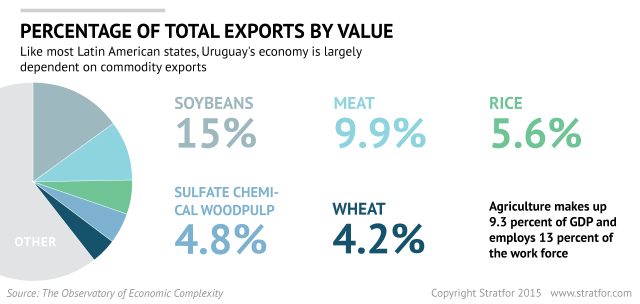
Like most Latin American states, Uruguay's economy depends largely on commodity exports. Agriculture is a particularly important sector, though Uruguay also serves as a regional banking and transshipment hub through its Atlantic port capital of Montevideo.
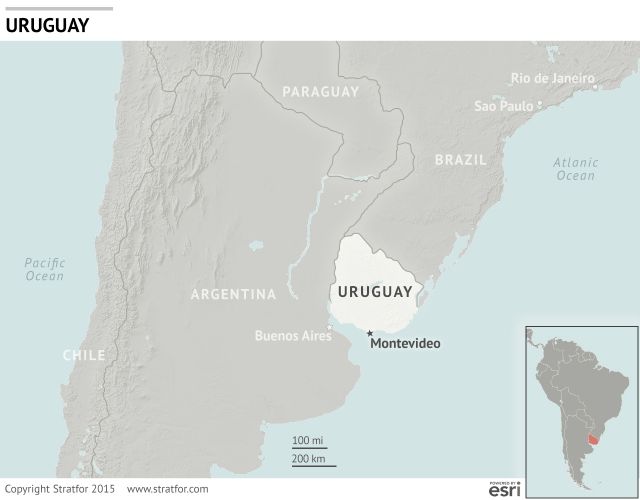
Uruguay's geography and location have been key in shaping its economic relationships. Sandwiched between the much larger countries of Brazil and Argentina in the Southern Cone of South America and with little in terms of geographic barriers, Uruguay historically has been a buffer state. Traditionally, Uruguay's imperative has been to balance between the two states. This is reflected in its trade relationships: Brazil and Argentina are major export destinations for Uruguayan goods (17 percent and 5 percent, respectively) and are the two largest of Uruguay's import partners at 17 percent and 15 percent of total goods.
Uruguay also uses this balance as a means to exact concessions from both states. Mujica, the outgoing president, has been quoted as saying, "To get something from Argentina, you have to get in bed a bit with Brazil ... it's like the old law of the pendulum." Uruguay is also closely integrated with these countries as a member of Mercosur, a South American trade bloc that comprises Brazil, Argentina, Paraguay, Uruguay and, more recently, Venezuela.
The Challenges of Mercosur
Uruguay's economic growth has slowed in recent years — from an average of 6.4 percent from 2010 to 2012 to 4.4 percent in 2013 and 3.3 percent in 2014. The two main factors behind this slowdown are the fall in global commodity prices and increasing trade tensions within Mercosur.
Within Mercosur, Uruguay has been struggling to grow under the weight of increased trade protectionism spearheaded by Argentina, which has attempted to use trade restrictions to mitigate a growing balance-of-payments crisis fueled by rising energy imports and high levels of capital flight. Perhaps even more detrimental to Uruguay was Argentina's decision to ban the transshipment of Argentine goods through Uruguayan ports because Montevideo did not approve the conditions of the Multilateral Agreement of Mercosur Maritime Transportation. This has caused trade and traffic at the Montevideo port to decrease, with overall port transit falling by 18 percent in 2014. Inflation due to high exposure to Argentina is also an issue for Uruguay, and the government has put price freezes on food products over the past year to help control it.
Related to these difficulties, Rodolfo Nin Novoa, Uruguay's next foreign minister, said that the next administration will try "an open, frank policy" in its relations with Mercosur members but noted that changes to the grouping are necessary in order to meet its original objective of free trade. Novoa also has emphasized trade outside of Mercosur, pointing out that Uruguay has 140 markets and now needs to focus on the accessibility of these markets. Taking a more extreme position, Paul Riezler, president of the Euro-Chamber in Uruguay and of the Uruguay-Germany Commerce and Industry Chamber, said Uruguay should act outside of Mercosur and try a bilateral trade agreement with the European Union. Riezler suggested that a good moment for the change of strategy could be when the new Uruguayan administration takes office.
Available Options
These challenges put the onus on the incoming Uruguayan government to look for more options within the country's current trade frameworks as well as outside of them. One such option is to leverage port access for neighboring landlocked countries, particularly Paraguay but also potentially Bolivia, as a means to increase port traffic. Uruguay already has given Paraguay port space at Nueva Palmira port and has held discussions about giving Bolivia and Paraguay access to a future deepwater port in Rocha, the construction of which could begin as soon as March. However, these countries' economies and export potential are relatively small, so increasing economic prospects with this option would be of limited effectiveness for Uruguay.
Another option for Uruguay is to expand its economic relationships outside of Mercosur, particularly with Mexico. Uruguay already has a free trade agreement with Mexico, but Montevideo has been encouraging companies from third-party countries to set up a portion of their production chain in Uruguay. Montevideo has specifically targeted Brazil, which does not have a free trade agreement with Mexico but has been looking to increase its own industrial and automotive exports there. Brazil has faced problems accessing the Mexican market — high Brazilian import tariffs have complicated talks over establishing a new trade agreement between the two countries — so Brazilian companies have been looking at Uruguay as a place to assemble and produce goods to send to Mexico. Moreover, Uruguay's labor laws are more flexible than Brazil's, so Brazilian companies operating in Uruguay would not have to deal with as much red tape as they do in Brazil. This could create more foreign direct investment into Uruguay, while Brazil and potentially other countries could take advantage of Uruguay's free trade pact with Mexico.
Uruguay has also been pushing Argentina to approve a free trade deal between Mercosur and the European Union. The deal has been under negotiation for several years but continues to face hurdles and delays. The incoming government prefers to stick to the negotiation process as a bloc, though further delays could force Uruguay to revise its position. Achieving such a trade deal bilaterally, as Riezler suggested, would be very difficult for Uruguay because the Mercosur bylaws prevent member states from signing most bilateral free trade agreements (with Mexico serving as an exception) without the unanimous approval of the rest of Mercosur. Therefore, any departure from the current negotiations would likely depend on the position of Brazil, which, like Uruguay, is seeking to speed up the negotiation process but has much stronger economic and political heft within Mercosur.
However, Argentina is not the only obstacle to the EU-Mercosur free trade agreement; several EU members have been reluctant to agree to certain conditions of the deal, and the European Union is currently preparing its own version of an agreement proposal. Therefore, the new Uruguayan government is likely to work within the bounds of Mercosur while seeking greater flexibility within the trade bloc and looking beyond the bloc for additional economic opportunities. But given its size and limited options, Uruguay is likely to remain dependent on its larger neighbors, Brazil and Argentina, in shaping its economic and political decision-making.
