
Forecast:
- Brazil will pursue the revision of Mercosur to speed up trade negotiations with the European Union and other entities.
- However, Brazil will not abandon its membership in the economic bloc and will be patient with Argentina's reservations on the EU deal.
- Meanwhile, Brazil will pursue increasing trade ties with other countries such as Mexico and the United States.
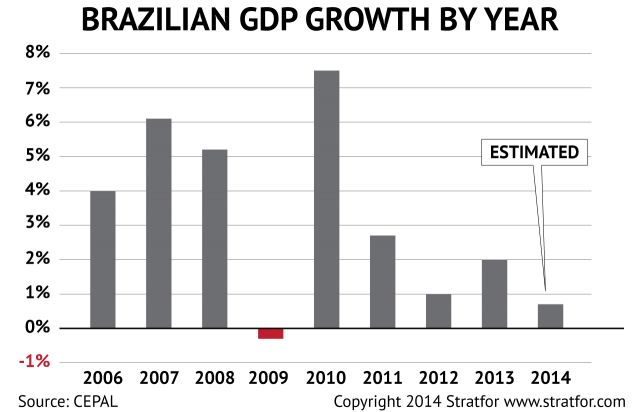
Amid a slowing economy that registered just 0.1 percent growth in 2014 and is projected to contract by 1 percent in 2015, Brazilian President Dilma Rousseff has made returning to fiscal health and expanding trade opportunities top priorities. The appointment of several officials beginning in January, including Finance Minister Joaquim Levy and Minister of Development, Industry and Foreign Trade Armando Monteiro Neto, made this desire to lead a new economic strategy abundantly clear. Levy subsequently set a target of a 1.2 percent budget surplus in 2015 and a 2 percent surplus in 2016, while Neto called for the government to expand trade with major markets, including the European Union, the United States and Mexico.
However, nearly six months into Rousseff's second term, the Brazilian government has been slow to realize its trade expansion plans. This lack of progress was apparent during trade talks between Mercosur (an economic bloc comprising Brazil, Argentina, Uruguay, Paraguay and Venezuela) and the European Union, when Mercosur foreign ministers met with EU Trade Commissioner Cecilia Malmstrom in Brussels on June 10-11. Talks between Mercosur and the European Union have been ongoing since 2010 over such aspects as customs and trade facilitation, eliminating technical barriers to trade, and intellectual property. Brazil and other Mercosur members hoped that these negotiations would lead to concrete advancement toward a free trade deal between the two economic blocs.
The Obstacles
But a major obstacle to progress leading up to the meeting in Brussels was Argentina, which has been hesitant to establish a free trade agreement with the European Union. The country's reservations stem, in part, from the government's policy of protecting the domestic market and local industry. It is also a presidential election year. Consequently, Argentina was slow to get its proposals ready for the trade talks in Brussels and generally more reserved in pushing through with a major trade deal. The European Union had also been hesitant about Argentina's participation, given the country's current trade environment, with companies struggling to export to Argentina and facing delays or non-payment for their goods.
Argentina's position led to calls for a "two-speed" negotiation process, in which some members of Mercosur could advance in the free trade talks with the European Union at a faster pace than others. Currently, a rule in Mercosur legislation, known as Decision 32/2000, requires all members of the bloc to collectively negotiate and sign free trade deals with anyone outside of the bloc (except Mexico). But the region's economic slowdown and the slow pace of the negotiation process between Mercosur and the European Union — neither side has yet exchanged its respective proposals over what goods and legislation the agreement would entail — has made the rule increasingly controversial.
Uruguay has been the lead advocate for reforming Mercosur to adopt a two-speed negotiation process. Uruguayan President Tabare Vazquez has said that Montevideo is ready to sign a trade agreement with the European Union now and that if some members (referring to Argentina) need more time, they would be welcome to join the agreement later. According to Vasquez, Brazil and Paraguay also hold this position. However, just before the opening of the EU trade talks, Paraguayan President Horacio Cartes said his country still prefers to negotiate an agreement as a bloc, and he rejected the dual-track process. These divergent positions are likely a reflection of the economic trajectories of the two countries: Paraguay is expected to grow by an average of 4 percent over the next two years, compared with less than 3 percent for Uruguay.
Brazil's Position
By far the largest Mercosur economy, Brazil has adopted a more nuanced position on the trade issue. In a competitiveness seminar in Rio do Janeiro a few days before the EU talks, Monteiro Neto, the trade minister, said Mercosur must allow member countries to sign trade agreements with third parties and called for the end of the 32/2000 rule. The statement was in line with Uruguay's position. Moreover, Brazil's relationship with Argentina is growing increasingly tense. Argentina is not only trying to avoid any major decisions on the EU deal before its presidential election in October, but Buenos Aires also has had differences with Brazil over the renewal of an automotive trade agreement between the two countries that expires at the end of June.
However, the Brazilian government has been adamant that the country does not want to formally break out of the bounds of Mercosur and that it is a strong economic and political partner of Argentina. While bilateral automotive trade has fallen more than 20 percent over the past year, Argentina still serves a major market for Brazil's automotive products. Argentina is an important trading partner in general. And while Brazil now vocally supports the two-speed negotiation process, Brasilia is not willing to break ties with Buenos Aires or compromise the existence of Mercosur over the issue.
Indeed, despite wanting to set July as a deadline for Mercosur and the European Union to present and exchange their trade proposals after failing to achieve such an outcome at the Brussels meeting, Rousseff said that she understands and respects Argentina's position and that, "we have definitely not lost patience with Argentina." The Brazilian government at least appears to be taking a gradual approach to getting Argentina to be more flexible in the EU talks, which may see more progress after the new administration in Buenos Aires takes over for President Cristina Fernandez de Kirchner.
Other Opportunities
Until then, Brazil will pursue greater trade ties with other major economic powers in a bid to offset the country's economic slowdown. Rousseff is set to meet with U.S. President Barack Obama on June 30 to discuss trade. Negotiations between Brazil and Mexico on expanding goods as part of the two countries' free trade agreement are supposed to take place in July as well. Achieving a free trade deal with the European Union will be more difficult as Brazil tries to avoid antagonizing Argentina. Nevertheless, Brasilia will try to convince Buenos Aires to move forward diplomatically while pursuing revisions to Mercosur negotiation practices.
By doing so, Brazil could create an alternative path for trade relationships beyond Mercosur, a fundamental shift from the bloc's intended purpose. Mercosur was originally intended to be a self-sufficient trade bloc that could afford to maintain protectionist policies with anyone outside the union. But the Mercosur market is not big enough to do so, and Brazil is likely to become more creative and assertive in its efforts to return to sustained economic growth.
