
Forecast
- The International Criminal Court's power in Africa will dwindle as several powerful African countries reconsider their commitments to the institution.
- The court will not close its doors, but countries opposing it will render it incapable of penalizing transgressors in current conflicts.
- As resistance to the court increases in Africa, South Africa will use criticism of the institution to pursue its own interests and increase its regional influence.
The International Criminal Court's latest debacle began at the recent African Union summit in South Africa on June 14-15. Human rights activists and several Western governments, including that of the United States, criticized the South African government for failing to comply with its International Criminal Court treaty obligations when it declined to arrest Sudanese President Omar al Bashir at the summit.
The South African government, led by the African National Congress, responded to these criticisms with five arguments. First, Pretoria asserted that the African Union's principles provide immunity for all summit activity and that South Africa should not have been expected to detain the Sudanese president. The government also said that compliance with the International Criminal Court is voluntary, even for signatory members. Third, it argued that the court focuses disproportionately on conflicts in Africa and Eastern Europe. It also pointed out that the court is no longer used as a tool of last resort in prosecuting crimes against humanity and is improperly used as the most favored method of prosecution. Finally, Pretoria accused the court of no longer acting as a fair and independent institution.
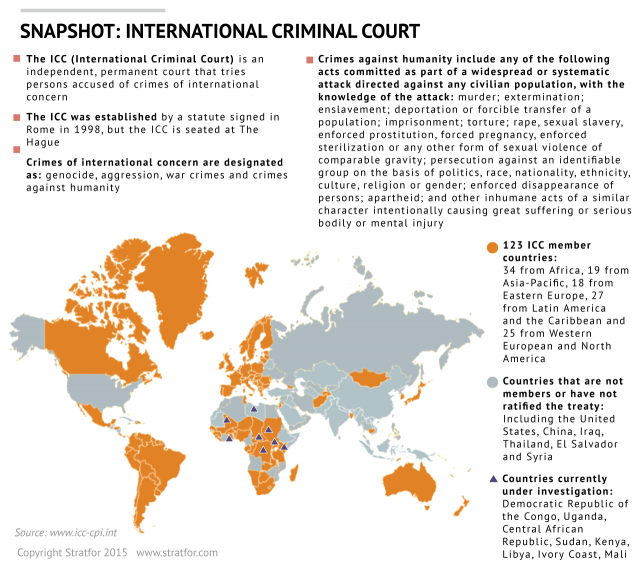
Opposition Across Africa
There is no consensus in Africa as to whether the International Criminal Court has abused its role or whether it has been prevented from carrying out its proper role. Regardless, the states opposed to or resistant to the court are gaining influence on the matter. Namibia, for example, has said that sitting leaders should be granted immunity from prosecution. Ethiopia has argued that the principle of immunity during participation in African Union gatherings should stand. Kenya's position has been more nuanced, with Nairobi refusing to make its leaders available to prosecutors investigating the violence that followed elections in 2007 until the cases against current President Uhuru Kenyatta and Vice President William Ruto collapsed.
Nigeria's position on the International Criminal Court is conflicted. Abuja supports investigations into war crimes committed in Sudan's Darfur region, including the deaths of Nigerian peacekeepers allegedly at the hands of Khartoum-backed militias. At the same time, however, the court undermined Abuja's foreign policy credibility when Nigeria's decision to grant then-Liberian President Charles Taylor exile in 2003 was revoked in 2006 under Western diplomatic pressure. Taylor was eventually extradited from the Nigerian city of Calabar and transferred to The Hague, where he faced an International Criminal Court-aligned war crimes tribunal for his role in crimes committed during the civil wars of the late 1990s and early 2000s in Liberia and Sierra Leone.
Several other African governments resist the International Criminal Court as well, likely because their leaders — with Taylor's case in mind — fear being prosecuted for crimes that they may have committed. Zimbabwe's government, for example, fears multiple charges of crimes against humanity for the ruling Zimbabwe African National Union-Patriotic Front's actions against its political opponents. Other sitting governments likely fearing prosecution for alleged crimes committed during their rule include Ivory Coast, Rwanda, the Democratic Republic of the Congo, Ethiopia and Eritrea.
South Africa's View
Although South Africa's government does not fear the International Criminal Court, confronting the controversy over the court's legitimacy gives Pretoria an opportunity to assert foreign policy leadership in the region and raises its international influence. Pretoria is using the attention on the court to support a broader foreign policy maneuver that invokes pan-African credentials to counter domestic and international critics.
South Africa has long seen itself as Africa's great power — a viewpoint held consistently no matter which racial group has held power in charge and even though the government's ability to shape events directly in Africa falls short of its self-image. South Africa lacks the military means to unilaterally and decisively intervene in conflicts elsewhere on the continent, as evidenced by its forays into the Central African Republic in 2013 and Ivory Coast in 2011. Questions of capability aside, South African leadership is not always welcome in other parts of Africa; relations with continental rival Nigeria are always fraught, and sentiments toward South Africa's influence in its own backyard are often mixed or hostile.
Meanwhile, Pretoria struggles domestically to balance the competing needs of its various constituents. As a result, the government is regularly attacked politically by the left, for ignoring the socio-economic interests of underemployed black laborers, and by the right, for fueling gradual economic decline. These tensions will be highlighted as the South African mining sector begins another collective wage negotiation period. The threat of strikes and disruptions to mineral output is high — a repeated circumstance that calls into question the long-term viability of investing in South Africa's critical mining sector.
The International Criminal Court is not the only controversial foreign policy issue Pretoria has sought to manipulate for geopolitical gain. Joining the BRICS (Brazil, Russia, India, China and South Africa) bloc of emerging economies in 2011 tapped into discontent regarding international financial institutions' perceived inequitable treatment of Africa. Through its calls for reforming the U.N. Security Council — by expanding the permanent membership to include representation from Africa (specifically South Africa) — Pretoria has similarly sought out international issues where it can become Africa's voice amid common concerns and receive support, however begrudgingly it is given.
The International Criminal Court will remain a viable institution. However, a confluence of interests resistant to its prerogatives will constrain the court in its ability to investigate and prosecute crimes against humanity in Africa.
