
The mining sector labor unions involved in upcoming wage negotiations all have differing positions that could complicate the collective bargaining process. But unions have reduced tension by holding preliminary discussions and agreeing on a negotiating framework before the talks officially start.
The National Union of Mineworkers, Solidarity, the United Association of South Africa and, critically, the Association of Construction and Mineworkers Union met together with South Africa's Chamber of Mines on June 9 to reach an agreement on the process of wage negotiations, including where it will take place and between which representatives. In past years, the decision to coordinate negotiations, rather than negotiate separate contracts, has been extremely contested. But in this year's preliminary talks, unions have already agreed to include a chairperson and facilitator who will coordinate between unions to settle on terms.
The inclusion of all the major unions in these preliminary discussions will reduce the risk of a two-track negotiation, with the mining companies making one set of agreements with more accommodating unions and another set of terms with non-participatory unions. Negotiating one contract with all the unions will take less time and be less disruptive to mining production.
About Boosting Membership
But while there are early moves to help make this year's gold sector wage negotiations less disruptive, the Association of Mineworkers and Construction Union, arguably the most militant of the mining sector's unions, may upset the process in its attempts to grow its membership. The union has already threatened to conduct an unprotected strike (meaning striking workers could legally be fired) if terms negotiated with the majority of gold sector unions are imposed on its membership without their consent.
A tough stance in negotiations is popular among members of the labor movement, and the vocal and militant union wants to expand its membership and overtake the National Union of Mineworkers as the largest union in the industry. Roughly 54 percent of unionized workers belong to the older National Union of Mineworkers, while about 29 percent are part of the Association of Mineworkers and Construction Union. Attaining majority membership would enable the Association of Mineworkers and Construction Union to shape the terms for wage demands and impose its own terms on smaller, weaker unions participating in the collective bargaining process. The fast-growing labor organization demonstrated last year that it is willing to endure considerable short-term costs to achieve its economic interests.
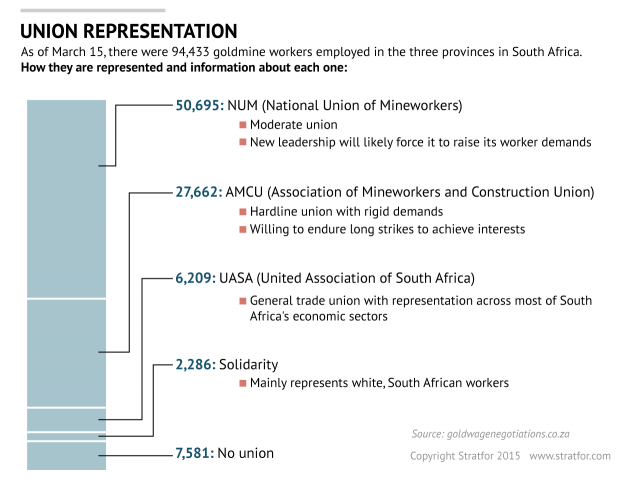
And the Association of Mineworkers and Construction Union is not the only South African labor organization maneuvering to expand its membership. Leaders from all the unions will be tough with mining companies in negotiations because making too many concessions would weaken their support and possibly hurt their membership numbers. The tough stance taken by the Association of Mineworkers and Construction Union is becoming popular across the labor movement, as indicated by the recent election of David Sipunzi to the head of the National Union of Mineworkers.
Sipunzi's election will inject greater responsiveness and a greater connection between union leaders and the labor movement in general, especially after Sipunzi's predecessor for 10 years, National Union of Mineworkers General Secretary Frans Baleni, was criticized for being too accommodating to mining interests. In fact, the Association of Mineworkers and Construction Union arose as a splinter group from the National Union of Mineworkers because of dissatisfaction with the older union's perceived weakness.
Executives from gold mining companies have been urging union leaders to conduct wage negotiations with an eye toward keeping the mining industry profitable in a difficult economic situation. But union leaders will focus on membership numbers rather than on the financial concerns of the mining companies. Instead, popular sentiment favoring tougher negotiations will convince union leaders to make it harder to come to an agreement with corporate mining representatives.
No Help From the ANC
The ruling African National Congress (ANC) will intensify these challenges because of its unwillingness to resolve any mining dispute or curtail disruptive union activity. The South African government, responsible for the country's economic policy direction, is monitoring the imminent wage negotiation period. But the ruling party also considers itself a liberation movement and has a strong base in the country's labor organizations. It is politically difficult for the ANC to carry out governance programs that its political base opposes.
The ANC is already under fire from several unions, including the Association of Mineworkers and Construction Union and the National Union of Metalworkers of South Africa, for representing corporate interests. The latter union is trying to become a political party because of its discontent over the ANC's perceived pro-business policies. In addition, the Julius Malema-led Economic Freedom Fighters — now the country's third largest party, although it holds a modest 25 parliamentary seats compared with the ANC's 249 — has been stealing the votes of struggling workers, particularly those in the mining sector, on a platform of demanding concessions from mining that the ANC is unwilling or unable to do.
Local government elections in 2016 will be a bellwether of ANC performance and popularity ahead of party elections in 2017 and national elections in 2019. The ruling party is unlikely to take steps in favor of mining companies that would jeopardize its standing with poor and underemployed South Africans.
However, South African unions understand the financial situation the mining companies are in. Depressed commodity prices, reduced demand for output, and difficult access to capital all explain why the unions are cooperating so far. Unions depend on the success of the mining industry as much as corporations. But that cooperation does not mean the wage negotiation period will be an easy one. Union leaders will need to adopt a tough stance in negotiations with mining companies to maintain and attract their members.
