
Forecast
- Spain's political scene will grow more fragmented as the country approaches the end of its traditional two-party system and national elections set for late 2015.
- Six years into the economic crisis, voters will look to anti-establishment parties and activists (new to Spanish government) in search of relief from lasting unemployment.
- The new central government in Madrid will be faced with an unstable political climate and an economy still struggling to recover.
Spain held elections in 13 of its 17 autonomous regions and all of its municipalities on May 24, and the biggest winner was political fragmentation. The country's main political parties are now holding informal negotiations after failing to win absolute majorities in most regions and several municipalities. The elections instead showed decreased support for the country's mainstream parties and significant gains for anti-establishment forces.
The largest political parties in Spain (the ruling center-right Popular Party and the center-left Socialist Workers' Party) won in most territories, but they failed to secure enough seats in regional parliaments and several municipal assemblies to govern alone. As a result, they will be forced to share power with anti-establishment parties (most notably the left-wing Podemos and the centrist Ciudadanos parties) and smaller regional parties.
The regional and municipal elections serve as a preview of things to come: Spain will hold national elections by the end of the year (the exact date has yet to be announced), and once again difficult political agreements will have to be made. The next central government in Madrid will have to deal with potentially rebellious regions, pervasively high unemployment and a weak economic recovery, in addition to its own instability.
The elections took place against the background of Spain's persistent unemployment crisis. After four years of a conservative government, the jobless rate is slowly decreasing. However, many of the new jobs are precarious and pay poorly. Although the Spanish economy is growing again, the quality of life for most Spaniards is still lower than before the crisis. The economic woes have also harmed the popularity of the opposition Socialist Workers' Party, as some of the austerity measures currently in place were introduced by a previous Socialist government. Meanwhile, several corruption scandals have further hurt the ruling Popular Party's image.
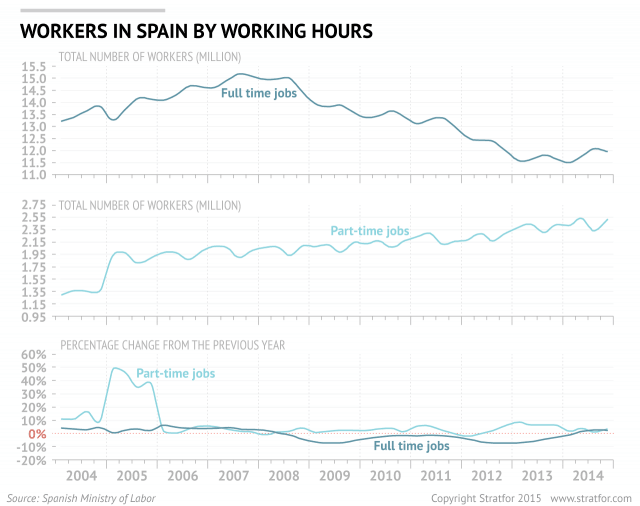
The most notable outcome of the elections is activists leaving the streets and occupying municipal assemblies. In Barcelona — one of Spain's largest and wealthiest cities — the mayoral election was won by Ada Colau, an activist who opposes housing evictions and has no previous political experience. Manuela Carmena, a retired judge close to the "Indignados" movement that emerged during the early stages of the Spanish crisis, could end two and a half decades of conservative government in Madrid after coming in a close second. At the regional level, Podemos and Ciudadanos will become kingmakers, since the support of one or the other will be necessary to form governments in most of Spain’s autonomous communities.
Tough Negotiations Ahead
Bargaining between Spain's largest parties is already underway and will lead to complex deals. These agreements will combine ideology and strategy, as parties will have to make deals that are electorally acceptable and politically sustainable. The Socialist Workers' Party and Podemos will seek agreements in regions where their joint forces would allow them to keep the conservatives from power, likely producing left-leaning governments in the autonomous communities of Valencia, Asturias, Extremadura and Castilla-La Mancha. The Popular Party, in turn, will seek agreements with Ciudadanos to control regions such as Madrid, Murcia, Castilla y Leon, and La Rioja. The intentions of Ciudadanos remain ambiguous; the party could make deals with the center-left or the center-right.
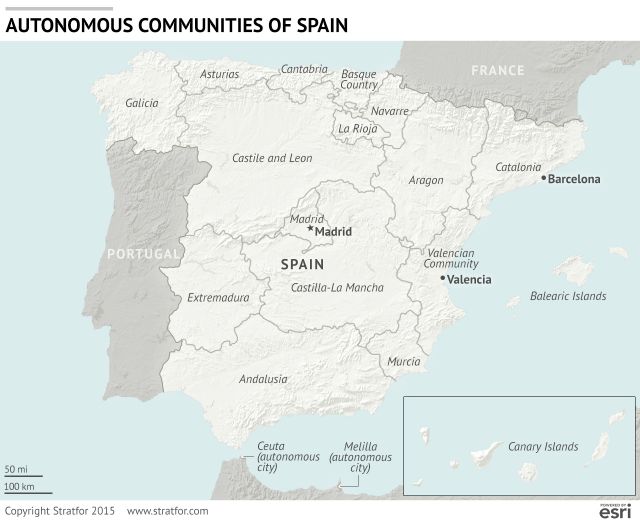
During the negotiations, anti-establishment parties will demand several concessions from their mainstream peers. Podemos will request the reversal of spending cuts in the public sector and demand measures to stop home evictions. Ciudadanos will insist on lower income taxes and more credit for small and medium enterprises. Both startup parties will stress the need for anti-corruption measures.
The agreements will be fragile and, in some cases, unofficial. Some regions will need two-party deals, but in others three-party agreements will be necessary. Additionally, Podemos and Ciudadanos may choose not to formally enter regional governments and instead offer external support for minority governments led by mainstream forces. With Spain's national elections only a few months away, the anti-establishment parties probably will decide to preserve their protest profile and avoid formal alliances with parties they criticize.
This dynamic will have multiple consequences. In the immediate term, many regions could see political paralysis. Indeed, Andalusia already offers a glimpse of this situation. The region held elections in March, but the winning Socialists failed to get sufficient support from the rest of the political forces to appoint a regional president. As a result, the region could be forced to hold new elections before the end of the year. Similar developments could happen elsewhere in Spain. Navarra is the most extreme case: Seven parties entered the regional parliament after the May 24 elections, and at least three parties will be needed to form a government.
Because Spanish voters have expressed their discontent with austerity measures, the new governments — regardless of their ideological position — will be wary of introducing controversial measures of fiscal consolidation. In recent years, Spain came under pressure from the European Union to reduce its deficit, forcing the central government in Madrid to push regional and municipal governments to cut spending. No matter who governs Spain starting next year, the central administration will deal with more confrontational governments at both the regional and municipal levels.
The regional and municipal elections will also weaken Catalonia's push for independence. The Catalan government decided to hold early regional elections next September to strengthen its popular mandate to push for independence. While the ruling Convergence and Union party won the May 24 municipal elections in most Catalan cities, it surprisingly lost support to left-wing parties focused on economic issues more than Catalan independence. Since Catalonia's failed attempt to hold an independence referendum in November, the secessionist movement has continued to lose momentum. The election in Barcelona, Catalonia's capital, is representative of this situation.
A More Fragmented Spain
The ongoing dealmaking at the regional and municipal levels will be crucial for the future of Spain. The country will hold general elections by the end of the year, and the political fragmentation will probably continue. As a result, the regional and municipal alliances formed by the Popular Party, the Socialist Workers' Party, Podemos and Ciudadanos will set the framework for potential post-election agreements.
The regional and municipal elections mark a notable weakening of the two-party system created after the end of the Francisco Franco dictatorship. Spain's political parties have shared power at the regional and municipal levels in the past, but this will be the first time that they will enter negotiations from positions of weakness. The government that will take over in 2016 will deal with a fragmented parliament, rebellious regional and municipal governments and voters who want a change of direction that includes a tougher stance on corruption and a softening of austerity measures.
This could lead to renewed market pressure on Spain. While traders are still more worried about Greece leaving the eurozone than Spain increasing its deficit, markets reacted negatively to the Spanish elections. Recent European Central Bank policies helped stabilize Europe's debt markets, but a fragile or inefficient government in Madrid could lead to renewed doubts about the country's financial situation — especially since public and private debt remain problematic.
The traditional alternation of power between the Popular Party and the Socialist Workers' Party led to three decades of political stability in Spain, but it also created a rigid political system and pervasive corruption. The European crisis broke this system, as the drop in popular support for Spain's traditional parties led to the rise of the anti-establishment blocs, reflecting the trend seen across Europe. Unemployment remains at the heart of Spain's tribulations because it is connected to most of the country's problems, from high deficit to tight credit conditions. With no end in sight for Spain's unemployment crisis, the next government in Madrid will deal with the country's traditional problems in the context of unusual political volatility.
