
Spain's political landscape continues to fragment, and voters are split into four groups of similar size. The country's two mainstream parties, the ruling conservative Popular Party and the center-left Socialist Workers' Party, have levels of public support almost equal to that of the two newcomers, the left-wing Podemos and centrist Ciudadanos. According to an April 12 Metroscopia opinion poll published by El Pais, only 3 percentage points separate the main contenders for Spain's general elections, which will be held in November or December.
Post-electoral party alliances will probably be difficult because no party will be in a position to form a government alone, a result of Spain's economic crisis and the traditional parties' corruption scandals. Spain will see an early manifestation of this trend on May 24, when 13 of the country's 17 autonomous communities and all of its municipalities will hold elections. The alliances and agreements these parties reach will set the tone for the general elections later in the year.
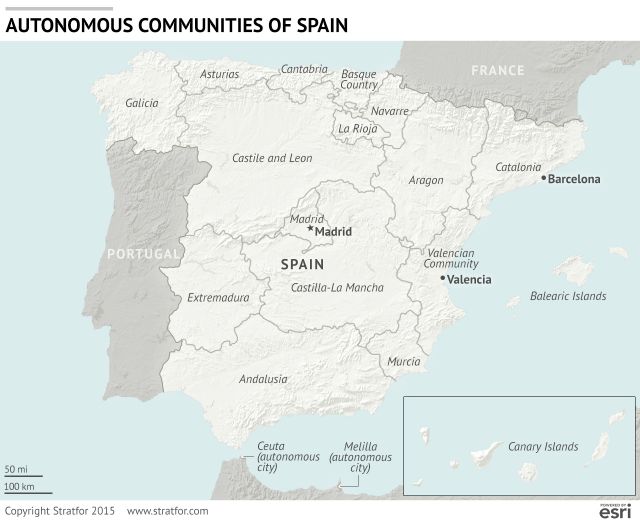
Economic Crisis in Catalonia
As in the rest of the country, Spain's economic crisis has weakened the region's ruling party; Convergence and Union has lost ground to the opposition Republican Left. But at the same time, the economic crisis has reignited Catalonia's secessionist claims.
A large number of Catalans disapprove of Madrid's centralized control of the country, especially its tax policy. The region is home to one-fifth of Spain's population, but it contributes a quarter of the country's gross domestic product. Many Catalan voters believe they contribute more in taxes than they get in return. They are tired of supporting poorer regions, and now they are seeking secession. An emerging left and growing popular demands for independence forced Convergence and Union to move closer to the Republican Left and to shift its rhetoric to support the pursuit of Catalan secession. However, the party's change of direction did not prevent it from losing votes in the 2012 regional elections.
Convergence and Union's coexistence with the Republican Left was never an easy one; some party members favor negotiations with Madrid while the Republican Left tends to support a unilateral declaration of independence. The Catalan government held a non-binding independence referendum in November, and the region will hold early regional elections Sept. 27. Catalonia's pro-independence parties agreed to use the elections as a starting point for a declaration of independence, though they are still debating the mechanisms and the timetable for creating the Catalan republic.
Newcomers Disrupt Old Plans
Over the past four years, Catalonia's political debate has centered on the issue of independence. Convergence and Union and the Republican Left attracted support from most of the people upset with the national government.
But the emergence of Ciudadanos and Podemos disrupted Catalonia's political landscape. According to a March opinion poll, support for Convergence and Union is at around 20 percent, considerably below the 30.4 percent of the vote it received in the 2012 regional elections and far from the 38.4 percent it received in the 2010 regional elections. The party's popularity has also suffered from a corruption scandal involving former Catalan President Jordi Pujol. Similarly, the Republican Left's support sits at around 17 percent, which is above the 13.6 percent it received in the 2012 regional elections but still not enough to lead a government. The support for Ciudadanos, however, has grown from 7.5 percent in the last elections to almost 18 percent. Podemos, which did not exist in 2012, holds around 10 percent of public support.
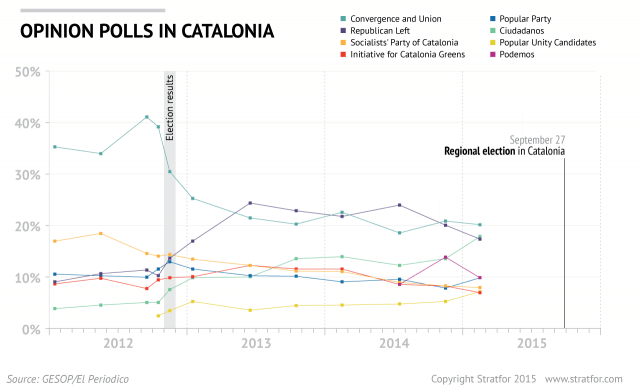
This landscape could have serious consequences for the Catalan government's push for independence. If the pro-independence parties only secure the 58-60 Catalan Parliament seats they are projected to win, they will fall short of the 68 required to have a majority. Additionally, Ciudadanos and Podemos oppose Catalan independence. The parties base their platforms on the criticism of Spain's traditional political elite and austerity measures on Spanish citizens, not independence.
Furthermore, Catalonia's Center for Opinion Studies released a report in March showing that public support for independence is stagnating, and opposition is growing. Some 44.1 percent of Catalans support independence, almost the same figure as in December (44.5 percent). Meanwhile, 48 percent oppose independence, up from the previous poll (45.3 percent). These sentiments coincide with the drop in popularity of the pro-independence parties.
Now the parties are tearing into each other. In a recent interview, Podemos leader Pablo Iglesias compared Convergence and Union to Spain's ruling Popular Party, suggesting that both support spending cuts and tax hikes. In early April, Catalan President Artur Mas characterized Podemos as an "obstacle" to the independence process and accused the party of advancing the interests of the national government.
Catalonia's independence movement was already suffering from Madrid's strong opposition and divisions in the secessionist camp. But now, protest votes are migrating from pro-independence parties to anti-establishment parties. It will create another challenge for the movement, reducing the likelihood that Catalonia will declare independence.
