
On March 9, Spanish newspaper El Pais released the results of Metroscopia's latest election poll. It revealed that, for the first time since the death of fascist leader Gen. Francisco Franco in 1975, four parties will closely contest the general elections, with Podemos currently running ahead of the others by a slim margin.
Podemos' rise has been dramatic. Since launching in January 2014 at a rundown theater in Madrid, the party has grown with inordinate speed. It has moved beyond its roots in the anti-austerity Indignados movement, which gave birth to the occupy movements that went on to inspire similar campaigns around the world. Pablo Iglesias, the party's founder and leader, has been the face and driving force behind the group, regularly appearing on television shows and delivering speeches. His message has been one of frustration with the status quo, and it has proved deeply attractive to a populace still suffering from an unemployment rate of 24 percent. He has derided the establishment politicians of the PP and PSOE as members of the corrupt "elite caste" while characterizing Podemos as the party of the people.
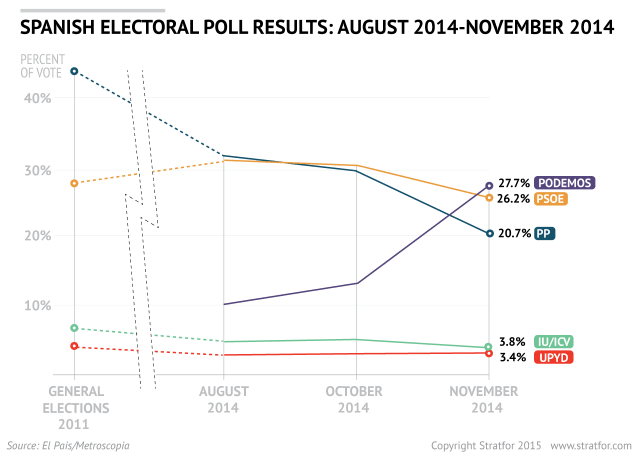
Playing to Podemos' advantage has been the traditional parties' inability to avoid damaging political scandals. Since 2013, the ruling PP has labored under the dark cloud of the corruption scandal involving its former treasurer, Luis Barcenas. Two more scandals emerged in October 2014, one involving credit cards in which members of both the PP and PSOE were implicated, and later a corruption scandal that saw 51 senior officials arrested, including six mayors and several senior PP party members. Prime Minister Mariano Rajoy apologized to the Spanish people, but Podemos' popularity jumped sharply, from 13.8 percent of support to first place with 27.7 percent in just one month.
Life at the Top
Podemos spent the next few months consolidating its position. By keeping its message somewhat vague, the party managed to draw supporters from both establishment parties. Instead of placing itself on the traditional left-right axis, Podemos has framed issues in a top vs. bottom struggle, even though its roots and links are clearly on the left. Podemos has also avoided taking a strong line on nationalism, which is always a sensitive subject in Spain. This looseness of policy and promise of change has been an effective technique for attracting disaffected votes from both the PP and PSOE.
Meanwhile, Iglesias has been deepening the party's ties with the Syriza party in Greece. He spoke at a Jan. 22 rally in Athens just days before Syriza won the parliamentary elections, one of several instances in which Iglesias and Syriza leader Alexis Tsipras have publicly supported each other. The two leaders share many political similarities and messages. The anti-austerity message that brought Iglesias to prominence in Spain was the same platform that won Tsipras the Greek election, and both leaders have raised the prospect of renegotiating their countries' debt with their European creditors. They have also been linked to a Chavista-style political outlook. In fact, Venezuelan President Nicolas Maduro recently joked that if he were to run for prime minister of Spain, he would stand a good chance, considering how much the Spanish press writes about him.
Pride Before a Fall
Coming into January, Podemos appeared well positioned for the December parliamentary elections. The party was polling strongly as the PP floundered and the PSOE watched its support drop month by month, and its members celebrated publicly as their Greek counterparts took power. In the past six weeks, however, the party's fortunes have turned. Two unexpected developments emerged, each with the potential to deal serious blows to Podemos' plans, while the party's proximity to Greece is beginning to look like a fatal miscalculation.
The first major blow occurred when Podemos became embroiled in a corruption scandal of its own. One of its founding members came under suspicion of tax fraud over funds he received for doing consulting work in some of the so-called Bolivarian Republics of Latin America, namely Ecuador, Bolivia, Venezuela and Nicaragua. Because such a large part of Podemos' rhetoric is based around cleaning out the greed and corruption of the existing political class, such a scandal within its own ranks undermines the platform upon which it stands.
A New Challenger Enters
The second major development came when February's poll results revealed the arrival of a new challenger on the political scene, a Catalan party named Ciudadanos.
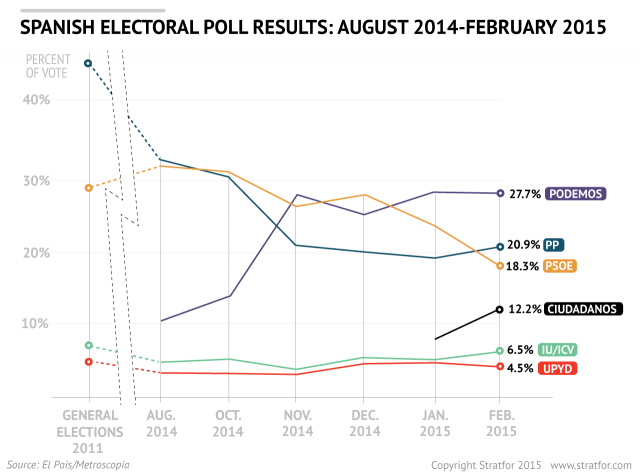
Formed in 2006 as a regional anti-independence party in Catalonia, Ciudadanos has gradually improved its performance in regional elections. Still, the party surprised many when it polled at 12.2 percent in January, just one month after it announced that it would run in the national elections. Like Podemos, the party campaigns on the notion that Spain's main problems are inequality, poverty and social exclusion. In addition, Ciudadanos has enlisted the help of a well-known and respected economist who has drafted some clear economic policies that are considerably less radical than those put forward by Podemos, helping Ciudadanos to attract the more moderate voters.
More important, from a broad perspective, Ciudadanos has a newcomer's attitude toward Europe. It is considerably less confrontational than Syriza and Podemos because it advocates structural reforms across Southern Europe. The party's anti-separatist identity is also putting pressure on Podemos to take a stronger position on the issue, something that could alienate some of its more nationalist voters.
In essence, though the two parties have somewhat differing ideologies, Ciudadanos and Podemos are in direct competition. Podemos will have to grapple on equal terms instead of Podemos punching upward against the establishment as it has in the past. In fact, in some respects, it appears Podemos' new adversary may outmatch it.
Meanwhile, developments in Greece suggest that Iglesias may have made a political miscalculation when he linked his party so closely to Syriza. February's debt negotiations revealed European lenders' deep resolve to deny the radical Greeks a single inch of leeway. Greece proved unable to obtain any significant concessions, and the two sides ultimately agreed on a four-month extension that only postponed the main confrontation until June. The Spanish electorate will be watching these negotiations, and if Syriza has to make a humiliating compromise or exit the eurozone, voters will not be pleased. They would surely trace the link back to Podemos, eroding its support in advance of Spain's elections.
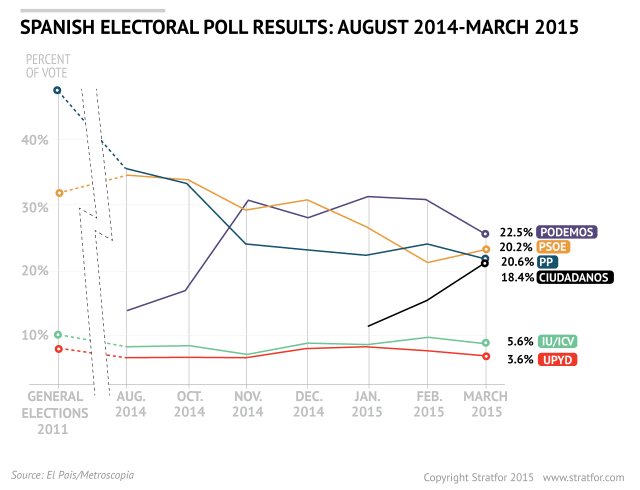
In light of the obstacles Podemos has run into, it should come as no surprise that the party's support has dropped from 22.7 percent to 22.5 percent. At the same time, Ciudadanos' rise from 12.2 percent to 18.4 percent makes sense. Now, only four percentage points separate Spain's four major parties.
A Look Ahead
Until Ciudadanos emerged in February, it appeared the December election would be a three-way struggle in which the PP or Podemos would court the fading PSOE as a coalition partner. Now Ciudadanos threatens to change the dynamic by potentially entering a coalition with the PP or PSOE.
While Podemos enjoyed its seemingly unstoppable rise in popularity, there was a distinct possibility it could win control of Spain's parliament and guide the country toward a Greek-style confrontation with its European lenders over its debt, only one with higher stakes because of Spain's larger economy. But Podemos' developing weaknesses and the rise of Ciudadanos have made that possibility more remote. While the prevailing current of Europe is still ultimately moving toward fragmentation, for the time being, Spain will continue to struggle against it.
