
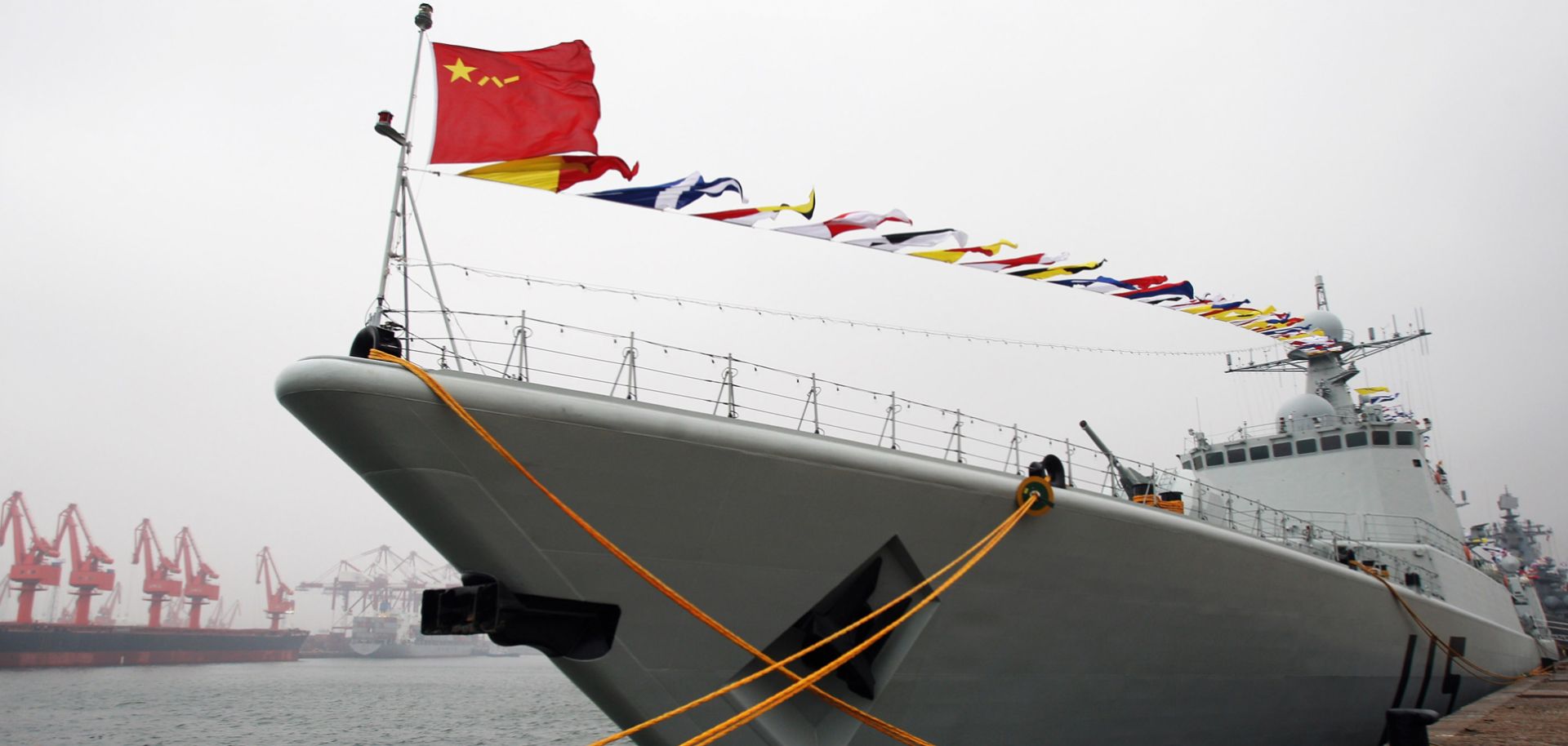
QINGDAO, CHINA - APRIL 20: Chinese Navy missile destroyer 115 Shenyang docks at Qingdao Port to attend an international fleet review to be held on April 23 to celebrate the 60th anniversary of the founding of the People's Liberation Army Navy on April 20, 2009, in Qingdao of Shandong Province, China. (Photo by Guang Niu/Getty Images)
As noted in part one of this series, China has had three core geopolitical imperatives for much of its history: maintaining internal unity in the Han Chinese regions, maintaining control of the buffer regions, and protecting the coast from foreign encroachment. To these can be added a fourth imperative, predicated on China’s shift from an agricultural to an industrial economy: securing sea-lane approaches to the Chinese mainland and maritime routes of resource acquisition. It is this fourth imperative that has prompted the modernization and reform of the People’s Liberation Army to include a naval expeditionary focus.
But such a focus will put China on a collision course with other emerging or established maritime powers. China’s supply lines are, for the most part, identical to Japan’s supply lines and run through India’s maritime domain. Chinese naval expansion also runs square in the face of a key U.S. imperative — preventing any major regional or international naval power from developing and thus challenging U.S. domination of the seas.
India’s Imperatives
India, China’s neighbor across the Himalayas, is nearly as populous as China but covers a much smaller land mass. While the Indian culture and population have spread throughout history, the subcontinent itself has been fairly isolated by geography, surrounded as it is by the jungles and mountains of Myanmar to the east, the Himalayas and Tibetan Plateau to the north and the deserts of western Pakistan and Afghanistan to the west. The geopolitical imperatives of India have evolved within this "island," though not all have been achieved:
- Achieve suzerainty in the Ganges River basin.
- Expand nominal control from the core of the subcontinent to the natural geographical barriers.
- Expand control past the Ganges River basin to the Indus River basin.
- Expand power into the Indian Ocean basin to deter foreign penetration.
India has not yet achieved its third imperative and thus remains in a constant struggle with neighboring Pakistan, where Indian security focuses most of its attention. This has not, however, prevented India from moving on to the early stages of achieving its fourth imperative — developing a navy capable of exerting nominal control over the Indian Ocean basin.
New Delhi has alternately relied on Moscow and Washington to assist in this development, when it isn't trying to develop technologies and training doctrine on its own. Russia poses little threat to Indian naval expansion and has even encouraged it, so long as New Delhi remained close to Moscow. Russia can offer equipment that is far beyond the reach of indigenous Indian development, but it is the United States, which has dominated the Indian Ocean for decades, that India must turn to either as a competitor or as a partner in extending its maritime influence.
Beijing’s push into the Indian Ocean has left New Delhi worried about a Chinese strategy of encirclement. China has close relations and/or port and tracking facilities in Myanmar, Bangladesh, Sri Lanka and Pakistan — all India’s neighbors and, in Pakistan’s case, a direct competitor. While Beijing’s move may have more to do with preventing interdiction of its long, vulnerable supply lines that run from Africa and the Middle East through the Indian Ocean to the South China Sea, even moves intended for defense can be interpreted (or used) for other purposes.
The Indian navy sees its own necessary sphere of operations pushing out from the Indian Ocean and Bay of Bengal to the Persian Gulf and east coast of Africa, and west through the Strait of Malacca to the western coast of Australia. Like China, India has a strategic vision based on a combination of potentially vulnerable trade routes and the need to protect the country from seaborne threats.
In many ways, Indian naval development remains in its nascent stage. But a perceived Chinese maritime encirclement of India has spurred a surge in Indian naval investment and driven New Delhi closer to Washington as a strategic naval partner. This, in turn, can be seen by Beijing as a growing threat to its own maritime security, which could accelerate a regional maritime arms race.
Japan’s Imperatives
Like China, Japan is a resource-dependent industrialized nation. As an island, however, Japan is more dependent upon resources from overseas than China is and has been for a longer period of time. As a result, Japan is a much more developed naval power, one that was able to strike a serious blow to the U.S. Pacific Fleet at the onset of World War II.
Like any country, Japan has strategic imperatives shaped in large part by its geography. Japan is a collection of relatively resource-poor islands lying off an Asian landmass rich in space and resources. The Japanese imperatives start at the center and move outward, like the layers of an onion.
- Keep the home islands under the control of a central government and unified military. Maintain control of the seas around the Japanese islands.
- Become the dominant influence in the land masses abutting the territorial seas, namely the southern portion of far eastern Russia and the Chinese coastline, at least as far south as Shanghai.
- Be the dominant maritime power in the Northwest Pacific, south to Formosa/Taiwan and southeast to Iwo Jima.
- Secure control of access to mineral resources in mainland China/Southeast Asia (and later to the Middle East as resource routes expand).
Even before Japan’s consolidation in the 16th century, the Japanese islands were known regionally as a center of trade and pirate activity, with pirates staging raids along the Korean and Chinese coastlines and down into the South China Sea. At the end of the 15th century, Japanese forces, under the leadership of Toyotomi Hideyoshi, led a massive naval and amphibious assault on Korea, with the intent of moving through to Ming China.
Initially, the invasion demonstrated the strength of Japanese naval power, but its end showed the major weakness of a maritime invasion of mainland Asia — the Japanese were outnumbered by the continental Asians. When the Koreans cut the Japanese maritime supply lines, the invasion collapsed.
Two and a half centuries later, an insular Japan was forced open by the gunboat diplomacy of the imperial powers, including the United States. In response, Japan underwent a rapid shift in its own military evolution, embracing maritime power as the way to defend its interests and expand its influence. By the 1930s, Japan’s growing need for resources led to the invasion of China and the military drive into Southeast Asia. Once again, Japan found it difficult to conquer mainland Asia; the population was just too large for the Japanese to overcome. At the same time, Japan’s expansion into Southeast Asia created the need to control the waters along the vital supply lines, placing Japan squarely on a confrontational course with the United States. The outcome was World War II’s Pacific War, which resulted in a U.S. victory and the loss of all of Japan’s strategic interests, including sovereignty of the home islands.
After World War II, as the Cold War intensified, Washington saw a need for a strong ally in Japan as a way to contain the spread of Communism and Soviet power. Japanese strategic needs were met in a new manner — Washington provided maritime security while Tokyo dealt with domestic issues and focused on economic expansion.
Decades later, Japan transitioned from being a vanquished foe of the United States to being a major economic competitor, underwritten by U.S. naval power. Rising competition, the end of the Cold War and the reduction of U.S. willingness to underwrite the Japanese economy led Tokyo to begin reassessing its own military capabilities, particularly its Japan Maritime Self-Defense Force (JMSDF). Japan would embark upon a revitalization of its own navy and prepare to take more responsibility for its own maritime security. This inevitably will involve a Japanese challenge to China in the East China Sea over territory and undersea resources.
Because Japanese supply routes, particularly for access to Middle Eastern energy sources, are virtually the same as Chinese routes, Japan sees China’s maritime defense moves as a potential threat. This is an untenable situation for Tokyo, and Chinese action and Japanese reaction are feeding a regional maritime arms race. Tokyo is re-engaging Southeast Asian nations, reviving ties left dormant when Japan’s economic malaise in the 1990s slashed Japanese development assistance money that had been going to the region. Japan also is looking to enhance ties with India and Mongolia — part of a strategy to refocus China’s security concerns and perhaps redirect Chinese investments.
Even more important, Japan already has what many consider the second-best navy in the world. The JMSDF is well-funded, developing rapidly and fields some of the latest in modern naval hardware. In this competition, as in the competition with the U.S. Navy, the People’s Liberation Army Navy is at a profound disadvantage.
U.S. Imperatives
In their naval expansion, China, India and Japan all must deal with the reality of the world’s dominant maritime power: the United States. In many ways, U.S. naval expansion beginning in the late 1700s also was an expression of defense, but the degree of expansion over almost two centuries created room for offensive, or "pre-emptive" defense around the globe.
A Chinese navy that is aggressively expanding, no matter the reason, poses a potential challenge to the fundamental U.S. interest of maintaining control of the seas. The strategic imperatives of the United States are rooted both in the relative isolation of the country and in its contact with both the Atlantic and Pacific oceans.
- Dominate North America through expanding colonization, conquest and concessions.
- Allow no power to emerge in the Western Hemisphere to challenge U.S. domination of North America.
- Control the waters of the Western Hemisphere to prevent the approach of foreign military power.
- Dominate the world’s oceans to protect global trade and ensure that no power can build a navy to challenge the United States.
- Ensure that no single continental power arises on the Eurasian landmass capable of challenging the United States.
The expansion of the young United States from a colonial holding of Great Britain to a continental nation to the world’s sole superpower attests to its focused, if not always overt, efforts to fulfill and maintain these imperatives. Control of the world’s oceans remains a major goal of the United States because it provides the ability not only to protect trade, but also, essentially, to attack any country anywhere while preventing any country from attacking the continental United States.
U.S. dominance of the seas is thus a core imperative of U.S. strategic defense, and emerging challengers are either confronted or redirected. World War II saw the clash of the two emerging naval powers in the Pacific — the United States and Japan. Neither could allow the other to become dominant; Japan needed to expand its empire in order to preserve the security of its natural resources, and the United States could not allow Japan to interdict emerging trade routes in the Pacific or threaten the U.S. Pacific coastline. This clash of strategic imperatives drove the two economic partners to a military confrontation at sea, whether they wanted one or not.
After World War II, the United States dealt with the potential emergence of the Soviet Union as a sea power by encircling it through a series of alliances, redirecting Soviet technology and priorities to a land-based defense. The United States also has employed this strategy in space, another potential battlespace where Washington must ensure that it can strike any country anywhere while preventing any country from attacking the United States.
At least for the next 100 years, whether on the sea, under the sea or in space, when an emerging power begins to push out more aggressively, it will meet resistance from the United States. Chinese naval developments have definitely drawn the attention of the U.S. military, and confrontations and accidents have already occurred as the United States has asserted its claimed right to operate off the Chinese coast for whatever purpose.
Beijing will find U.S. resistance not only at sea. Its flirtations in space have drawn serious U.S. responses, and Washington still holds the strategic card of alliance encirclement, which in this case would link Japan, Australia, India and a few key Southeast Asian nations in the effort. Perhaps more troubling for China is the potential for the United States, or possibly even India or Japan, to stir up unrest in China’s buffer regions, such as Tibet or Xinjiang.
Strategy of Distraction
Despite the risks, China now considers it necessary to become a naval power, and it has made dramatic progress in doing so. Its interests have become too global for it to focus inward and rely mainly on land-based defense. This recognized imperative, along with China’s unwillingness or inability to align with a powerful ally to help guard its interests, is already raising the potential for a maritime arms race in East, Southeast and South Asia, drawing in not only Japan and India, but also South Korea, Malaysia and other Southeast Asian states. The biggest challenge, of course, will come from the United States.
If history is any guide, Washington will work with other countries in the region to enclose China’s maritime expansion within the first island chain, from Japan to the Strait of Malacca. And a U.S. strategy of containment may not be limited to maritime activity. As the United States demonstrated in dealing with the Soviets, causing trouble for China along its land periphery could be a useful tool — and China has many internal problems that could be exacerbated by foreign pressure. While China has no choice but to look to the sea, its strategic focus could be forced to turn inward again, as it has been for virtually all of its history.
