
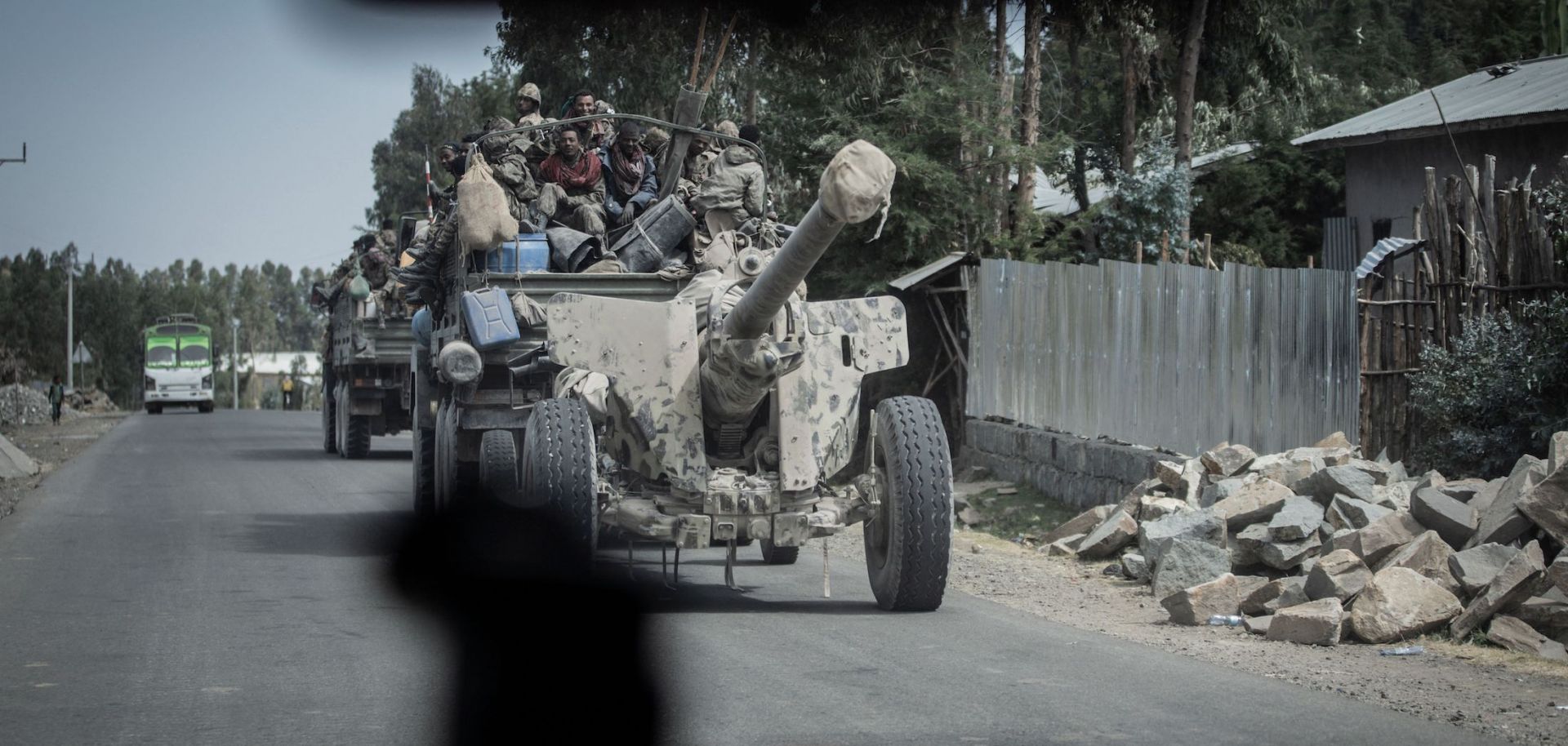
Ethiopian military forces transport a Saeer KS-19 automatic 100 mm anti-aircraft gun Dec. 5, 2021, in Shewa Robit, Ethiopia.
Disarmament by Tigrayan rebels markedly improves the likelihood that the peace framework in Ethiopia will hold, which would facilitate greater humanitarian aid flows, increased regional access to services and the eventual return of foreign investment. Tigray Peoples' Liberation Front combatants began handing over heavy weaponry to the Ethiopian military as part of its disarmament and demobilization process Jan. 10. A monitoring team including members of the TPLF, Ethiopian armed forces and the Intergovernmental Authority on Development oversaw the handoff in Agula, about 18 miles (about 30 kilometers) northeast of Mekelle, Tigray's regional capital. The military equipment included tanks, armored vehicles, heavy mortars, guns, anti-tank guns, Ural trucks and rocket-loaded cars.
- The civil war in Tigray broke out in November 2020 when Ethiopian Prime Minister Abiy Ahmed ordered a military offensive against the TPLF in response to a TPLF attack on a military base. Tigray and the Ethiopian central government were at odds for years preceding the attack as the government pursued the centralization of power and the TPLF demanded greater regional autonomy.
- Representatives from the Ethiopian military and the TPLF began formal peace talks Oct. 25, 2022, in Pretoria, South Africa, agreeing Nov. 2 to a permanent cessation of hostilities. Negotiators agreed Nov. 12 on a peace framework that would include the disarmament, demobilization and reintegration of TPLF combatants and the withdrawal of foreign troops.
TPLF disarmament improves the chances that the peace framework will hold between Tigrayan rebels and the Ethiopian military and lead to improved security in Tigray. TPLF combatants' willingness to hand over heavy weaponry to the Ethiopian military indicates that elite-level commitments are being implemented and adhered to on the local level, a marked improvement since the November cessation of hostilities. Disarmament will enhance trust between the Ethiopian armed forces and the TPLF, as the TPLF has so far shown a willingness to begin disarmament without full Eritrean withdrawal from Tigray, which presented a barrier to negotiations at other points during the conflict. If the peace framework holds, Tigray will likely continue to experience a return of services and exchange, including greater humanitarian aid flows, improved access to banking and telecommunications, and greater frequency of flights between Addis Ababa and Mekelle. A sustained peace will also help facilitate a return of foreign investment to Ethiopia, which is increasingly suffering from reduced foreign exchange and a mounting debt burden.
Despite this progress, Eritrean forces and local militias still pose destabilization risks for Ethiopia. The deal signed Nov. 12, known as the Executive Declaration on the Modalities for the Implementation of the Pretoria agreement, provided that TPLF disarmament of heavy weapons will be done concurrently with the withdrawal of foreign forces in the region. Eritrean troop withdrawals from several major Tigrayan towns, including Adwa, Axum and Shire, in late December appear to have precipitated the TPLF's willingness to begin disarmament, but Eritrean troops have intermittently engaged in fighting in other parts of the Tigray. In a further complication, the TPLF views militias of the Amhara ethnic group as foreign forces despite their origins in the neighboring Amhara region, and the two sides reportedly continue to clash. Eritrea's continued presence in Tigray, fights between TPLF and Amhara militias, an ongoing conflict in the still-restive Oromia region of Ethiopia and a long-standing territorial dispute with Amharas over western Tigray will still pose risks to the longevity of the peace deal. Despite recent progress, parties excluded from peace negotiations, including the Eritrean military, Amhara militia members and the Oromo Liberation Army, may attempt to derail the process for their own reasons.
- Like the TPLF, The Oromo Liberation Army has a long history of conflict with ethnic Amharas, which led the two rebel groups to join forces in the Tigray fight. The TPLF's peace deal with the government, however, has no bearing on the ongoing conflict in Oromia and may lead to increased violence in the region as the Ethiopian military — no longer preoccupied with fighting in Tigray — can devote additional forces to the Oromia conflict.
- Fano, an Amhara militia in conflict with the TPLF for decades that fought with the Ethiopian military during the war, could attempt to disrupt the peace deal over outstanding issues like overlapping territorial claims in western Tigray.
- Eritrean President Isaias Afwerki has repeatedly condemned the TPLF as an existential threat to his country and called for its extermination. While Eritrea appears to be gradually backing down, it could still return to violence against Tigrayan forces and civilians.
