
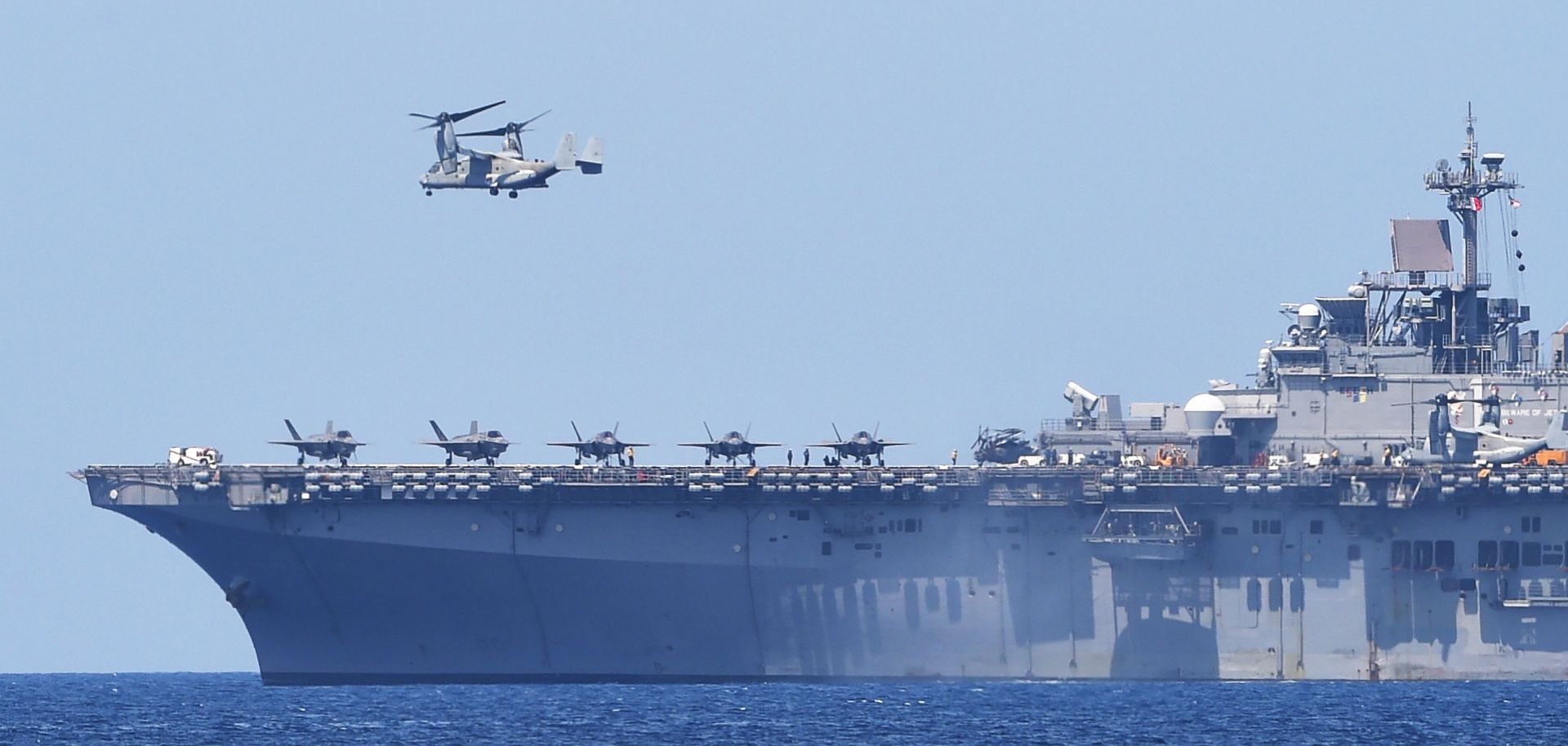
A helicopter takes off from a U.S. Navy ship during joint military exercises with the Philippines in waters facing the South China Sea on April 11, 2019.
The Philippines’ clarification of when maritime confrontations with China would trigger its defense pact with the United States reflect Manila’s bolder efforts to regain initiative in the South China Sea. In an interview with CNN Philippines over the weekend, the chief of the Armed Forces of the Philippines, Lt. Gen. Andres Centino, clarified Manila’s stance on the invocation of its Mutual Defense Treaty (MDT) with the United States, which pledges U.S. assistance if the Philippines comes under attack, following China’s Nov. 16 use of water cannons against Philippine supply ships. Specifically, Centino said that “the act of using the water cannon against our vessel [was] not considered an armed attack,” though it could be seen as “a hostile act.” Hostile acts do not trigger the MDT, which only pledges U.S. assistance if the Philippines comes under an armed attack. Centino’s clarification thus temporarily eases concerns that future clashes could draw the United States into more direct confrontations with China in the South China Sea. But his comments also send a warning to Beijing that escalation beyond water cannons could prompt Manila to call for U.S. support.
- In November, Chinese vessels used water cannons to block Philippine supply ships from reaching Ayungin Shoal (also known as the Second Thomas Shoal or Renai Jiao), a reef occupied by Philippine marines as part of its claim to disputed islets in the South China Sea.
- Manila’s initial response included both a protest to Beijing, as well as a commitment to continue with supply runs in the future escorted by the Philippine Coast Guard. Philippine Coast Guard Vice Admiral Oscar Endona, speaking at a Senate sub-committee meeting on Dec. 7, noted that coast guard vessels had their own water cannons and would use them in response to any similar acts by Chinese ships against resupply missions.
Moving forward, Manila’s policy toward its maritime claims will be more proactive. On Dec. 6, the Philippine House of Representatives also approved a Maritime Zones Act, a legal mechanism allowing Manila to build on the Baseline Act of 2009, define its claimed maritime territories, and set the legal framework for enforcement. The new act highlights Manila’s switch to a more activist approach instead of a more passive policy under outgoing President Rodrigo Duterte. This, along with the recent statements from the country’s top army and coast guard officials, clarifies the Philippine strategy to manage tensions around the Ayungin Shoal and other disputed areas. Manila is planning to step up the protection of its resupply efforts and match Chinese actions, which could push China to back down. But if Beijing instead decides to escalate beyond the use of water cannons, the Philippines has made it clear when they could escalate themselves by calling on the United States to intervene.
- The Maritime Zones Act is pending in the Philippine Senate. The final law is expected to be passed before the end of the current legislative session.
