
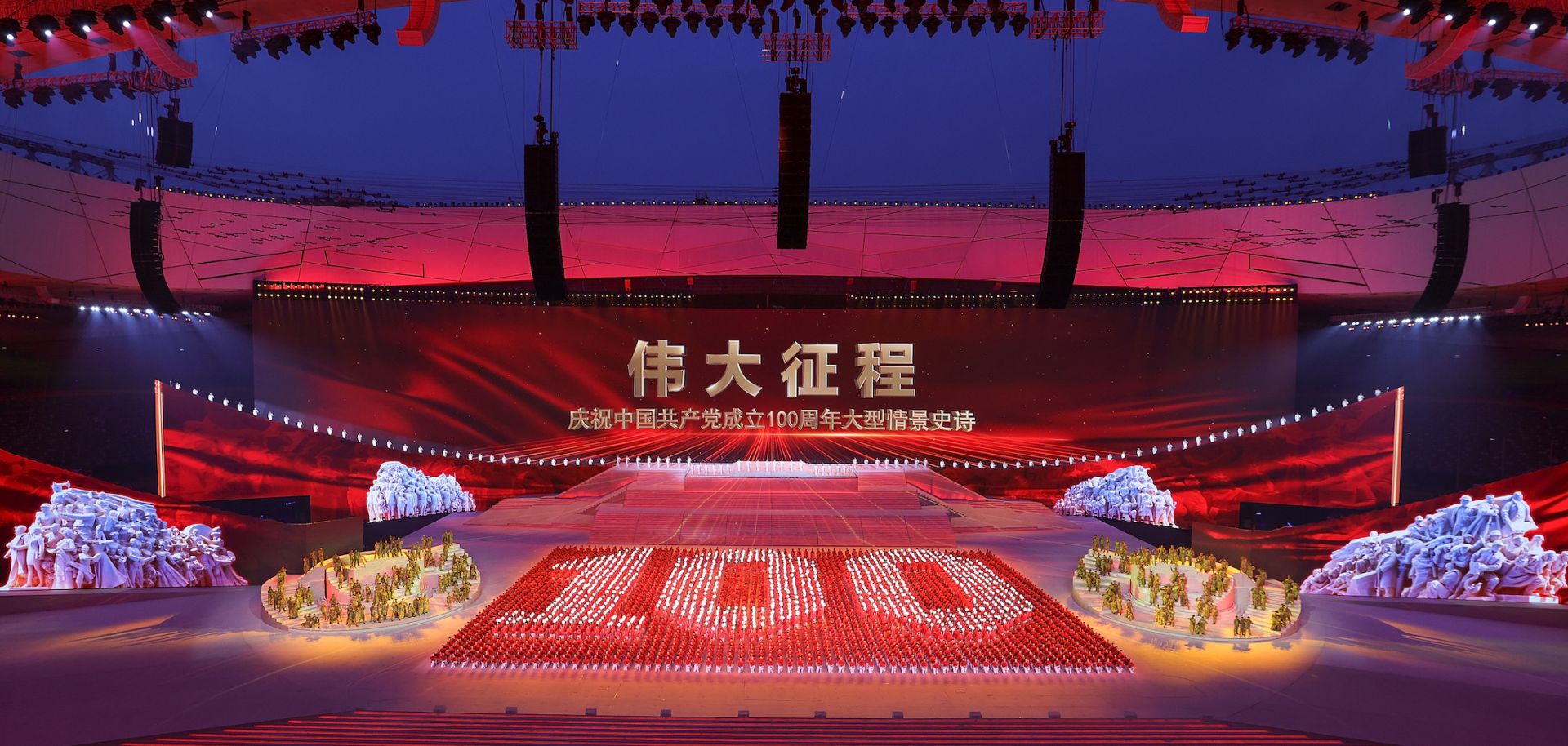
Actors perform in celebration of the 100th anniversary of the founding of the Communist Party of China on June 28, 2021, in Beijing.
The 100th anniversary of the founding of the Communist Party of China on July 1 will prompt the CCP to crack down on dissent, lash out at external critics, and stoke nationalism to levels that could threaten foreign business operations in and with China. President Xi Jinping and senior Party leadership will host a ceremony in Beijing's Tiananmen Square to celebrate 100 years of CCP achievements and, according to state news outlets, share the CCP's governing experiences with the world. These events will preface a politically sensitive time for China in the lead up to Xi’s third term as General Secretary of the CCP (and as president of China) — an unprecedented tenure since Mao Zedong's death in 1976 — set to begin in November 2022.
- Xi will give a major speech highlighting the leading role of ideology in China's history and in its current development path.
- The Party will publish a new history, emphasizing Xi's role as the CCP's irreplaceable core leader, downplaying troubled moments in China's past, and lauding 100 years of CCP accomplishments while upholding socialism as the only viable path for China's development.
- There will be no military parade, but leaders will urge the People's Liberation Army to have "absolute loyalty" to the CCP and assert Party leadership over all aspects of society.
- Key government agencies will host a seminar studying the "theoretical aspects" of Party ideology in order to reinforce the tenets of modern-day Chinese socialism with Xi as the guiding teacher.
The anniversary is, first and foremost, a chance for Xi to spin the narrative of his indispensability to China's present and future success by casting himself as both the pilot in China's new era of economic leadership and the leading defender of China's much-touted unique development model as an alternative to Western models. But Xi also has broader goals for the centenary, all of which serve to bolster the CCP's legitimacy and that will dictate Beijing's actions ahead of and following the celebrations.
- In the lead-up to his third term as President, Xi aims to further link his fate with that of China over the next 10 years by presenting his resume of policy successes and promoting ever-increasing Party unity (spurred on by Xi's anti-corruption and ideology campaigns) as a governing necessity for China's road to economic success and its escape from Western "containment." As part of this effort, Xi will push to reinvigorate his anti-corruption campaign, which has helped protect Xi from political rivals while alleviating societal anger against corruption, and reemphasize the central importance of ideology in China's governance as a means of enforcing societal and intra-Party support for his leadership.
- The celebration also gives the CCP a chance to reiterate recent governing successes, such as landing a rover on Mars and vaccinating 40% of its citizens against COVID-19 and the CCP's claim to have eliminated poverty in China. All of these will help justify the CCP's continued leadership in a technologically and economically ambitious China.
- Senior Party members will highlight China's global ideological leadership at the centenary by lauding the benefits of state leadership and political unity and putting forth China's development path as one that developing countries could emulate. In doing so, the CCP's message will serve to contrast China's path to that of the capitalist, liberal democracies of the West and give political cover to China's partnerships with authoritarian regimes in Iran, Russia, North Korea and Syria.
- Xi will also use the celebrations to bolster nationalism, particularly among young people, by encouraging Chinese people to support the CCP in the face of external challenges (namely, from the West), focusing on the importance of patriotic education in China's schools and positioning the CCP as the driving force behind China's innovation drive. These efforts are also intended to boost Party recruitment, which has lagged in recent years due to anti-corruption campaigns.
The centenary comes as China finds itself amid an uneven economic recovery and a hostile international environment heavily driven by a U.S.-led effort to counterbalance China's rise economically, militarily and ideologically. These headwinds give Xi and the CCP an opportunity to boost political legitimacy by highlighting China's economic and technological successes in the face of adversity. Though China was largely spared the spring 2021 COVID-19 wave that hit Asia, its economy — highly dependent on export revenues — is experiencing an uneven recovery undergirded by public investment and subject to localized industrial delays as micro-outbreaks of COVID-19 send cities into ironclad lockdowns. Moreover, the ongoing U.S.-China trade war and U.S.-led campaigns to investigate Chinese human rights abuses in Xinjiang and restrict Chinese technological exports on national security grounds are hindering exports in one of China's most underdeveloped regions and threatening Beijing's plans to build foreign markets for China's strategic emerging industries, including solar energy and semiconductors, respectively. In the security realm, China's continued consolidation of its strong position in the South China Sea and increasingly aggressive posture toward Taiwan have led regional neighbors like Japan to renew commitments to Indo-Pacific maritime security, making Beijing feel increasingly isolated militarily. Internally, Xi's anti-corruption campaign has pushed China's center-local power balance in Beijing’s favor, making the government's administrative duties evermore reliant on the decisions of Xi and his senior ministers and increasing the potential for miscalculation in economic policies as central planners struggle to serve China's diverse localities. In addition, China's demographic decline was highlighted by the 2020 census released in May, which showed birth rates dropping much faster than Beijing anticipated. This development added a sense of urgency to Beijing's plans to capitalize on the demographic dividend to move up the value chain, thus making political unity toward national development goals particularly important as China seeks to avoid the middle-income trap.
Beijing's focus on political unity and domestic nationalism in the wake of the CCP's centenary will prepare the Party for a number of upcoming events that, if successfully orchestrated, will bolster Xi's role at the core of the CPP. The close proximity of these events will make the 18 months following the centenary a particularly busy time in Chinese politics and a dynamic period for Chinese foreign policy. During this time, Beijing will aim to tamp down on domestic instability and boost industry buy-in for China's national development plans, particularly for cutting-edge tech companies. Meanwhile, Xi will spin China's successes as his own and China's failures as the mistakes of ineffective or insufficiently loyal Party officials. Despite these aims, lingering discontent in Hong Kong and private sector doubts about central planning will work against Beijing's plans for domestic unity. At the same time, growing international criticism (e.g., of Xinjiang human rights abuses) and the global economic drivers complicating China's recovery will limit the impact of Xi's political wins, while Xi's growing profile of responsibilities will increasingly check his ability to shift blame to local officials. Nonetheless, these difficulties over the next 18 months will not significantly hinder Xi's high chances of assuming a third term in November 2022 given the CCP's lack of potential successors to Xi and Xi's heavy influence over power brokers in the economic ministries, the military, and (most important) the Party's top decision-making bodies.
- October 2021: The Sixth Plenum of the 19th CCP Central Committee will meet to discuss social and cultural policies in China and rules governing the Party itself.
- December 2021: Hong Kong will hold its first legislative elections since the enactment of the National Security Law postponed the region's legislative future and Hong Kong senior officials, under Chief Executive Carrie Lam, passed rules mandating legislative loyalty to Beijing.
- February 2022: Beijing will host the Winter Olympics, a unique opportunity for China to boost its global image and ease international tensions surrounding China's rise.
- October 2022: The 20th National Congress of the CCP will very likely see Xi chosen for a third term as general secretary of the CCP, the most important leadership role in China and a natural precursor to his follow-up selection for a third term as president.
The period between now and the start of Xi's third term in 2022 will present a number of societal risks as the CCP attempts to build on and preserve any political legitimacy gains from July 1. These risks will exist regardless of how successfully the CCP leverages the centenary as Beijing ardently seeks to boost domestic stability and bring strategic emerging industries on board with CCP national development plans. Societal risks will be greater for Chinese citizens, but they could also impact foreign citizens and businesses operating in China as well as China's relationships with Western countries. Beijing will be increasingly sensitive to both domestic dissent (such as unrest in Hong Kong) and international criticism (such as on human rights in Xinjiang and Beijing's handling of COVID-19), lowering the threshold for retaliation against businesses operating in China that take stances on these issues. This is particularly true in light of China's recent Anti-Foreign Sanctions Law, and increases risks of arbitrary detention as a means of protecting national security, broadly defined. Within the Party, there will greater odds of dismissals of high-level officials — like Party secretaries and senior ministerial officers — as Beijing makes examples out of cadres who fail to implement national development goals as laid out in the 14th Five-Year Plan or who pose last-minute threats to Xi's power base ahead of his third term. In all domestic forums, Beijing will continue to lean on its "Western containment" narrative of foreign relations to prop up nationalism, which will increase the chance that grassroots nationalism will overflow into foreign company boycotts or small-scale maritime clashes with regional powers in the South China Sea.
