
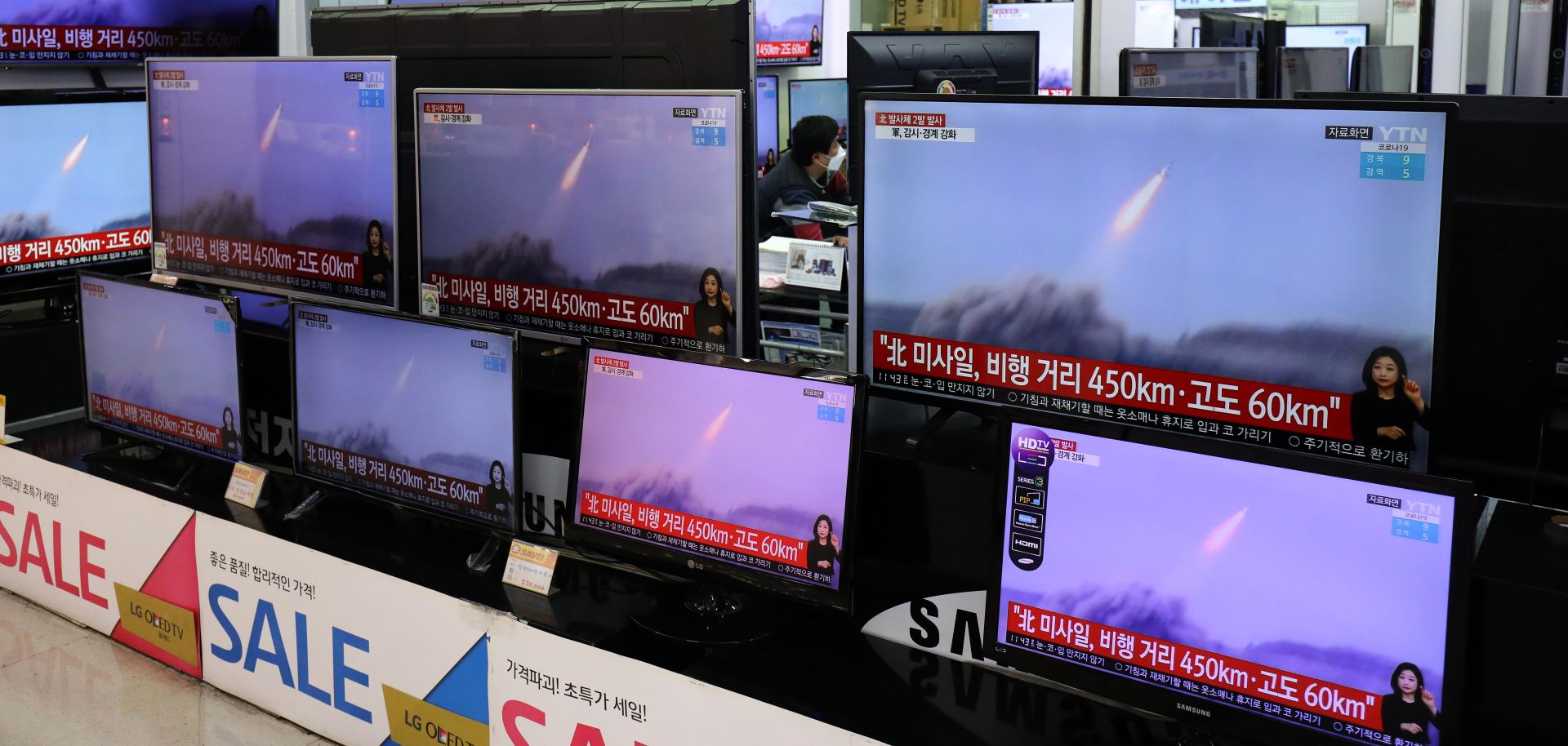
TV screens show the launch of North Korean missiles on March 25, 2021, in Seoul, South Korea.
North Korea’s first ballistic missile test since U.S. President Joe Biden took office suggests that Pyongyang will seek to advance the development of key weapons systems without jeopardizing the prospect for long-term U.S. outreach or unifying the international community around a harder-line stance against the regime. On March 25, South Korean officials confirmed that North Korea had tested two devices, likely short-range ballistic missiles, early that morning from the eastern town of Hamju. The devices were both launched around 450 kilometers (280 miles) eastward into the Sea of Japan at an altitude of roughly 60 kilometers (37 miles). If confirmed to be a short-range system, such a test does not represent an escalation from those that North Korea conducted during former U.S. President Donald Trump’s term. The testing of ballistic missiles also technically violates U.N. resolutions but does not violate promises made during the Trump administration to refrain from intercontinental ballistic missile (ICBM) tests.
- According to Japan’s Research Center for Advanced Science and Technology at Tokyo University, the system tested may have been the upgraded KN-23 missile (similar to the Russian Iskander). The KN-23 missile system debuted in North Korea’s January military parade featured a conical warhead and an accompanying five-axle transporter erector launcher. Such a system would primarily threaten South Korea, and suggests a continued focus by North Korea on developing battlefield weapons over testing strategic weapons.
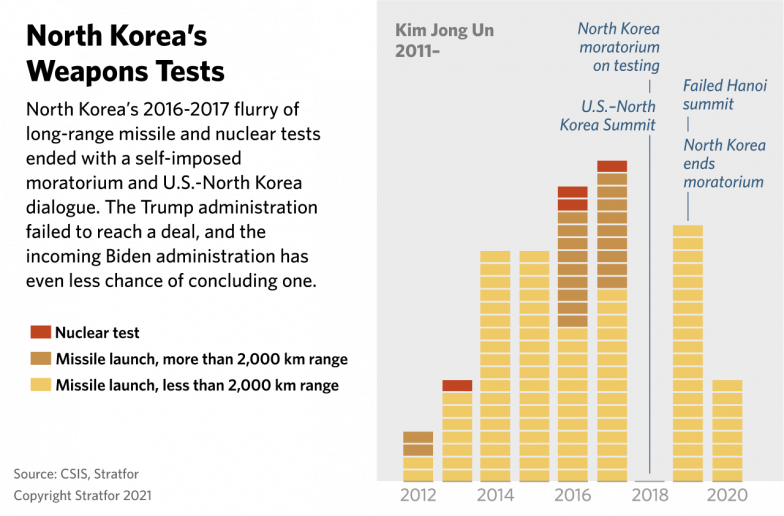
- This test follows March 21 suspected cruise missile tests, which not only marked the first North Korean weapons tests since Biden took office in January, but the regime’s first missile tests in a year. The lengthy hiatus of North Korean tests, which coincided with the COVID-19 pandemic, followed over two dozen launches of short- and medium-range ballistic missiles, as well as rockets in 2019-2020 following the breakdown of talks between Trump and North Korean leader Kim Jong-un in Hanoi. North Korea has not conducted a test of an ICBM or nuclear device since 2017 following a self-imposed moratorium on such tests amid U.S.-North Korea outreach. This is in spite of Kim saying at the start of 2020 that the country was no longer bound by this moratorium.
- A five-year initiative to bolster North Korea’s nuclear and missile programs was announced during the January 2021 North Korean Workers’ Party Congress. The initiative specifically calls for the development of tactical nuclear weapons and civilian nuclear power, and also emphasizes the near-completion of a new nuclear submarine. Shortly after the announcement, North Korea held a military parade featuring a new submarine-launched ballistic missile, the Pukguksong-5.
While it matches past North Korean military timelines, the timing of this latest missile test also presents a convenient opportunity to underscore Pyongyang’s continued threat to regional stability and nearby U.S. allies, as well as North Korea’s displeasure with the U.S. hard-line position on denuclearization.
- The timing of the test coincides with North Korea's military calendar, with the resumption of activity amid the spring training cycle. Major tests were likely delayed through much of 2020 and early 2021 amid COVID-19 disruptions.
- South Korea's National Intelligence Service said that the North Korean launch may have been timed to precede Biden's first press conference since his inauguration on March 25, guaranteeing that he will have to address North Korea publicly. In addition to Biden presser, this test comes in the wake of U.S.-South Korea command post military drills, which were widely condemned by North Korea, as well as the first-time extradition of a North Korean to the United States following a Malaysian court ruling.
The United States is unlikely to shift its approach towards North Korea based on this test alone since it does not represent a substantially escalated threat to U.S. forces deployed in the Asia Pacific. South Korea, with presidential elections in March 2022, may try to use the latest test to advocate for the United States to prioritize outreach to North Korea. However, given that the United States is increasingly focused on countering China as its peer competitor, North Korea will slip down the list of U.S. priorities as a peripheral but important challenge.
- Leaks indicate that the Biden administration will meet with Japanese and South Korean national security officials the week of March 29 to discuss the White House’s North Korea policies following the completion of an official review.
- North Korea will likely continue such tests at regular intervals as in past years. This may include a particular focus on South Korea to pressure Seoul to advocate with the United States. On March 23, South Korea said it is monitoring the deployment of rocket and other weapons systems on Changrin island along the inter-Korean maritime border.
