
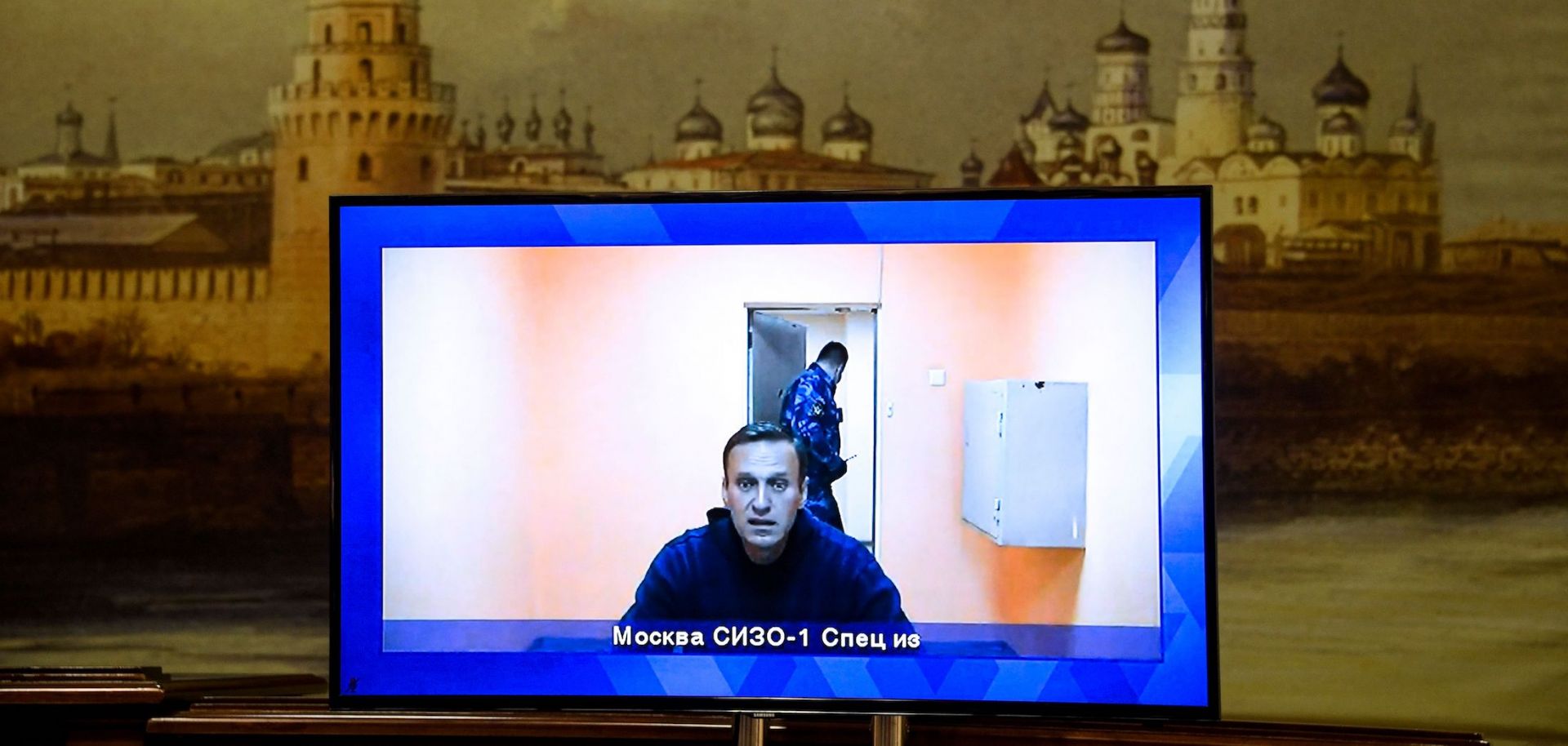
Russian opposition leader Alexei Navalny appears on a screen via a video link from Moscow's penal detention center during a court hearing of an appeal against his arrest in Krasnogorsk, Russia, on Jan. 28, 2021.
In response to the jailing of Russian opposition leader Alexei Navalny, the United States and Europe will struggle to find penalties that actually reverse the Kremlin’s behavior, thus keeping Russia’s relationship with the West at an impasse. On Feb. 2, a judge sentenced Navalny to 3.5 years in a corrective labor colony, minus time already served under house arrest, for a total of two years and eight months. The sentence comes after the judge agreed to the government’s request to convert Navalny’s suspended sentence for a 2014 fraud conviction into a prison term. For years, Navalny has been repeatedly detained for short periods, but until now, Russian authorities had avoided permanently imprisoning him.
- According to Russian authorities, Navalny broke the terms of his suspended sentence by failing to appear for scheduled check-ins. Navalny returned to Russia on Jan. 17 after spending five months in Germany, where he was medically evacuated following an alleged assassination attempt by Russian security services. He had argued that his convalescence prevented him from checking in, but prosecutors asserted that he had missed scheduled meetings in the years even before his alleged poisoning last August.
- Despite being detained upon returning to Moscow, Navalny has successfully instigated mass anti-government protests the past two weekends. His allies also recently released a viral video accusing Russian President Vladimir Putin of owning an opulent palace. These actions have put authorities on the defensive and probably increased their desire to imprison Navalny for a longer period of time than they would have otherwise sought. The sentencing also demonstrates the Kremlin’s resolve to curtail Navalny’s influence in advance of parliamentary elections scheduled for September.
- Navalny faces multiple charges in other cases, which he says are politically motivated. These charges also carry possible prison time that authorities could use to go after him in other ways. Europe’s top human rights court, to which Russia is a party, ruled in 2017 that Navalny’s 2014 conviction was “arbitrary and manifestly unreasonable.”
Navalny’s jailing will engender swift and strong public rebukes from Western states, even as they are likely to defer more concrete penalties. Numerous Western leaders admonished Russia for temporarily detaining Navalny upon his return to the country, ensuring similar, if not stronger, statements in response to his new sentence. Similarly, some countries have already called for new sanctions — including travel bans and asset freezes on individual Russians involved in the Navalny case, as well as broader penalties on Russian economic sectors. But Western leaders will probably delay considering these measures.
- The European Union is unlikely to consider a response until, at the earliest, the conclusion of EU foreign policy chief Josep Borrell’s meeting with Russian Foreign Minister Sergei Lavrov in Moscow on Feb. 5. More likely, the bloc will defer imposing any penalties until the end of March, when national leaders will convene for a high-level meeting that will address EU-Russia relations and offer the opportunity to expand or levy new sanctions, which requires unanimity among its member states.
- The United States may defer any major response until the completion of President Joe Biden’s recently requested intelligence assessments into various malign Russian actions, including Moscow’s alleged attempt to kill Navalny. White House officials have stated that they reserve the right to respond to suspected Russian involvement in the SolarWinds cyberattack at a time and in a manner of their choosing, which suggests the Biden administration might link a reaction to Navalny’s jailing to the Kremlin’s malfeasance in other areas.
Navalny’s imprisonment will expose the West’s limited options to fundamentally change the Kremlin’s strategic calculus, ensuring continued standoffs in multiple areas of disagreement and confrontation. Since Moscow’s invasion of Ukraine in 2014, among other actions, Western countries have imposed multiple rounds of sanctions on the Russian economy and Russian individuals, tried to isolate Russia diplomatically by removing it from what was then the Group of 8 (G-8), and placed troops in countries along Russia’s western border. These actions, however, have failed to meaningfully alter the Kremlin’s antagonistic behavior abroad or democratic suppression at home. In fact, many of the West’s more severe penalties have enabled Putin to portray Russia as under siege and in need of a strong leader to confront supposed Western belligerence. Ultimately, Western leaders have also been unwilling to sacrifice cooperation with Russia in other areas — such as the energy trade — over Moscow’s human rights record.
- Western countries are unlikely to impose country-wide economic sanctions akin to those the administration of former U.S. President Donald Trump levied on Iran’s oil exports, as causing significant harm to Russia would have major international economic repercussions that could backfire.
- The United States has considered trying to disconnect Russia from the Society for Worldwide Interbank Financial Telecommunication (SWIFT) network, which underpins global financial transactions. Russia, however, has reportedly developed an alternative that, while imperfect, would probably allow it to recover after a short-term collapse of its currency, the rouble. Ousting Russia from the SWIFT network would also harm Western companies with Russian operations and, in 2019, former Russian Prime Minister Dmitry Medvedev said such a move would amount to a declaration of war, making it less appealing for Western states seeking to avoid significant escalation.
- Several countries have pressured Germany to cancel the final stages of construction of its controversial gas pipeline with Russia, but the current government in Berlin remains committed to the project. Even if Germany’s election in September produces a new set of leaders who seek to do so, Russia would still have other routes to export its energy.
- The West’s most potent tool is probably Magnitsky legislation — named after a Russian whistleblower who died after being tortured in police custody in 2009 — which Canada, the European Union, the United Kingdom and the United States maintain. The legislation enables sanctions against individuals who have committed human rights violations or corruption, and have been subject to repeated complaints from targeted Russian officials and businessmen. However, the EU and U.K. versions encompass only human rights abuses, not corruption, which limits their effectiveness.
