
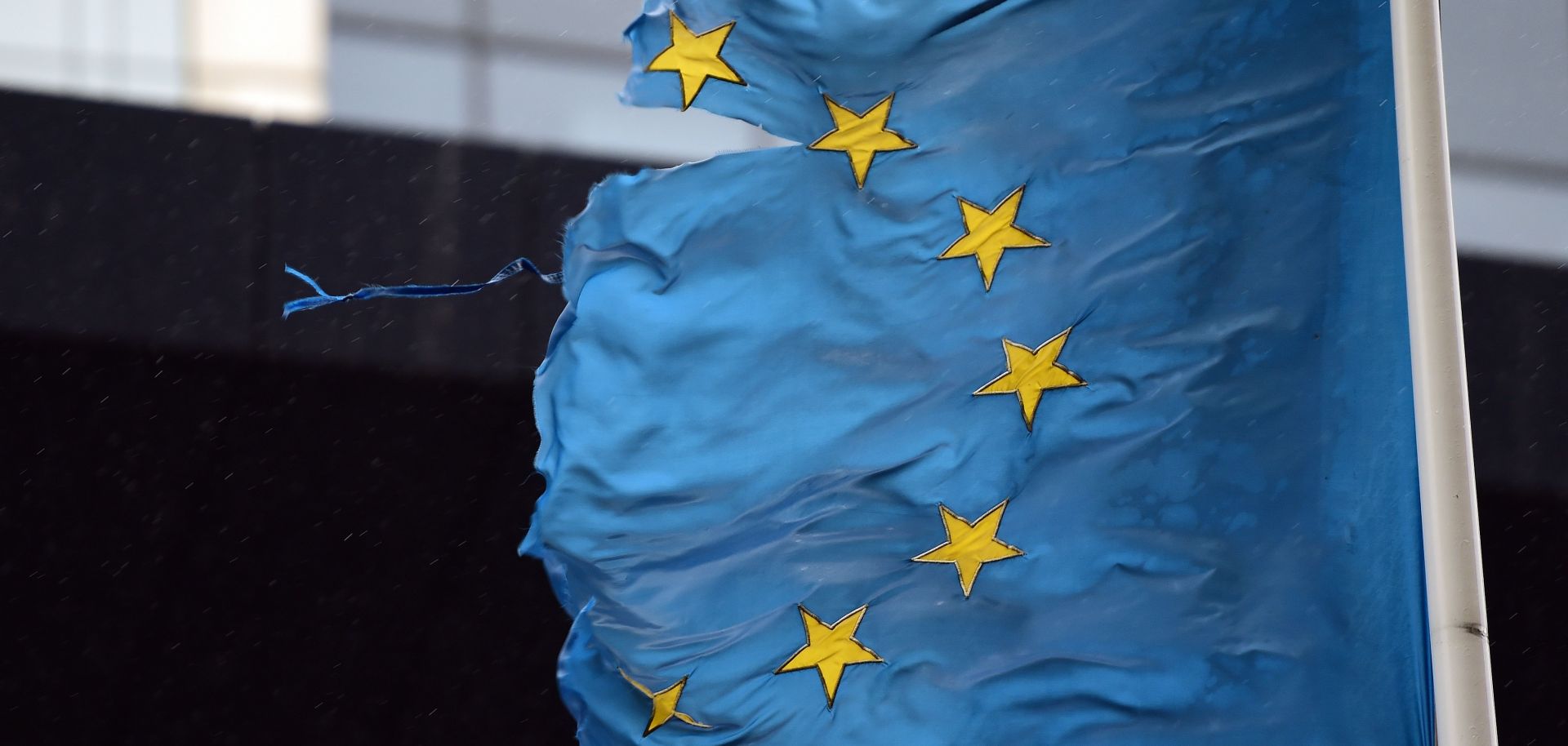
A shredded EU flag flutters in the wind on March 1, 2016, in Brussels, Belgium.
Recent disputes between Poland, Hungary and EU institutions have reignited questions about the future of both countries’ membership in the continental bloc. The evolution of these disputes is relevant for the future of the European Union because pervasive nationalist sentiments in Europe mean that the prospect of additional countries moving away from the idea of pan-European federalism and resorting to sovereignist positions is a real possibility. This would further weaken the European Union’s internal cohesion, make its decision-making process even more complex and reduce its geopolitical clout.
The Issue of Poland and Hungary
Since the mid-2010s the European Commission and several EU countries have criticized the governments of Poland and Hungary because of their increased control of the judiciary, their pressure on independent media and, more recently, their discrimination against the LGTBQ community. According to the critics, these policies are incompatible with the European Union’s values and rules and the principles of a democratic society. But Warsaw and Budapest argue that their decisions are necessary to fight against corruption in the judiciary, end misinformation campaigns by domestic and foreign actors, and protect their culture and identity. More importantly, they argue that as the democratically elected governments of sovereign states they have the right to implement whatever policies they see fit.
These disputes underscore a fundamental problem: the Polish and Hungarian governments see the European Union as a club of nation-states that share some common interests but are ultimately still independent. A recent ruling by Poland’s constitutional court establishing that the European Court of Justice is not superior to Poland’s constitutional order underscores this view. This radically contrasts with Brussels’ understanding of the European Union as a group of states that progressively give up their national sovereignty to become a federation governed by supranational institutions.
Brussels’ Credibility Problem
Poland and Hungary’s behavior creates risks for them because the European Court of Justice can impose financial sanctions on countries that fail to enforce its rulings. The European Commission can also suspend funding for countries that violate the bloc’s values. Warsaw and Budapest are net receivers of EU agricultural and structural funds, which means that they could lose billions of euros in EU money if their disputes with the bloc’s institutions continue. And if the disputes escalate further, the bloc has the nuclear option of suspending their voting rights in the European Council, where the most important policy decisions are made.
The problem is that many of these actions are not politically viable. Some of the more extreme sanctions against uncooperative member states require the unanimous support of the rest of the EU governments. Many countries, especially in Central and Eastern Europe, would oppose any attempts to significantly punish Poland and Hungary for fear that they could be next because of their own rule of law issues. Unfortunately for the European Union, Poland and Hungary are not the only member states where EU principles are not fully respected.
Even Germany, a country that cares deeply about the rule of law, would probably push to water down any painful sanctions against Poland and Hungary out of fear that a strict punishment could exacerbate the nationalist and illiberal tendencies in two countries that are within its sphere of influence. Poland and Hungary are in Germany’s backyard and are a part of its supply chain, which means that Berlin wants them to be as stable and as prosperous as possible. Many German politicians are terrified of the prospect of more authoritarian and poorer neighbors to their east.
There is also the risk of a more isolated Poland and Hungary seeking political, economic and security assistance from non-EU countries. Poland is unlikely to turn to Russia because of Moscow’s long history of aggression against the country, but China does not represent the same kind of red line. Hungary has already shown that it is interested in keeping good economic and political ties with Moscow and Beijing. Russia and China have neither the resources nor interest to fully replace the European Union as Poland and Hungary’s main sponsors, but isolation could bring Warsaw and Budapest close enough to them to make EU bureaucrats nervous. The fact that individual member states can veto EU decisions such as sanctions against China and Russia illustrates the disproportional leverage of national governments. This explains why Germany and others will push for dialogue over isolation when it comes to Poland and Hungary.
Perhaps the European Union’s greatest limitation is that it does not have the power to expel member states. According to EU rules, countries can leave the bloc only if they decide to do it themselves, as was the case with the United Kingdom after the Brexit referendum. Brussels can threaten and isolate member states to quite painful degrees, but that’s all it can do. This means that Poland and Hungary will only leave the European Union if they want to, which is unlikely given that the political and financial pressure both countries are facing is still far from the point that it’d force them to reassess the merits of EU membership. Warsaw and Budapest may critique the European Union, but the bloc still provides substantial political, economic and security benefits for them that they will not give up so easily.
A More Fragmented EU
The European Union will continue pushing Poland and Hungary to change course and may go as far as to delay the disbursement of funds, but is unlikely to impose real economic pain on them. Warsaw and Budapest will continue to implement their controversial policies, in part because the external pressure is modest and in part because they are popular at home. They will be willing to make superficial concessions to Brussels every now and then to keep the dispute within tolerable limits, but without a substantial change of direction.
The United States could play a role here since Hungary and, in particular, Poland both see the White House as their ultimate protector against foreign aggression. So far, however, Washington has shown little interest in internal EU disputes. As long as Europe’s NATO member states don’t get too cozy with the likes of China and Russia, the White House is unlikely to care too much about the future of European integration.
Change, if it comes, is more likely to emerge from within Poland and Hungary than from EU institutions. So far, unprecedented levels of prosperity have allowed the governments in Warsaw and Budapest to be constantly re-elected, but there is a significant part of the civil society in both countries that thinks economic growth does not justify their governments’ actions. Polish and Hungarian nongovernmental organizations (NGOs), journalists, activist groups and opposition parties are more relevant agents of change than bureaucrats in the European Commission.
But the European Union’s challenges go well beyond the specific cases of Poland and Hungary. The factors that led to the emergence of nationalist governments in both countries — including anti-establishment and anti-globalization sentiments, the feeling that European integration is eroding national cultures and sovereignty, and the view of the state as a protector against immigrants and meddling from foreign bureaucrats in domestic affairs — are present in most of the Continent. And Brexit has shown that these factors have real consequences. This means that in the coming years, more EU member states could imitate Poland’s and Hungary’s actions and rhetoric, which have allowed their governments to win elections without resulting in significant punishment from the European Union.
One of the greatest risks connected to the current illiberal and nationalist tendencies in Europe — and the European Union’s limited options to deal with them — is exacerbating the trend of a multi-speed integration in the bloc. The idea of the entire bloc moving at the same speed and in the same direction in the federalization process is long gone, and recalcitrant member states old and new alike will make it even more difficult to achieve. A probable outcome of such a situation is EU member states increasingly focusing on smaller alliances to get things done in an effort to circumvent the problematic governments.
While this would allow some countries to make faster progress in the federalization process in areas ranging from defense to financial integration, it would erode the European Union’s ability to speak with a single voice on internal and particularly on foreign affairs. Outside players such as China, Russia and the United States could also take advantage of the European Union’s disunity to advance their own agendas, opening the door to greater foreign meddling. The current ideological disputes within the European Union thus risk leading to a weaker, more fragmented bloc that falls behind in the economic, political, security and technological competition between more cohesive and effective global players.
