
An image of the Algerian flag. Plummeting oil demand and prices due to the COVID-19 crisis have sapped the Algerian government of its primary revenue source.
Energy-Based Wealth
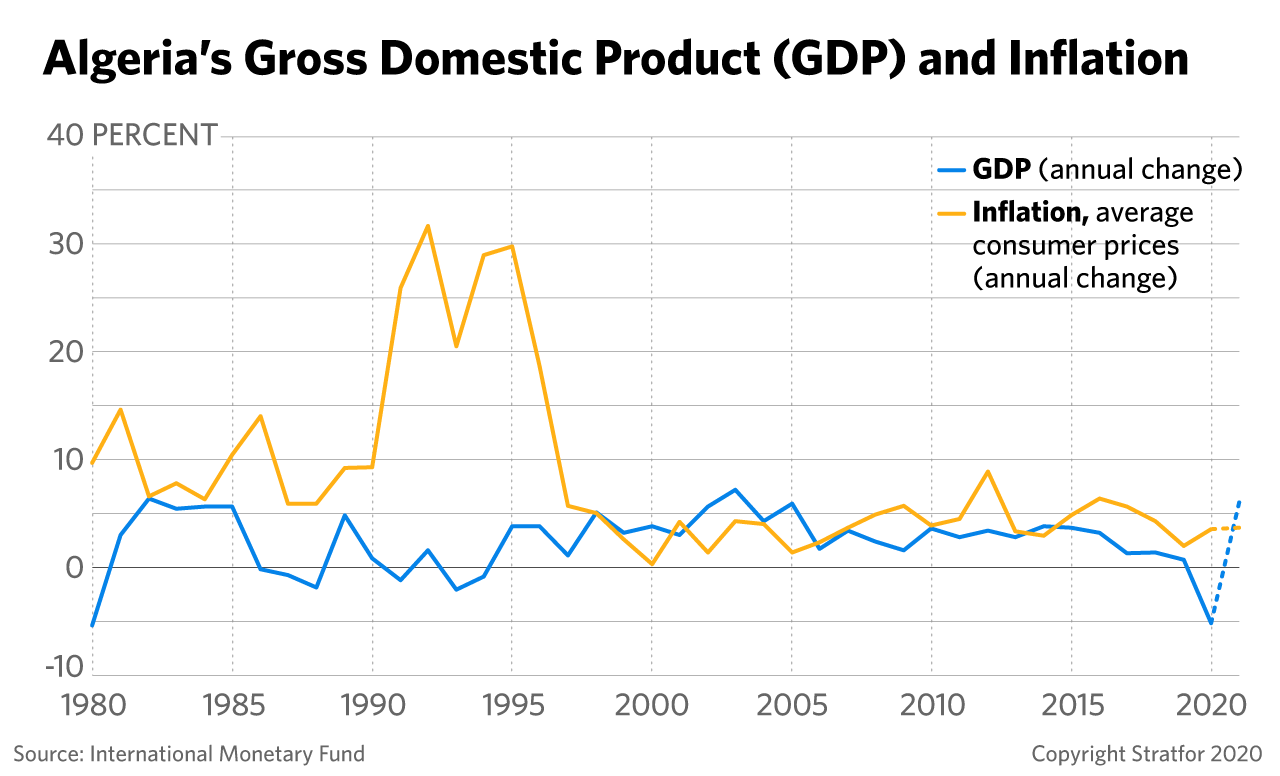
Algeria has relied on oil and gas revenue to fund its myriad of extensive but expensive social spending programs for decades. But the government’s primary development tool now risks collapsing under the weight of plummeting oil prices and demand due to the COVID-19 pandemic. Since the previous oil and gas price slump in 2014, when export revenues were halved, Algeria’s foreign exchange reserves have dropped from $194 billion to just $62 billion in February of this year. The reserves are likely to continue draining fast as the pandemic continues to rattle global markets and suppress global demand for oil and gas.
Despite being one of the wealthiest countries in the Middle East and North Africa, Algeria’s wealth heavily depends on oil and gas revenue, which accounts for 60 percent of its state budget and nearly all (94 percent) of the country’s export revenue. By highlighting its severe vulnerability to global market shocks, the COVID-19 pandemic is increasing pressure on Algeria’s government to quickly diversify its oil-dependent economy. But after last year’s rocky political transition, Algiers still lacks the legitimacy to implement the social spending reforms needed to do so.
Sky-High Social Spending
Algeria's government has been in the midst of a disruptive political transition since anti-government protests successfully forced President Abdel Aziz Bouteflika’s resignation in April 2019. For fear of suffering the same fate as Bouteflika’s administration, this has made Algeria’s current government particularly sensitive to heightened social demands. Street demonstrations remain unlikely in the near-term due to fears of spreading COVID-19. Once the health crisis ends, however, the likely dire economic fallout form the pandemic is all but guaranteed to spur another wave of anti-government protests.
To avoid igniting yet more social unrest, Algiers will thus be compelled to do whatever it can to maintain its current level of spending on social programs. To shore up finances amid the COVID-19 crisis, Algerian President Abdelmadjid Tebboune recently called on the government to delay state projects and cut public spending by 30 percent. But Algiers was quick to reassure that it will still maintain education and healthcare spending. The government also promised to keep public sector wages intact, which alone account for roughly 30 percent of the government’s total expenditure. But as oil prices, demand and exports remain low, the continued losses of revenue will make sustaining this level of social spending an increasingly difficult feat.
A New Openness to Foreign Debt
The added economic strain of pandemic-related losses in oil revenue will, in turn, accelerate Algeria’s lean toward opening up for more foreign investment and taking out more foreign debt. At only 1.9 percent of GDP, Algeria has a low level of external debt. Although this may appear as a dramatic shift from the country’s historic reticence to take on foreign debt, the country’s economic reality — combined with its declining oil and gas output due to its energy sector’s aging infrastructure — had already begun forcing Algeria to move in this direction. In addition to making landmark adjustments in recent months to the country’s foreign investment and hydrocarbons law to make it easier for foreign investors to participate in the economy, the Algerian government has referenced the African Development Bank and the Islamic Development Bank as potential sources for foreign aid.
To fund its likely worse than anticipated 2020 budget deficit and make up for shortfalls in government revenue due to the COVID-19 crisis, we should thus anticipate Algeria being even more open to taking on foreign debt and working with external institutions for funding shortfalls. Algeria, however, will be seeking outside capital at a time when the global appetite for investment will likely be low, as the COVID-19 pandemic prompts countries to weigh the costs and benefits of sending capital overseas against the growing need to support their own struggling economies and populations at home.
