
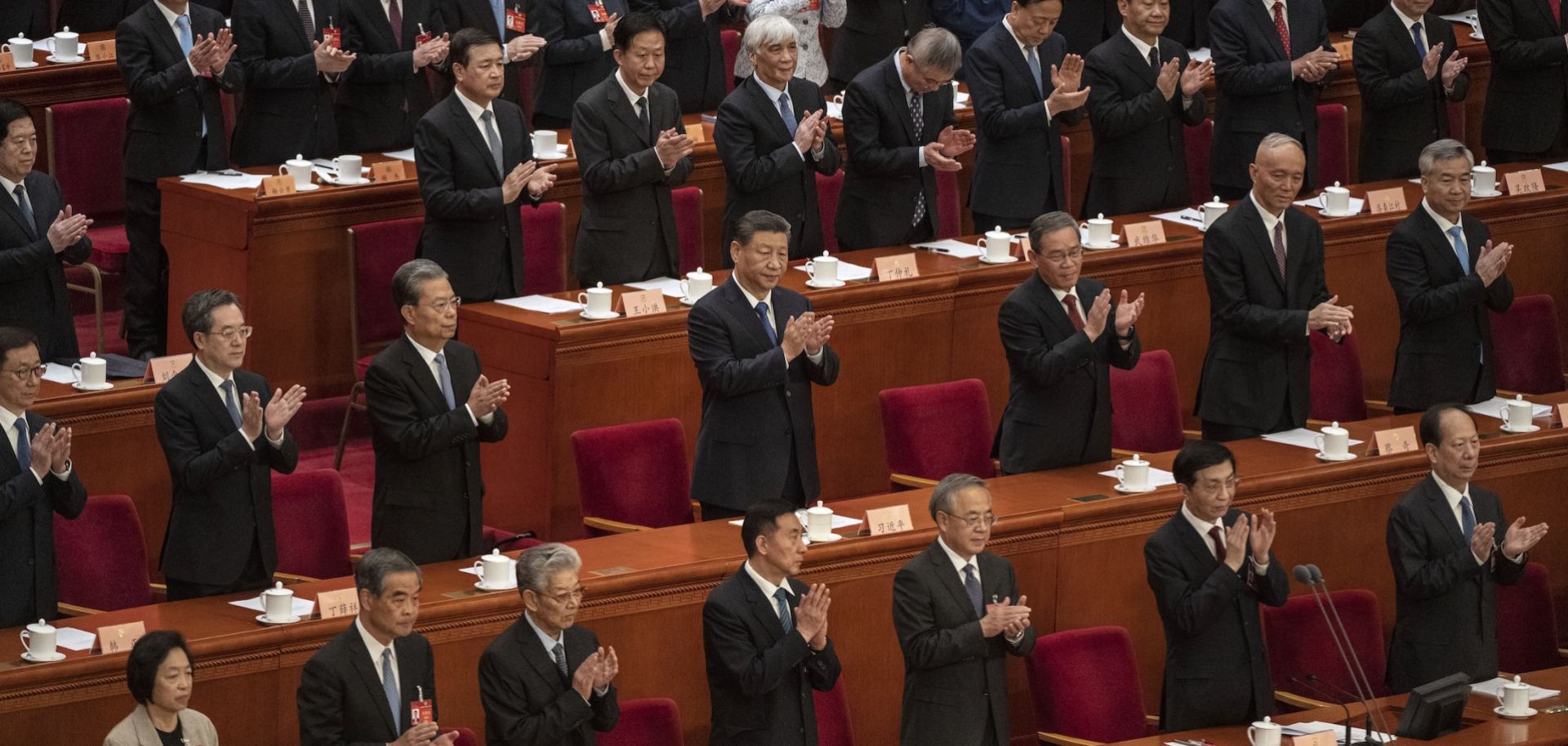
The Chinese government will maintain its cautious approach to economic stimulus following its annual legislative conference, which will also reveal more details on state plans for debt relief, foreign investment promotion and responding to Western trade restrictions. The Chinese People's Political Consultative Conference (CPPCC) will start its annual session on March 4, while the National People's Congress (NPC) will start its annual session on March 5, kicking off a week-long policymaking period commonly referred to as the ''Two Sessions.'' Premier Li Qiang will deliver the closely watched annual government work report on March 5, in which he will review last year's accomplishments, discuss China's domestic economic conditions and growing ''external pressures'' (in reference to growing trade tensions with the West), and this year's economic, security and political goals for the Chinese Communist Party, or CCP. The NPC will also conduct a second review of the draft Private Economy Promotion Law, which includes measures to ensure fair competition and improve private sector financing in China. However, the body's spokespersons noted on Feb. 21 that the law would require a third review at an unspecified date followed by passage ''as soon as possible.''
- The CPPCC serves as a policy advisory body for China's central government. Its members are selected by the CCP and comprise politically upstanding industry leaders and minor political parties. The body ostensibly gives outside opinions on top policy issues, though it is chaired by a Politburo Standing Committee member, Wang Huning, and it rarely ever contradicts the central authorities on policy direction, but rather proposes tweaks in collaboration with the authorities.
- The NPC is China's rubber-stamp legislature. It meets to propose, review, and pass legislation, nearly always with 99-100% approval (with rare abstentions). The body receives orders on what policies to propose and pass from the CCP's central leadership, the Politburo, meaning the NPC serves as more of a procedural body for policy formulation than a check on the power of the CCP or China's executive branch.
The rhetoric and policy foci of Li's government work report will give insights into Beijing's planned support measures for China's slowing economy, but a major surge in stimulus remains unlikely. In state media and government documents, Beijing has repeatedly emphasized stability over rapid growth amid post-COVID concerns of a debt bubble in China's real estate and banking sectors, and in local government finances. As such, the government work report will likely encourage a continued, gradual expansion of light-touch economic support measures, rather than propose a major surge of consumer stimulus measures (e.g. cash handouts) or debt relief for the real estate, local government, and banking sectors (e.g. via transferring debt to state-run asset management companies). The report will also lay out broad plans for bolstering employment and wages in 2025 as a means to boost consumption, but it will likely be light on details, as in previous pronouncements over the last year. Based on recent reports by China's top administrators in the State Council as well as China's economic planning agency and the finance ministry, the report will likely call for moderately expanded funding for economic initiatives, particularly for banking sector credit support as the lender of last resort to indebted developers and local governments. It will likely also call for purchasing excess housing capacity for use as rental housing to relieve developers of bad assets, as well as for expanding subsidy schemes for narrow baskets of consumer goods (like personal devices and household appliances). These measures will help prevent China's sluggish economic conditions — including weak consumption and wage growth, persistent deflation or low inflation, and an elevated risk of private sector and municipal debt defaults — from significantly worsening in 2025. However, they are highly unlikely to spur recovery, as was the case in 2024 (given that most of China's latest measures are repeats from a preexisting playbook). Nonetheless, Beijing is sticking to this conservative plan because its leaders, particularly President Xi Jinping, believe China must reduce its reliance on cheap growth (i.e. increasingly capital-inefficient fixed asset investment) to become a high-income, healthier economy with fewer debt risks. Likewise, the report will spill much ink on rhetoric about supporting foreign businesses in China, including via the passage of the Private Economy Promotion Law and other pro-business reforms, such as those aimed at reducing the instances of police double-fining or local authorities wielding regulatory cases to discriminate against companies based in other countries or Chinese provinces. However, as has been the case over the past two years, these facilitative measures will likely be minor (e.g., looser visa restrictions) and will not substantially address foreign business concerns about an uneven playing field or growing regulatory and geopolitical risks.
The report will also focus on achieving Beijing's long-term industrial indigenization and economic reform goals, which will likely shed light on how China plans to strengthen its resilience to (and retaliate against) Western trade pressure, particularly from the United States. The 14th Five-Year Plan for 2021-2025, a high-level economic policy framework put out by the Politburo, expires at the end of the year, as does the Made in China 2025 indigenous innovation and industrial development policy. Thus, Beijing's desire to accomplish the objectives outlined in these long-term frameworks will influence the government's policy priorities for the year ahead. These will include emphasizing national self-reliance in strategic industries and pushing ''common prosperity'' (e.g., via wage growth) as a framework for addressing labor grievances and societal concerns about wealth equity. Additionally, the government work report will focus on how to achieve Beijing's goal of leading the world in green industries as a way to move China up the manufacturing value chain and fulfill ''dual circulation,'' a system by which China's economy becomes reliant on domestic consumption while also supplying the world with high-tech, unique goods that help China inoculate itself from trade disputes. Li will likely avoid calling out the United States or Europe by name as the main perpetrators of trade and investment restrictions on China. However, judging from past precedent, the report will give hints about the makeup of China's trade retaliatory toolkit in 2025 — beyond tariffs, export restrictions, entity lists and regulatory scrutiny — given the recent spate of U.S. tariffs and their likelihood of growing over the next year under President Donald Trump. The report will likely also offer insight into the Chinese government's plan to support exporters hurt by Western tariffs in finding new markets.
- China's annual inbound foreign direct investment, or FDI, shrank by 8% in 2023, marking the first drop in at least a decade, and it dropped a further 27% in 2024. This comes on the back of China's failure to revive pre-COVID growth figures in 2023, including FDI, GDP and consumption levels. It also comes amid growing geopolitical headwinds, stemming from Western trade and investment restrictions, particularly as Trump continues to threaten tariffs that specifically target China, as well as more general ones that would also hit Chinese exports.
- Li is unlikely to hold a (highly scripted) post-Two Sessions press conference for foreign and domestic journalists, given that an NPC spokesperson at last year's legislative conference stated they would forgo the press conference in this and future Two Sessions. If, however, Li returns to this tradition, it could serve to boost the confidence of domestic and foreign businesses and investors that Beijing is listening to their growing concerns since China emerged from the COVID-19 pandemic.
