
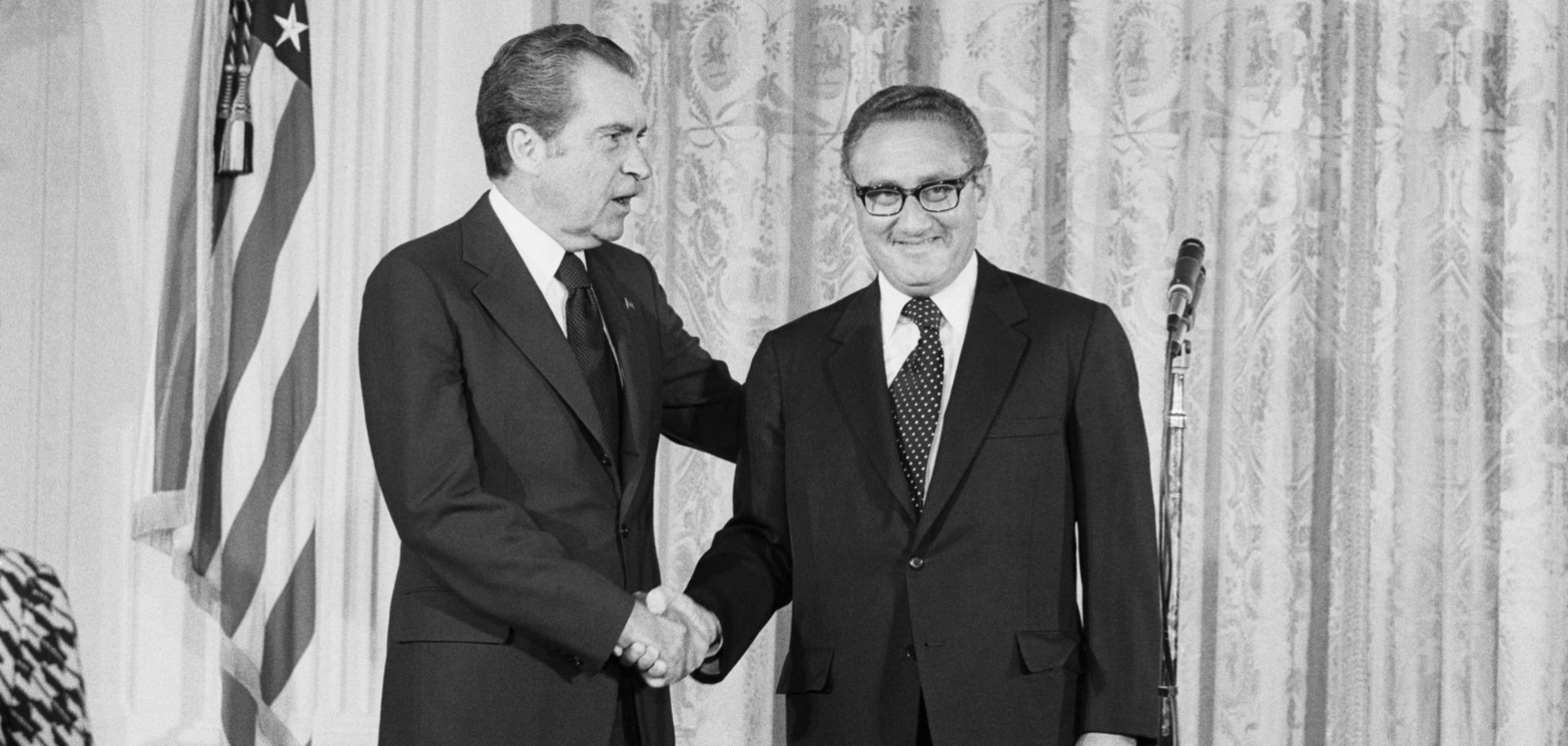
Henry Kissinger's death has engendered numerous articles, commentaries and remembrances, in praise and criticism of the former American diplomat, who served as Secretary of State and National Security Advisor under U.S. presidents Richard Nixon and Gerald Ford. As neither a diplomatic historian nor a former acquaintance, I will leave it to others to shed light on Kissinger's life and legacy. In looking at both the controversy around and adulation for Kissinger, however, I find his passing a time to reflect on the importance of strategic thought, and the need to balance interests and ideals. As a key actor during the Cold War, Kissinger emerged at a time when strategic thought was respected and sought after, and when the identification of national interests — while still at times uncomfortable for many — played a pivotal role in shaping foreign policy. In the post-Cold War West, both strategic thought and the concept of national interests have taken on the stigma of outdated and even evil ideas.
Geopolitical Interests vs. Ideals
If we look at Kissinger's actions, statements and writings, we can see a preference for interests over ideals. At a time of strong anti-communism, Kissinger led the opening with China as a way to exploit the Sino-Soviet split and enhance containment. When political ideals sought to counter communist expansion as a way to ensure democratic freedoms, he supported bombing campaigns in then-neutral Cambodia to achieve U.S. aims in Vietnam, and backed the overthrow of democratically elected governments in Latin America to preserve U.S. hegemony in the Western hemisphere. While the means caused physical harm to many (and assertions of war crimes), the ends, in the long run, appear to have been effective in stemming Soviet advances and thus stymying the heartland power, though it is hard to prove counterfactuals. For Kissinger, policy decisions were rarely clear-cut, or drawn from a list of good options. The bigger picture, the strategic ends, were what tilted the balance between two or three bad options.
Kissinger's conceptions of international security are clearly framed in classical Euro-American geopolitical terms. He saw the Soviet Union as the heartland power, drawing on British geographer Halford Mackinder's imagery. He fought potential communist expansion along what American geopolitician Nicholas Spykman coined the rimland, the stretch of coastal land encircling Eurasia. He used balance of power as a tool to reduce both what he saw as potential existential threats to the United States, and to manage regional and global dynamics. And if his actions weren't enough, an anecdote from Dr. Geoff Sloan, one of the founders of the Anglo-American Mackinder Forum, regarding a conversation he had with Dr. Zbigniew Brzezinski, who served as U.S. President Jimmy Carter's national security advisor, highlights the very concrete role geopolitics played in Kissinger's early academic formation. In 2002, Sloan asked Dr. Brzezinski about when he first encountered geopolitics, to which he replied that, as a postgraduate at Harvard, he was assigned with another student to present a paper on Mackinder's geopolitics. That other student was Henry Kissinger.
Kissinger's understanding of American interests, framed by classical geopolitics, recognized the folly of assuming an isolationist United States would be a secure United States. His ability to think strategically, looking across geographies and time horizons, provided a way to see and seize opportunities even where political expediency may have weighed against them. He secured the United States' preeminent influence in the Middle East by turning Egypt from a Soviet ally to an American client, shaped the withdrawal of U.S. forces from Vietnam, exploited the Sino-Soviet split, and reframed Soviet containment through detente. Each of these proved effective, but often at an immense human cost abroad — and at the expense of the overall image of the United States. Kissinger dealt in hard power, not soft power, and he sacrificed ideals for interests, considering the latter both more important and ultimately necessary to ensure the former.
We can criticize the underweighting of traditional American ideals, the frequent disregard for human rights, and the apparent lack of concern for the impacts of decisions much beyond the core security of the United States. But from an intellectual and policy perspective, one of Kissinger's strengths was his ability to identify and act on national interests, couched in raw national security terms, even when those actions appeared contrary to stated ideals or political expediency. He could explain the U.S. rapprochement with communist China (and abandonment of Taiwan), for example, in terms of interests, rather than an abandonment of anti-communist ideals.
Acknowledging National Interests
Kissinger did not shy away from the uncomfortable truth that nations have interests that, at their most fundamental, are shaped by raw geography, which is uncaring and unfair. To quote Mackinder's 1919 Democratic Ideals and Reality, ''There is in nature no such thing as equality of opportunity for the nations.'' This simple statement still stands as an irrefutable basis for international relations and geopolitical analysis. Resources, climate, access and routes are not distributed evenly across the globe, and thus from the start, there is inequality and competition. Whether through trade or conquest, enticement or coercion, nations seek to preserve and exploit what they have and access or bypass what they do not. We do not have to like this to recognize that it remains a key pattern of international relations.
In the ongoing return to a multipolar global system, understanding the way different nations identify and articulate their own national interests is vital to anticipate changes, risks and opportunities. Countries that fail to understand their interests, or those of other countries, risk being outmaneuvered by more astute or larger powers. For big powers, without clearly defined interests, foreign policy wanders, drawn from one crisis, event or ideological imperative to another, with little cohesion between actions and little consideration for the overall impact of those actions. This leads to overreach, contradictory initiatives and, oftentimes, a moment of crisis where the government must prioritize resources and expenditures, undermining the very ideological image it is seeking to project.
Kissinger no doubt leaves behind a complicated legacy. But while the controversies shrouding his diplomatic career highlight the dangers of pursuing interests without consideration of ideals, pursuing ideals without a clear understanding and articulation of interests can cause just as much harm. Navigating today's increasingly multipolar world will thus require reinvigorating the importance of and training for strategic analysis, identification of interests and shaping of priorities, while still recognizing the continued power of ideals.
