
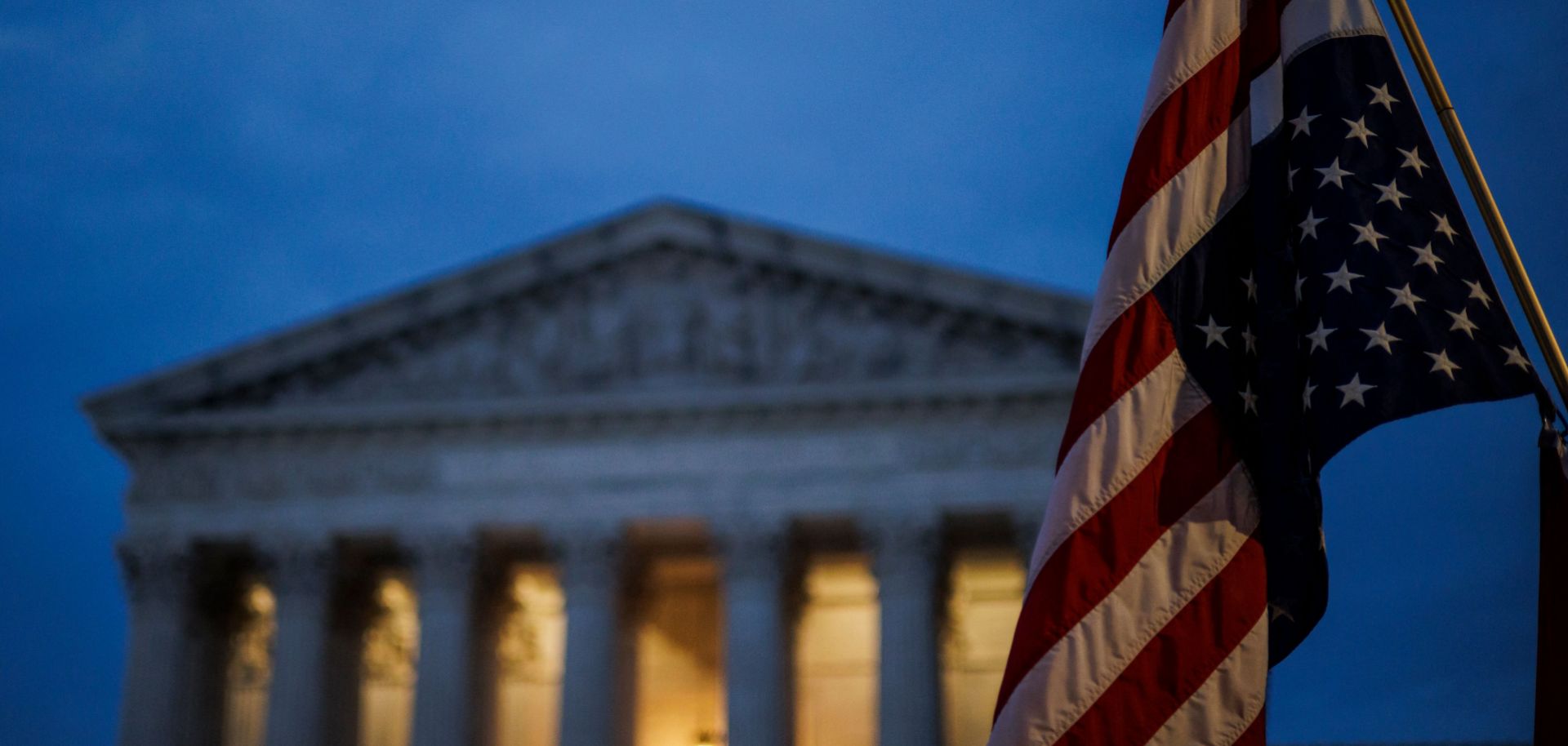
An abortion rights activist flies an upside-down U.S. flag, the international sign of distress, outside of the U.S. Supreme Court during a protest in Washington, D.C., on June 26, 2022, two days after the landmark Roe v. Wade decision was overturned.
Editor's Note: In the first part of this three-part series, we explore how a string of divisive political events in the United States have set the stage for the spread of false or misleading information ahead of next month's vote, and what social media companies are doing to prepare. The next part — which examines the risk of external meddling from actors like Russia, China, Iran and North Korea — can be found here.
As the November 2022 U.S. midterm elections approach, state-sponsored cyber threat groups, hacktivists and cybercriminals will ramp up new or capitalize upon existing disinformation campaigns for various malign ends. Although social media platforms are preparing for the onslaught of disinformation, their efforts will likely fail to mitigate the full extent of cyberthreats, heightening societal and physical security risks. Since the 2016 presidential election, disinformation has attracted significant attention from politicians, media outlets, researchers and commentators, who have drawn attention to how inaccurate information can undermine democratic processes and sow political polarization. It is true that midterm elections are generally less high-profile and have less impact on U.S. government policy than presidential elections and, therefore, may not attract the same intensity of state-sponsored disinformation campaigns. However, they will nevertheless attract foreign actors seeking to undermine U.S. domestic stability. Additionally, social media platforms will face challenges in mitigating the extensive spread of misinformation that may exacerbate the impact of foreign-backed disinformation campaigns. While commonly grouped together, misinformation and disinformation differ in their communicators' intent.
- Misinformation refers to inaccurate information in general, which may circulate as a result of a misunderstanding, poor research or rumors that drive a false narrative. For example, especially during the beginning of the COVID-19 pandemic, a lack of knowledge about the virus and the science behind the vaccines drove many users on social media platforms to spread misinformation about the ways in which COVID-19 could spread or be treated.
- Alternatively, disinformation is created and proliferated with malicious intent, typically to sow division or drive political polarization. For example, during the COVID-19 pandemic, numerous studies have detailed Russia's efforts to deliberately spread false information about Western vaccines to undermine public trust in Western governments, sow political divisions and stymie the West's response to the pandemic.
As the midterm elections approach, social media platforms are preparing for a barrage of misinformation and disinformation, but they are largely sticking to strategies from the last election. In August, Meta announced its election plans for Facebook and Instagram, which are largely consistent with the policies implemented during the 2020 presidential election. According to Meta's blog post, posts rated false by one of the company's fact-checking partners will get a warning label that will force users to click past a banner reading ''false information'' before they can see the content. Facebook will also continue its ban on political advertisements during the week leading up to the election. TikTok also announced its midterm plans in August, which similarly continue its fact-checking program from 2020 to prevent some videos from being recommended until outside fact-checkers verify them. In addition, TikTok is rolling out an ''Elections Center'' on its platform, where users can access verified information on the election, including information on how to vote in more than 45 languages. Posts containing election content and posts created by government accounts, politicians and political parties will be labeled to promote transparency. Similarly, in August, Twitter announced plans in line with its regulations developed for the 2020 presidential election, including labeling misleading information about elections and civic events and including links to credible sources. Moreover, Twitter announced that the platform will not recommend or amplify tweets it labels ''misleading'' and that users will be shown a warning prompt before they can like or share such tweets. Twitter will also bring back its 2020 ''prebunks,'' or messages that appear at the top of users' feeds to debunk misinformation.
Social media firms are taking these steps as recent research suggests that the midterm elections are facing elevated threats to their legitimacy due to posts about voter fraud. Former President Donald Trump's claims that the 2020 election was ''stolen'' have had reverberating effects on social media platforms. According to research from media firm Zignal Labs, the phrase ''stolen election'' was mentioned 325,589 times on Twitter from June 19 to July 19, a total that had been fairly consistent throughout 2022 but is up nearly 900% from the same time period in 2020. This trend was supported by research from digital analytics firm Similarweb, which studied Rumble, a video-sharing platform popular among Trump supporters, and found that videos with the term ''stop the steal'' or ''stolen election'' were among the most popular in May, with such posts attracting 2.5 million viewers during that month alone. Similarweb's research also found that in May, posts pertaining to election fraud attracted 2.5 million viewers on the platform, more than triple the total from a year prior. Other narratives of election fraud have inspired new terms such as ''ballot trafficking'' and ''ballot mules,'' popularized by the May release of ''2000 Mules,'' a discredited documentary asserting the claim of widespread voter fraud in the 2020 election. In the aforementioned Zignal research, the company also found that the term ''ballot mules'' was mentioned 17,592 times in the same June 19 to July 19 time period, a term that was not mentioned at all prior to the 2020 election. High-profile political events in recent months have only worsened political divisions and opened the door for foreign states to spread misinformation and disinformation on social media platforms.
- The overturning of the landmark Roe v. Wade decision in June has amplified political polarization and catalyzed the spread of false information online, both inadvertently and deliberately.
- Moreover, the FBI's August search of Trump's Florida Mar-a-Lago residence immediately drove polarizing narratives on social media platforms. According to The New York Times, posts on Twitter mentioning ''civil war'' soared by nearly 3,000% in just a few hours following the raid.
Next: What to Expect From Disinformation Campaigns During the 2022 U.S. Midterms, Part 2
