
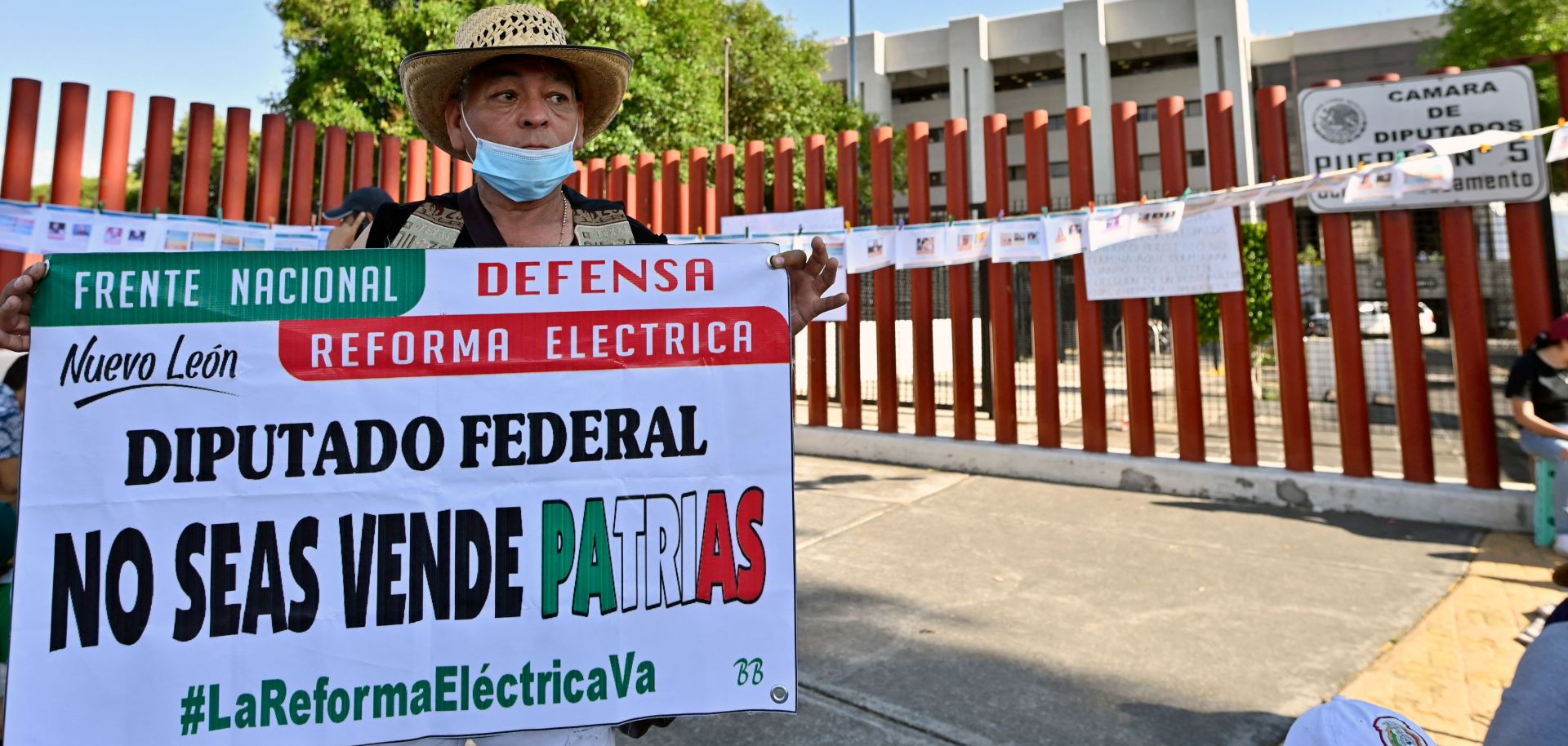
A supporter of Mexican President Andres Manuel Lopez Obrador's proposed electricity reform holds up a sign telling legislators "not sell the homeland" outside the building housing Mexico's Chamber of Deputies in Mexico City on April 17, 2022.
After failing to do so through a sweeping constitutional overhaul, Mexico's government will likely seek to boost the state's role in the energy sector by either collaborating with the opposition or unilaterally pushing legislation through Congress. On April 17, Mexico's lower house of Congress rejected President Andres Manuel Lopez Obrador's proposed constitutional amendment aimed at bolstering Mexico's state-owned energy companies against private competitors. 275 lawmakers in the 500-member legislative body voted in favor of the reform, falling short of the two-thirds majority needed to pass it.
- The constitutional amendment would have required Mexico's state-owned power company, the Federal Electricity Commission, to generate at least 54% of the country's electric grid. The independent regulatory bodies that currently oversee Mexico's electricity and oil sectors would have also been absorbed into government ministries, removing the degree of political separation these regulators currently enjoy. In addition, the amendment stipulated that both the Federal Electricity Commission and Mexico's state-owned oil company Pemex would no longer need to be profitable enterprises, which would have enabled them to continue operating at a substantial loss due to inefficiencies and lack of resources.
Lopez Obrador will likely continue to push to bolster the role of the state in the energy sector, potentially proposing similar constitutional amendments but changing tactics during negotiations with the opposition. The April 17 vote dealt a blow to Lopez Obrador's push to limit private energy production and bolster the state utility against competitors. But he remains unlikely to abandon these goals, which are major aspects of his policy platform. This could see Lopez Obrador continue to propose reforms aimed at enshrining greater state control over the energy sector in Mexico's constitution. If his administration demonstrates a willingness to collaborate, some opposition members may be more apt to approve potential future constitutional amendments, especially as Mexico enters a brief break between election cycles. This would likely require the Lopez Obrador administration to show goodwill toward the opposition by, for example, including them in the process of drafting any updated energy reforms. The government could also welcome the opposition's input on the federal budget and other items that Lopez Obrador's ruling Morena party has the ability to pass unilaterally. A constitutional amendment negotiated with the opposition would eliminate the risk of it being vetoed by the Supreme Court. But such legislation would likely also be watered down and more limited in scope compared with the package of sweeping energy reforms that Congress recently rejected. Lopez Obrador may be able to pass reforms that either bring Mexico's independent industry regulators under the purview of the country's energy ministry, or further bolster the country's state-owned energy and oil companies against private competitors. But the need to appease more skeptical opposition members means he's unlikely to achieve both.
- Since taking office in 2018, Lopez Obrador has sought to make Mexico's power industry more self-reliant and state-centric. This has included weakening the independent regulators and operators established by landmark 2013-14 energy reforms under his predecessor Enrique Pena Nieto's administration.
Alternatively, the government may resort to forcing through legislation to further its efforts to bolster state-owned energy companies. Lopez Obrador may be inclined to use his Morena party's simple majority in Congress to introduce reforms in the energy sector through ordinary legislation, which would avoid the need to make concessions to the opposition. This process would be lengthy, and any energy reforms proposed by the government would be subject to scrutiny by Mexico's Supreme Court. But the passage of Lopez Obrador's proposed lithium mining law on April 18 without support from the opposition indicates that the government may still seek to pursue this route as opposed to proposing new constitutional amendments, in an effort to circumvent the need to garner support from its political rivals. However, this strategy leaves the policy open to pushback from the country's federal court system, which can approve injunctions against legislation for individual cases of private sector involvement. This would likely result in a significant amount of regulatory and legal uncertainty for private companies, further complicating their existing operations in Mexico.
- On April 7, Mexico's Supreme Court ruled the Electricity Industry Law that the government introduced in 2021 was constitutional, but overturned a policy published by Mexico's energy ministry giving preference to the state-owned Federal Electricity Commission on the dispatch.
- On April 18, the lower house of Mexico's Congress approved the government's proposed addendum to the mining law that paves the way for nationalizing the country's lithium reserves. 275 lawmakers voted in favor, 24 voted against and 187 abstained. Opposition legislators left the discussion en masse following a heated debate.
