
The collapse of Romania’s government will make it hard for Bucharest to improve the country’s very low COVID-19 vaccination rate and absorb much-needed EU funding, both of which are essential for sustainable economic growth. The government of Romanian Prime Minister Florin Citu fell on Oct. 5 after losing a no-confidence vote in parliament. On Oct. 6, Romanian President Klaus Iohannis said that he will begin consultations with the political parties in parliament next week to explore the possibility of appointing a new government.
- Citu, the leader of the center-right National Liberal Party (PNL), became prime minister in December 2020 with support from the conservative Democratic Alliance of Hungarians in Romania (UDMR) and the centrist Save Romania Union (USR) parties. But USR left the government coalition in September to protest a 10 billion euro ($11.5 billion) spending plan proposed by Citu, which USR argued lacked accountability. On Oct. 5, USR joined the opposition in voting against Citu in the no-confidence vote.
Unless parties in parliament agree to appoint a new government, Romania may have to hold an early general election that would prolong political uncertainty in the country. There are several ways in which events could unfold in the coming days. President Iohannis could propose another prime minister from the PNL, considering that USR has said it will restore its alliance with PNL and UDMR if a different premier is appointed. A second option would involve Iohannis re-appointing Citu as the head of a minority government, without the USR. Such a government would be fragile and subject to another no-confidence motion in the near future, which would prolong political uncertainty. A third option would involve a technocratic government, led by a politician or an independent, to handle the country’s escalating COVID-19 emergency. Romania has appointed technocratic governments in the past, but the current deep ideological divisions between center-right and center-left parties in parliament could make it harder this time. If all these options fail to produce a new government, Romania may have little choice but to hold an early general election in the middle of the pandemic.
The political instability will further complicate Bucharest’s efforts to ramp up vaccination rates and mitigate Romania’s increasingly severe COVID-19 surge, which could lead to tightened lockdown measures at a high price for the economy. The collapse of the Romanian government happens as the country is battling its worst COVID-19 wave yet, which is the result of a very low vaccination rate. High levels of vaccine hesitancy and difficulties distributing shots in rural areas have stymied Romania’s inoculation efforts, with only about 34% of adults in the country fully vaccinated — well below the EU average of 74%. The uptick in infections is straining the country’s insufficient healthcare infrastructure and equipment and has prompted some areas of the country to tighten their social distancing measures in recent weeks. If the COVID-19 situation does not improve in the near future, Romania’s economic recovery risks slowing. Romania’s low vaccination rate and high number of COVID-19 cases could also result in new mutations of the virus emerging in the country, which could force other EU countries to close their borders to Romanian nationals. In addition, Romania’s unstable government has struggled to convince the European Commission to approve billions of euros in grants and loans to support the country’s economic recovery, with Brussels only green-lighting Bucharest’s spending plans in September. This means that Romania will start receiving the funds later than most other member states. A fragile government in Bucharest may also struggle to actually spend these funds, further impeding the Romanian economy’s rebound.
- Romania reported 15,037 new COVID-19 cases on Oct. 4, the highest daily count since the start of the pandemic. On Oct. 5, Romanian authorities also reported a recorded 331 COVID-related deaths, marking the country’s highest daily death toll since the beginning of the pandemic.
- On Oct. 4, the head of Romania’s Emergency Situations Department announced that public hospitals would suspend hospitalizations and non-emergency operations for 30 days to free up space for COVID-19 patients.
- Wearing face masks in public spaces is currently mandatory in Romania. Places like restaurants and cinemas are also required to operate at half capacity in several cities with high infection rates, while a night curfew is in place in cities including Bucharest.
- According to World Bank projections released on Oct. 6, Romania’s GDP is expected to expand by 7.3% in 2021, one of the highest growth rates in Europe. However, the World Bank warned that the strength of the recovery would depend on the country’s vaccination rate, as well as in its ability to absorb EU funds.
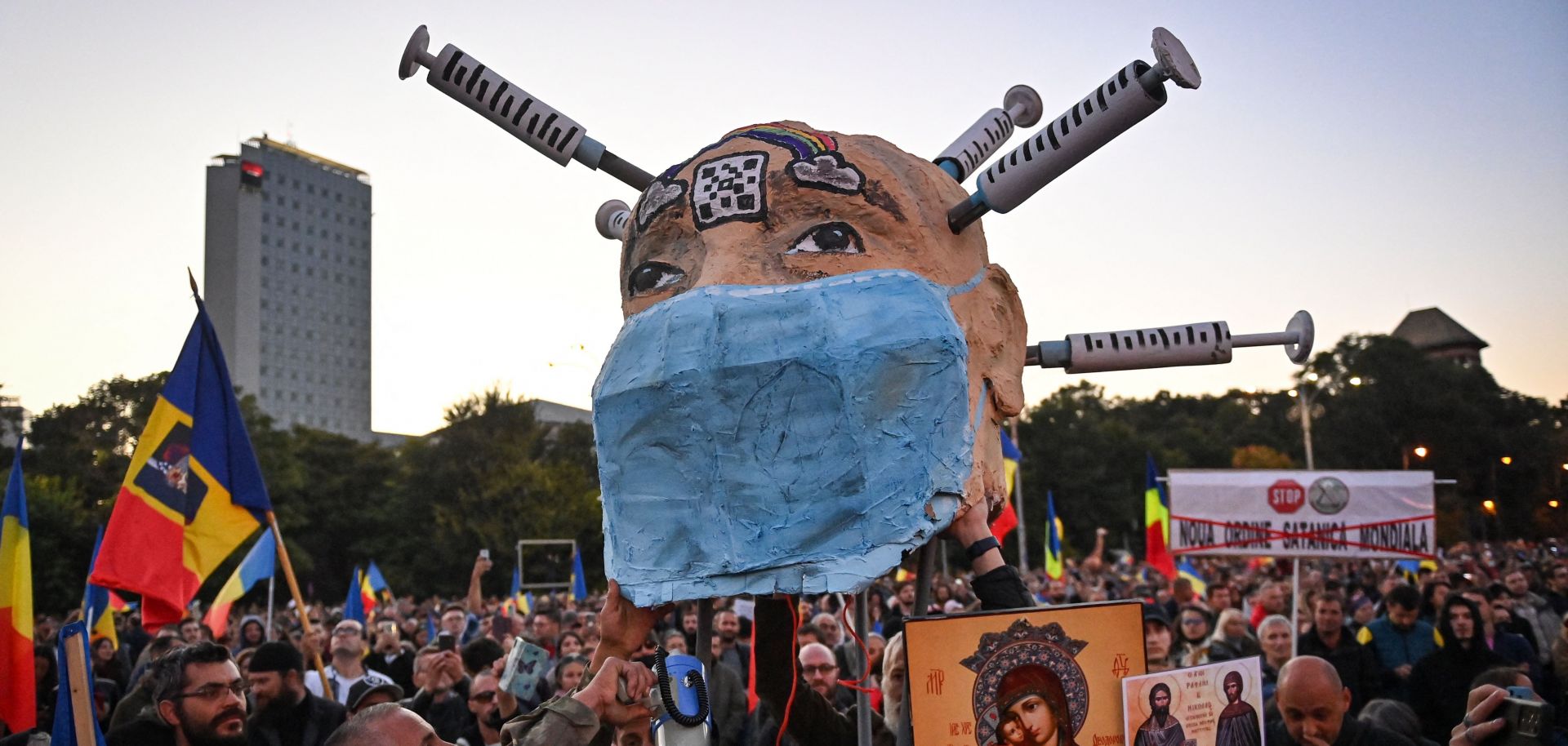
The ongoing health crisis, along with increasing levels of political and economic instability, also raises the risk of unrest in Romania. As in most parts of Europe, natural gas and electricity prices have skyrocketed in Romania in recent weeks, which could result in street protests and other forms of social upheaval if households see a sharp increase in their cost of living. Nationalist, anti-vaccination and anti-lockdown groups are also active across the country and contribute to unrest. On Oct. 2, for example, some 5,000 people took to the streets of Bucharest to protest against social distancing measures.
