
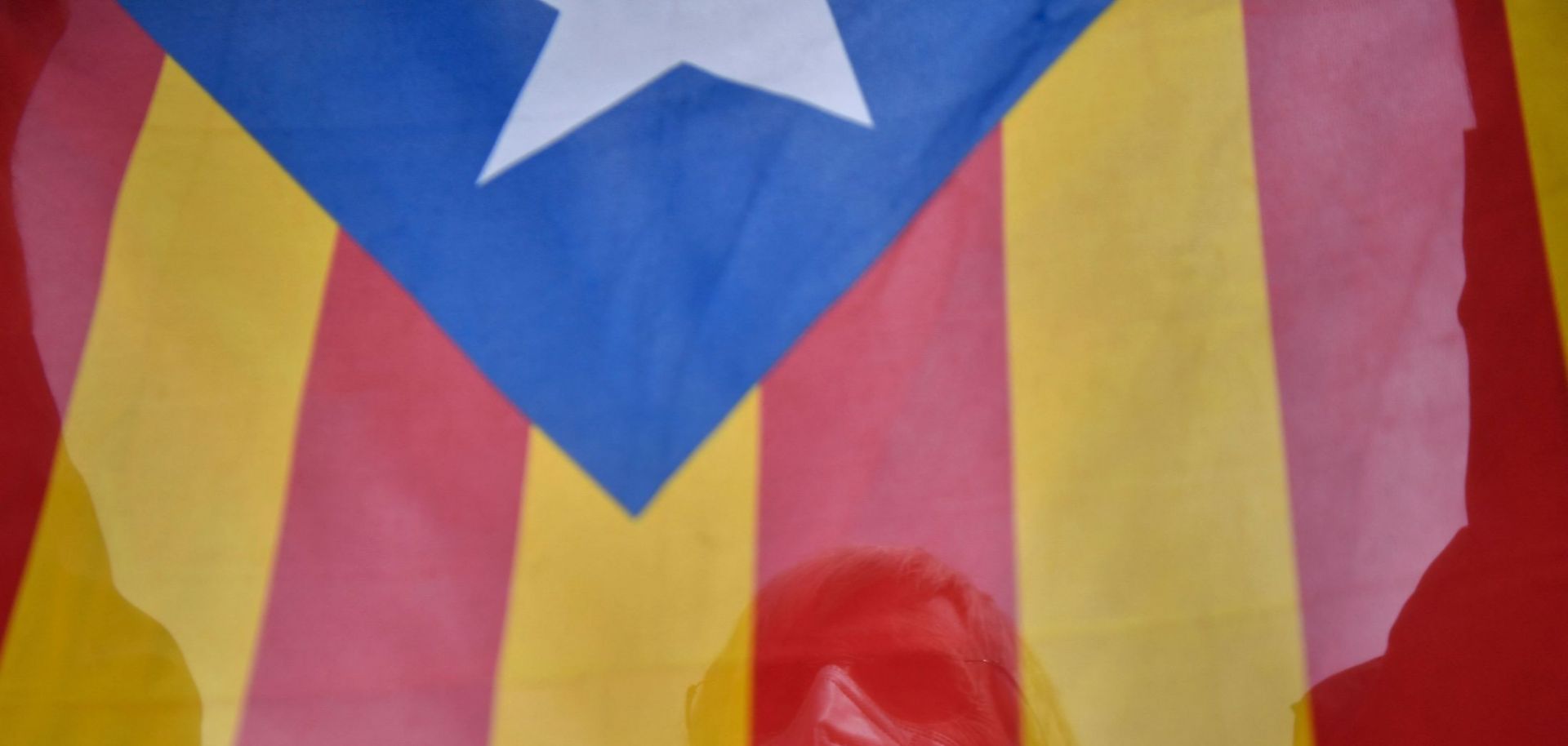
A man holds up a Catalan pro-independence Estelada flag during a demonstration in Barcelona on May 16, 2021.
Catalonia’s new government will not make any significant unilateral moves toward secession in the short-to-medium term and will instead focus on the region’s economic recovery and the release of secessionist leaders from prison. This will temporarily reduce one of the main sources of political risk in Spain, even as independence will remain the Catalan government’s long-term goal. After three months of negotiations, the pro-independence Republican Left of Catalonia (ERC) and Together for Catalonia (JxC) parties reached an agreement on May 17 to form a regional government. In a joint statement, the parties said that their goal will be “to govern for all” and “to move towards the common goal of independence in the form of a Catalan Republic.” After the announcement of the agreement, the Spanish government’s spokesperson said that Madrid hopes Catalonia’s pro-independence parties “have learned their lesson” and that the push for independence “only leads to prison.”
- Catalonia held a regional election on Feb. 14. The unionist Socialist Party won 23% of the vote, followed by ERC with 21.3% and JxC with 20.1%.
- Catalonia held an illegal independence referendum and unilaterally declared independence from Spain in 2017. As a result, the Spanish central government took direct control of the Catalan regional government. Some pro-independence leaders were also arrested while others fled the country.
The Catalan government will focus on the region’s economic recovery, as well as negotiations with Madrid to release jailed pro-independence leaders. According to Catalonia’s statistics institute Idescat, the region’s economy contracted by 11.4% in 2020 — more than the overall 10.8% contraction of the Spanish economy, due in part to Catalonia’s reliance on foreign tourists. The new Catalan government will negotiate with Madrid to receive a significant part of the roughly 140 billion euros that Spain will obtain from the European Union’s COVID-19 Recovery Fund in the coming years to boost the regional economy. The Government of Catalonia, which is based in Barcelona, will also seek to reposition the region as a major destination for foreign tourists and international events, for which political stability is crucial. Barcelona also wants Madrid to release from jail the pro-independence leaders who were arrested after the illegal declaration of independence in 2017. Madrid is interested in keeping negotiations with Barcelona alive because it often needs support from Catalan pro-independence parties to pass legislation in the Spanish parliament.
- Tourism represents around 12% of Catalonia’s GDP. In 2020, the arrival of foreign tourists to the region fell by around 80% because of COVID-19 lockdown measures.
- The Catalan government has presented to Madrid 27 proposals to spend the EU recovery funds, including plans to boost the production of electric vehicles and to produce green hydrogen.
- The Spanish government has said that it will consider pardoning the Catalan leaders to help pacify the region. Some secessionist sectors want an amnesty instead, which Madrid is unlikely to authorize.
Disputes within Catalonia’s pro-independence camp will also reduce the probability of unilateral moves toward independence. While JxC and ERC support independence, some factions in the former are willing to take unilateral action while the latter prefers negotiations with Madrid. These parties also compete for a similar electorate, which explains why there are frequent frictions between them. Meanwhile, recent surveys show that because of the COVID-19 pandemic and the economic situation, many voters in Catalonia do not see independence as a priority. These factors explain why ERC and JxC will not make any significant unilateral moves to achieve independence, even as they continue to defend it as their long-term goal. They may sporadically defy Madrid’s decisions, but a repetition of the events of 2017 is improbable. This means that Catalonia will be a lower source of political and economic risk in Spain than in the past, which will help Madrid focus on policies to boost economic growth after the severe GDP contraction in 2020.
- According to a survey published in the newspaper La Vanguardia on May 16, 41.5% of Catalan voters would support independence in case of a referendum. But in the same survey, 40.2% of voters also said they thought the new Catalan government should prioritize a negotiation with Madrid to obtain more autonomy and higher financing.
- The poll showed that 61.3% of Catalan voters think the jailed pro-independence leaders should be released from prison as well.
