
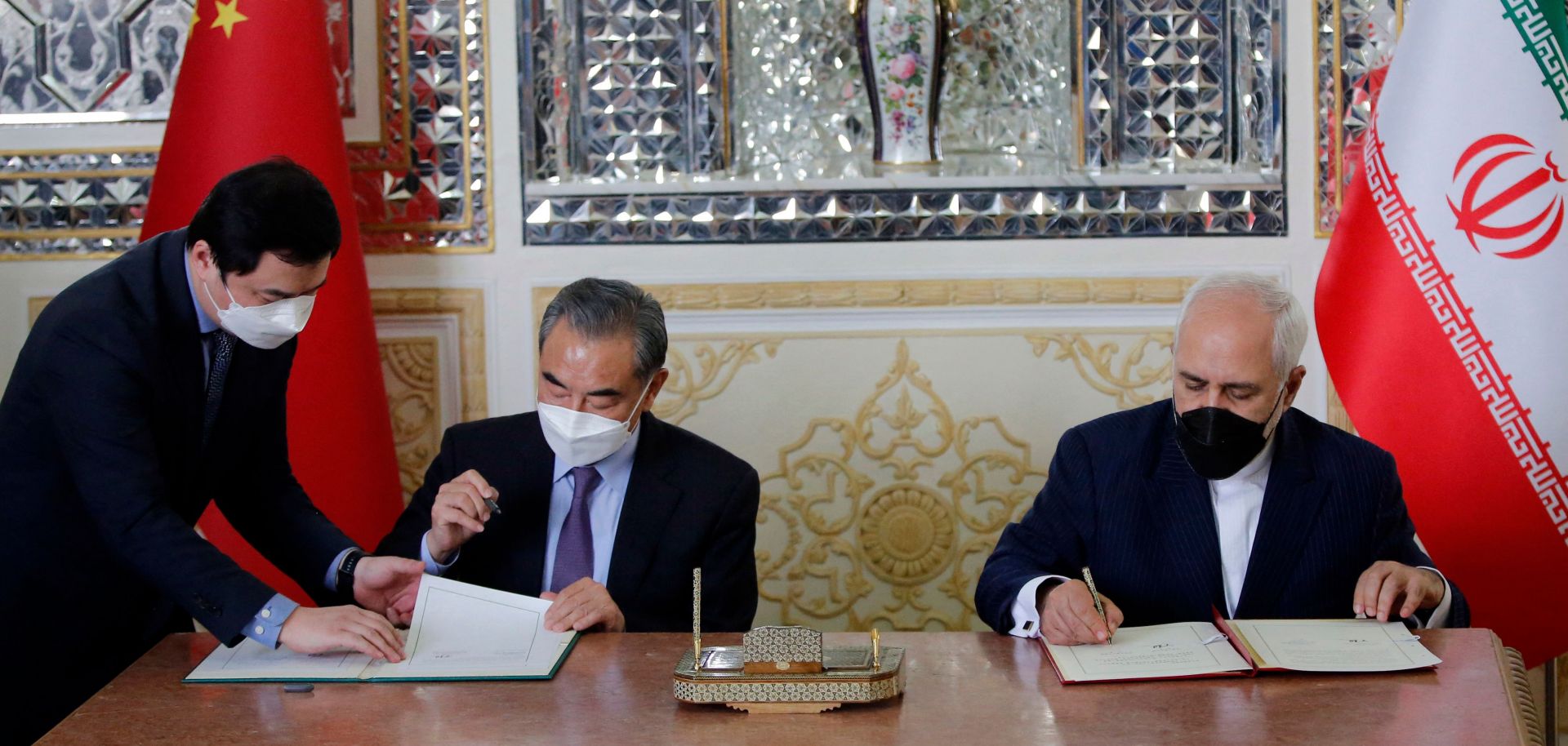
Iran and China’s foreign ministers (right to left) sign a partnership agreement in Tehran on March 27, 2021.
Iran’s strategic partnership with China will lead to increased security and economic cooperation, but Tehran will avoid fully siding with Beijing for fear of becoming too dependent on a single partner and alienating itself from the West. The March 27 signing of their 25-year Comprehensive Strategic Partnership is reflective of the mutual interest between Tehran and Beijing, including collaboration on Belt and Road Initiative (BRI), as well as on energy and defense matters. But Iran loathes becoming strategically dependent on any power and will seek to balance its partnership with China with improving ties to Western countries, to ensure Tehran remains as a “neither East, nor West, Islamic Republic,” as Supreme Ayatollah Ruhollah Khomeini put it.
- The deal with China appears to be relatively modest and effectively a statement of interest to cooperate in various fields. The official text has not been released, but an alleged leaked 18-page version of the agreement in Farsi appeared on social media in June 2020.
- The leaked document outlines a number of different areas where China and Iran could collaborate, including investment, trade, energy, petrochemicals, infrastructure and defense matters.
- The Petroleum Economist reported in 2019 that the potential partnership includes some $400 billion investments into Iran — a figure that The New York Times also reported in June 2020. But the leaked document lacks specific investments and figures, making the values aspirational and likely contingent on a number of things, including the status of U.S. sanctions on Iran.
Iran and China have a number of mutual strategic interests that are driving them to pragmatically work with one another on economic, political and security matters, as reflected in the vague partnership agreement. Both China and Iran are being pressured by the United States through sanctions and trade restrictions. They also both view the Western- and U.S.-led international system as being flawed and hope to strip down that dominance. Iran seeks substantial investment into its internal infrastructure as well, which fits neatly into President Xi Jinping’s BRI strategy thanks to Iran’s geographic location and the fact that construction is a key part of China’s stimulus plan to fuel its economic recovery from COVID-19. Iran has been trying to boost its conventional and strategic military power, something that China can help in part by increasing commercial investment that grows Iran’s economy. For Tehran, China’s willingness to continue some level of Iranian oil imports during the height of U.S. sanctions has also given Tehran some financial breathing room.
- Iran and China have a mutual interest in reducing the U.S. dollar’s role in international trade by using alternative currencies, such as the Chinese yuan, as well as alternatives to the Brussels-based SWIFT financial messaging platform that underpins international payments and transactions.
Iran, however, will remain skeptical of China's reliability as a strategic economic partner and will seek to avoid aligning too closely for fear of becoming too dependent on Beijing. Iran has a long history of trying to balance its relationships between different powers, which is rooted in the Islamic Republic’s ideology of self-reliance and non-alignment. Pragmatism coupled with sanctions has forced Iran to become more dependent on China. But the cost of Iran’s deep reliance on other outside partners throughout its history — including the United States, United Kingdom and Russia — has often outweighed the benefits, which has made Tehran acutely aware of the risks of doing so again, even with China. Iran also recognizes that China does not view Iran as a uniquely essential Middle Eastern partner. Indeed, the China-Iran strategic partnership agreement is not the first of its kind for China in the Middle East, as Beijing signed a similar one with the United Arab Emirates in 2012. Iran is under no illusion that China will come to its aid in a security crisis or that China views Iran as a more important economic partner than Iran’s Arab rivals. In addition, although Chinese officials have lamented and rejected U.S. sanctions, Chinese companies have largely followed them. Chinese investments into Iran’s oil sector and other sanctioned sectors have been slowed or put on hold because of U.S. sanctions. China has continued some level of imports of Iranian oil, but those exports fell substantially during U.S. President Donald Trump’s term, to a low of about 200,000 barrels per day, as major Chinese companies did not want to risk U.S. sanctions by continuing to buy Iranian oil. Moreover, Chinese products are common alternatives to Western products in Iran, making them the main foreign product competing against domestic industries and often undercutting them on price, driving up resentment by Iranians and Iranian companies toward China over trade issues.
- In 2019, Iran was not even in the top five Middle Eastern oil suppliers to China, with Saudi Arabia, Iraq, Oman, Kuwait and the United Arab Emirates all selling more oil than Iran.
- In 2019, China’s state-owned oil giant, the China National Petroleum Corporation (CNPC), withdrew from the South Pars gas project in the Persian Gulf over U.S. sanctions. Prior to the 2015 Iran nuclear deal, Tehran also kicked out CNPC from a project over stalled investments.
- Domestic concerns of Iran giving up too much of its economy and resources to China in the 25-year Comprehensive Strategic Partnership have pressured the Iranian government to release details of the deal since it was first announced in 2020.
China’s spotty history of fulfilling investment and trade promises to Iran under U.S. sanctions will drive Tehran to continue pursuing normalization with the West. The economic and investment aspects of the Iran-China strategic partnership are designed to support the Iran nuclear deal, formally known as the Joint Comprehensive Plan of Action (JCPOA), along with Washington and Tehran’s attempts to resume compliance with the deal. Indeed, the partnership was first proposed during President Xi’s 2016 trip to Tehran, predating the Trump administration’s sanctions-heavy “maximum pressure” campaign against Iran. Xi’s trip occurred less than a week after the United States implemented sanctions relief on Iran as a part of the JCPOA. At the time, Iran hoped that the JCPOA and the removal of sanctions would lead to a surge of investment by Asian and European countries into its economy. And a strategic partnership agreement with China was viewed as an enabler of significant Chinese investment. Even today, substantial Chinese investment into Iran will, in practice, be conditional on the U.S. lifting of sanctions.
- From Beijing’s point of view, such a partnership also incentivizes Iran to reach an agreement with the United States. China most certainly does not want Iran to become a nuclear power, which would also complicate Beijing’s deeper economic ties with other Middle Eastern regional powers, like Saudi Arabia and the United Arab Emirates.
But China will still be essential to Iran’s economic recovery even if the United States lifts sanctions, as any Iranian efforts to gain European investment would likely remain futile for several more years. Western companies that were willing to make investments into Iran under the JCPOA were burned by the United States’ decision to leave the deal in 2018, just over two years after lifting sanctions. This will make Western companies skeptical once sanctions relief returns, particularly as there will be questions as to whether or not the deal could survive another possible change in U.S. administrations in 2024. This will give Chinese companies a large first-mover advantage in getting lucrative opportunities in China. Eventually, this will only reinvigorate and drive more public Iranian opposition to China’s economic heft — further driving Iran’s leadership to take a balanced approach to its relationship with China. China will initially be most interested in investing in Iran’s energy sector and infrastructure under its BRI. But over time, Beijing will start eying Iran’s large educated workforce and population as a more important market to sell into in the future.
One of the more enduring areas of Sino-Iranian cooperation will be strategic and defense issues, as Iran will seek to deepen military cooperation with China )particularly on military technologies) regardless of the status of U.S. sanctions. Even as it pursues sanctions relief from the West, Iran is unlikely to gain access to Western military technology. As part of the JCPOA, the U.N. Security Council’s arms embargo on conventional arms sales to Iran ended in October 2020. Many of Iran’s legacy conventional military platforms are still U.S. systems that predate the 1979 Iranian revolution. Iran’s lack of modern conventional military platforms has also forced it to rely on its asymmetric capabilities. Iran views China (along with Russia) as an option to improve its conventional military and provide technical assistance and investment to its domestic defense industry. But the extent to which China will be willing to alienate the United States and its other regional partners in the Middle East by facilitating deep arms sales with Iran is unclear. This will probably keep the actual number of China-Iran arms deals modest, but from Tehran’s perspective, any increase in military cooperation will be significant.
