
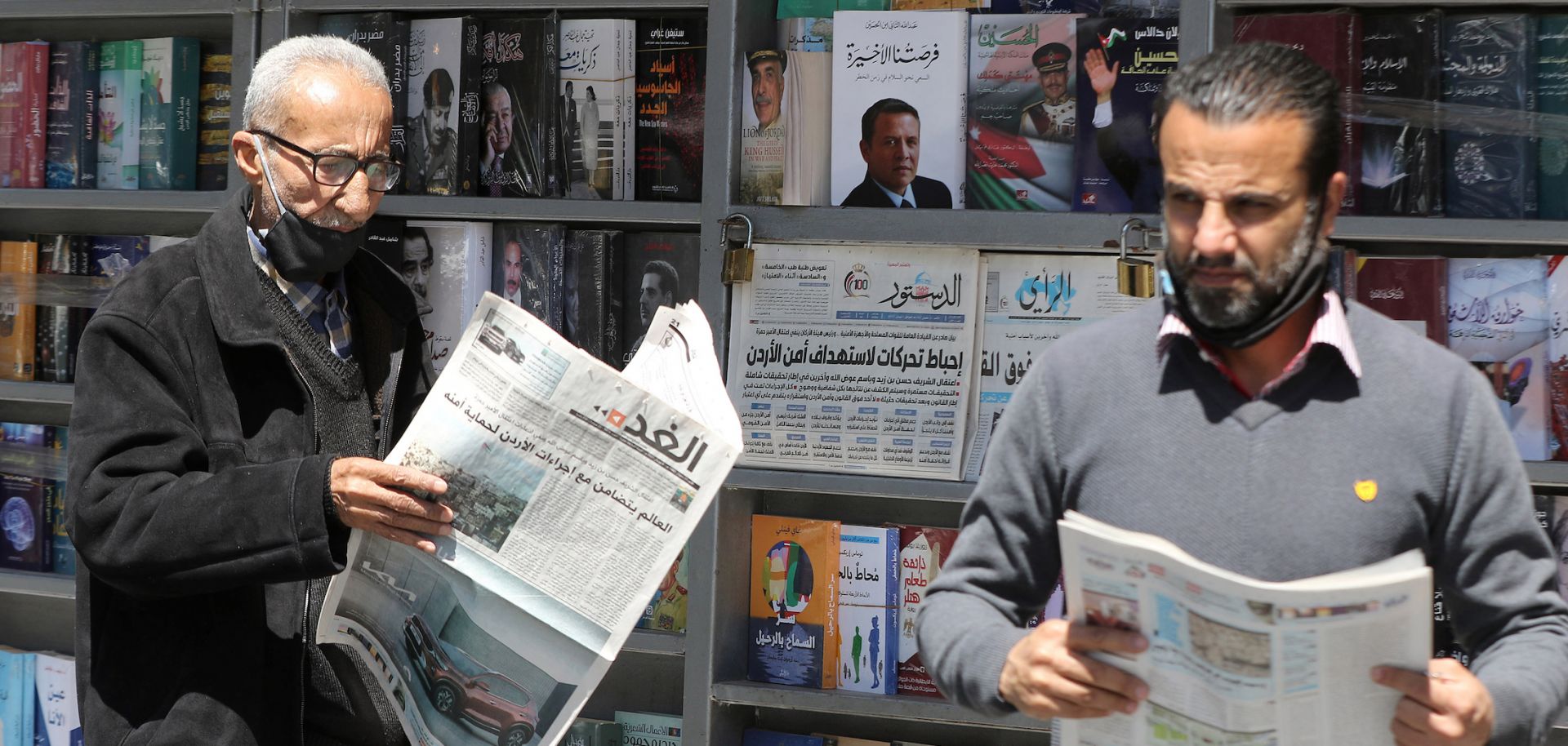
In Jordan, the arrest of a former crown prince reveals a kingdom uncertain of how to address its pandemic-induced economic crisis, which could harm Jordan’s reputation for stability if the monarchy fails to deter further high-profile displays of dissent from its own family members, as well as the general public. On April 3, Jordanian authorities arrested 20 people for an alleged plot to overthrow the government deemed to be a “threat to the country’s stability.” The most high-profile of the arrests include the former crown prince and half-brother of Jordan’s King Abdullah II, Hamzah bin Hussein, and his mother, who were both reportedly under house arrest as authorities conduct an investigation. Prince Hamzah released a video late on April 3 to the BBC claiming he was being silenced because he spoke out about corruption in Jordan and the “incompetence that has been prevalent in our governing structure for the last 15 to 20 years,” likely referring to King Abdullah II’s reign. It’s unclear what corruption Prince Hamzah was specifically alluding to. But he’s linked to the kingdom’s economically impoverished Bedouin tribal communities, who have been disproportionately affected by the COVID-19 pandemic’s impact on tourism, which many tribes rely on for employment. As of April 6, Prince Hamzah had signed a pledge of allegiance to King Abdullah II, signaling a tentative official end to the royal family dustup.
- Other prominent individuals arrested on April 3 include Bassem Awadallah, a former senior official in the royal court and special envoy for the Jordanian court to Saudi Arabia.
- COVID-19 lockdown measures have further harmed Jordan’s economy, which has struggled for years and has required foreign assistance to keep its national budget stable. In 2020, the country’s GDP contracted by 1.6% and its already high unemployment rate increased to 24.7%. The kingdom’s COVID-19 lockdowns have been deeply unpopular among Jordanians and security forces have had to break up numerous protests.
With limited economic options to improve public support, Jordan’s monarchy is likely to tighten security measures and its control of the media, as well as enhance the public role of current Prince Hussein, in order to deter dissent and project control of the country. Prince Hamzah is looking to capitalize on popular resentment over corruption and economic malaise enough to spur the government to enforce a wider crackdown. The monarchy relies on tribal and patronage networks to remain in power, while Amman’s national budget is heavily reliant on foreign aid. Its economic reliance on pandemic-affected tourism and foreign investment rates also limits the monarchy’s ability to promise the public much in terms of economic reforms. The monarchy’s control of the security services, however, appears firm, with the military backing the recent arrests and warning Prince Hamzah against communicating further dissent to the rest of the world.
- Prince Hamzah and King Abdullah II’s rivalry spans decades, though it has never exploded into the public eye prior to this weekend’s events. Five years after Prince Hamzah ascended to the throne, the king stripped his half-brother of the title in 2004 and transferred it to his son, Prince Hussein.
- Prince Hamzah is often seen as a populist who has tried to capitalize on his connections with Bedouin tribes and ordinary Jordanians to undercut his brother’s rule and influence the country’s policies. His popularity can also be attributed to his similarities to his father, the very popular King Hussein who ruled Jordan for 40 years.
- To help cement the current succession line and offset Hamzah’s influence, 26-year-old Prince Hussein’s public role has been expanding in recent years, including appearances at protests to discuss grievances with ordinary citizens.
If Prince Hamzah and others are able to continue voicing their dissent with the monarchy, it could force more public arrests and crackdowns — undermining the kingdom's reputation for stability, with negative implications for tourism and investment. Jordan has a unique reputation for stability among Western and regional governments, having weathered the Arab Spring and two Arab-Israeli wars while resisting the domestic formation of sizable terrorist or jihadist groups. If the situation persists and more arrests follow, then questions will continue about Jordan’s long-term stability, and the fate of the country’s monarchy in particular.
- Jordan’s long-term economic diversification program includes foreign investment to build up its technology sector and manufacturing and improve its resource-starved economy. However, stability concerns risk easily spooking investors given Jordan’s long-standing internal divisions and the nearby example of Syria’s civil war.
- Jordan’s post-pandemic recovery also necessitates the return of its tourism trade, which makes up close to 20% of the country’s GDP. Lockdowns and border closures brought tourism virtually to a halt in 2020. But with vaccines promising some normalization in 2021, Amman needs a stable reputation to convince tourists from Europe, the Americas and Asia to return.
