
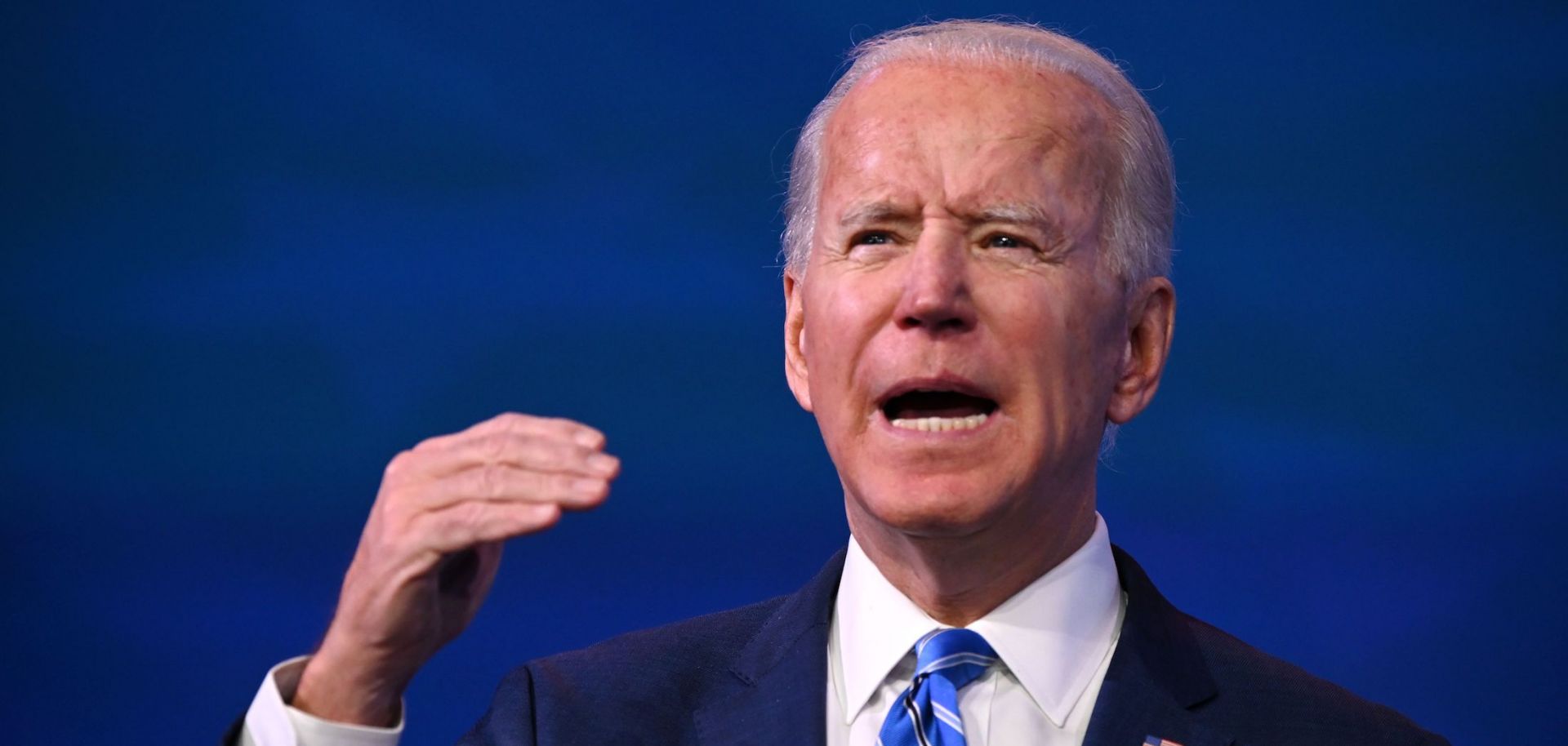
U.S. President-elect Joe Biden delivers remarks on the United States’ escalating COVID-19 crisis in Wilmington, Delaware, on Jan. 14, 2021.
For the U.S. economy, a sustainable long-term recovery must include putting people back to work permanently. But this depends on vaccines providing enough protection to shore up consumer confidence and return business activity to normal, which won’t occur until at least mid-year. Surging COVID-19 infections and more than 400,000 deaths are sapping momentum from the world’s largest economy.
- The U.S. economy rebounded at an annualized rate of 33% in the third quarter of 2020, but is thought to have grown in the low single digits in the fourth quarter and will possibly have negative growth in the first quarter of this year.
- Meanwhile, sentiment among American consumers is at a months-long low. And high continued unemployment — which is only partially reflected in the U.S. Bureau of Labor Statistics’ official data — is damaging household finances and consumption.
U.S. President Joe Biden has made clear he will prioritize addressing the country’s escalating COVID-19 emergency while simultaneously kick-starting its economy during his first 100 days in office. The newly sworn-in president has proposed a $1.9 trillion plan focused on coordinating and accelerating the national COVID-19 vaccination program, along with rapid testing to isolate and address new outbreaks without having to resort to widespread, renewed lockdowns. The proposal also includes short-term continued and temporary income support, including provisions to make housing and food payments, for U.S. families and businesses that have been suffering job and revenue losses since early-March 2020. The most critical elements of this two-pronged approach include:
- $400 billion to boost vaccination programs and testing since without controlling the pandemic, the economy cannot recover permanently or sustainably.
- About $1 trillion in income support measures, including supplementing $600 payments to individuals approved in December with an additional $1,400, as well as adding $100 per month to additional federal unemployment programs and extending the expiration from end-March to end-September 2021.
- $350 billion in aid to state and local governments, which shed 52,000 jobs in December to meet budget shortfalls.
- $170 billion to help states reopen schools.
Adjustments to vaccine distribution plans will face little political pushback, but implementing income support measures that increase the approximately $4 trillion in assistance already in place will be trickier and more politically controversial. In an approximately $22 trillion economy, an additional $2 trillion will provide a substantial one-time boost to GDP — even if it adds to fiscal deficits and federal debt. Yet, in the absence of conquering the pandemic, income support is only a palliative measure. An inability to achieve a widespread return of consumer and business confidence would result in a “jobless” recovery that does not provide widespread job creation and hiring. Income support programs are necessary given the current state of the U.S. economy. However, without effective pandemic management, such programs will not be sufficient to restore sustainable growth conditions and output that’s closer to reaching potential. More income support will also be needed if the public health emergency endures longer than a few additional months.
Congress will pass new fiscal support, but the size and scope will likely fall short of the Biden administration’s ambitions. Parts of Biden’s proposed $1.9 trillion plan are politically unpalatable to Republicans in Congress, who will require scaling it back, at a minimum. As a result, individual income support payments will likely be reduced and targeted to lower- and middle-income Americans with a higher marginal propensity to consume out of current income compared with those in upper-income brackets, who would be more inclined to save the stimulus check rather than spend it. Offering support for only those most in immediate need would have a smaller price tag and be more effective in spurring economic growth. Such targeted stimulus could probably pass both houses of Congress relatively quickly, avoiding a Senate filibuster, and be part of a package of unspecified additional assistance to small businesses and households struggling to make ends meet. Congress may also move to split the package to preserve some bipartisan appetite for additional financial aid if more is needed later this year. But unless the current public health emergency is cut short, a fiscal package will provide only a temporary boost to the U.S. economy.
