
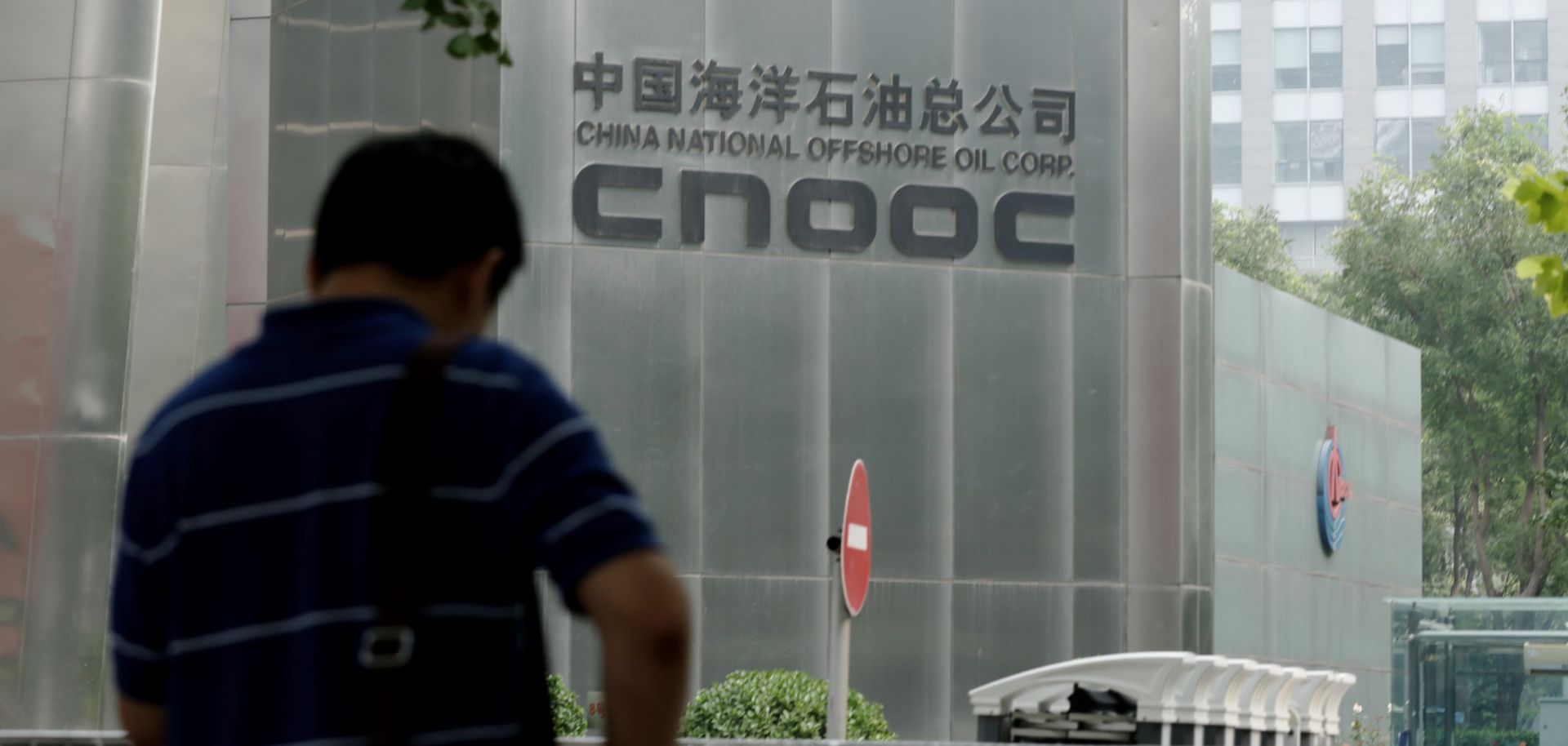
A man stands outside the CNOOC headquarters building in Beijing, China, on July 29, 2016.
The U.S. Commerce Department added the Chinese National Offshore Oil Corporation (CNOOC) to its entity list on Jan. 14, effectively cutting off China’s third-largest oil company from U.S. exports. The move highlights the South China Sea’s importance to U.S. strategy, which will likely continue — though not necessarily expand — under U.S. President-elect Joe Biden. The Trump administration has significantly increased pressure on CNOOC in recent months, beginning in December when it added CNOOC to a separate U.S. Pentagon list of companies that are either owned by or controlled by the Chinese military, which will force certain U.S. investors to divest from CNOOC’s shares by mid-November. Just hours before the Commerce Department’s announcement, the S&P Dow Jones announced it was removing CNOOC from impacted indices to comply with a Jan. 13 presidential order banning U.S. investment into designated Chinese military-linked companies. As a result, major U.S. exchanges will likely delist the company in the coming days and weeks.
Targeting CNOOC, historically the most technocratic of China’s major state-owned oil companies, indicates the rising U.S. attention on China’s assertive posture in the South China Sea. As China’s main offshore operator, CNOOC has been central to China’s drilling campaign in the region, which has encroached on disputed waters for years. The Commerce Department’s press release specifically cited CNOOC’s role in supporting Beijing’s efforts in the South China Sea, with U.S. Commerce Secretary Wilbur Ross saying that the company bullied countries like Vietnam on the behalf of China’s People’s Liberation Army.
- In 2012, CNOOC kicked off an accelerated drilling campaign in disputed waters claimed by Vietnam and Japan. Since then, the company has been involved in a number of escalations in the South China Sea, with Beijing using the company’s exploration activities as a way to effectively implement control over maritime territory.
The inclusion of CNOOC on the entity list will significantly cut off the company’s access to U.S. technology, which is pervasive throughout the energy sector. It will also damage CNOOC’s reliability as a partner in its overseas operations. The immediate impact of the new designation will be limited to CNOOC itself since none of its subsidiaries were added to the entity list. The biggest implications will be related to the company’s domestic offshore operations, as CNOOC will now have to find alternatives to the U.S. suppliers and technology being used in those operations. Although CNOOC’s overseas subsidiaries will not be directly affected, companies exporting to the subsidiaries and consortiums will now also need to conduct enhanced due diligence in order to ensure that exports – including deemed exports of technology – do not trigger U.S. restrictions by eventually falling into the hands of the parent company. The scaling up of the U.S. pressure campaign against CNOOC will also damage both the company and all of its subsidiaries’ global reputation, meaning international oil companies may be less willing to partner with CNOOC in future projects.
- CNOOC claims to be active in over 40 countries, and is particularly active in Africa, Asia and Latin America. CNOOC is also a major partner in burgeoning oil producers Guyana and Uganda. Through a subsidiary, CNOOC also has acreage in the United States as well.
- The Biden administration is unlikely to expand the ban to CNOOC’s international subsidiaries for fear of blowback from the company’s global partners, such as U.S.-based ExxonMobil. But a full removal of CNOOC from the list is also unlikely due to the political consequences of appearing weak on China and CNOOC’s expansive actions in the South China Sea.
The ultimate scope of the export ban is unclear as the United States could still approve any licenses requested by exporters. But the impact of Huawei’s inclusion on the entity list has shown just how effective Washington’s export bans can be when U.S. technology is essential to the blacklisted company’s business operations. According to the semiconductor market researcher TrendForce, Huawei’s share of the global smartphone market is expected to shrink to just 4% in 2021. Before the most extensive U.S. restrictions went into place in mid-2020, Huawei was the world's top smartphone maker.
