
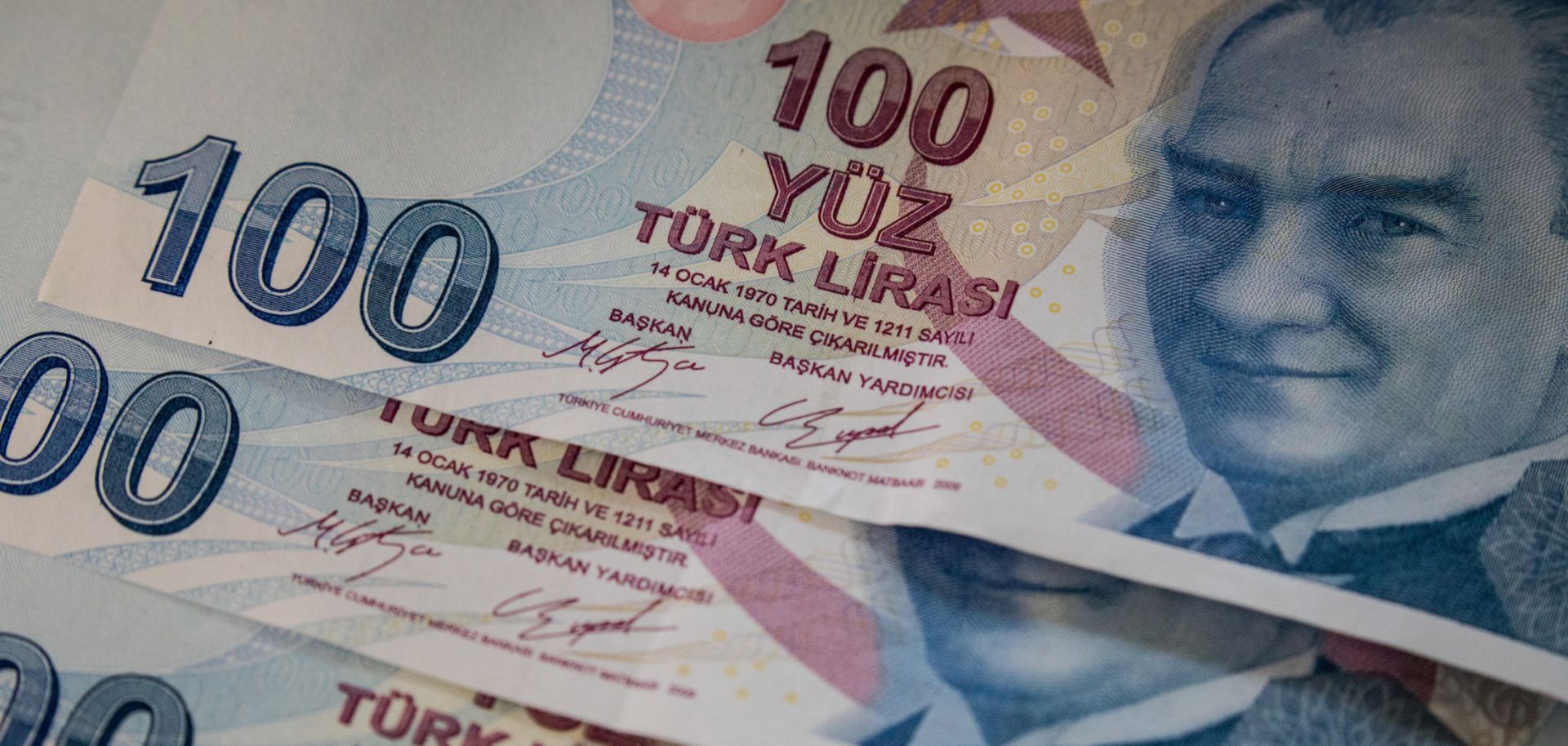
A photo illustration shows banknotes of the Turkish lira currency on Aug. 27, 2018, in Istanbul, Turkey.
The emerging personnel shakeup among Turkey’s financial and economic leadership indicates growing political pressure on and within the ruling Justice and Development Party (AKP) to fix the country's flagging economy, and could initiate a shift in Turkey’s monetary policy that would be welcomed by markets and investors. Turkish President Recep Tayyip Erdogan fired the central bank governor Murat Uysal on Nov. 7 and replaced him with former finance minister Naci Agbal. Then on Nov. 8, finance minister and Erdogan’s son-in-law Berat Albayrak resigned via Instagram, which Erdogan accepted on Nov. 9. Turkey’s currency rallied when markets opened on Nov. 9 to 8.1358 lira per $1, but the degree to which the lira will continue to rally and the economy recover will depend on the decisions Ankara’s economic team makes from here, and whether they make a real shift from the last two years of unorthodox intervention and easing.
The appointment of Agbal, a technocrat, may signal a willingness in the Turkish government to quickly raise its main policy interest rate in order to rebuild confidence in the lira. Turkey’s continued struggle with lira depreciation in the face of inflation — and its negative impact on purchasing power, consumer confidence, and foreign currency inflows — is a primary concern among Turkish investors and regular citizens alike. The initial market reaction to the personnel shake-up is positive, with the lira regaining some ground against the U.S. dollar. This matters because Turkey’s slow-motion currency crisis could accelerate without decisive policy action. Investors have also fretted that lira depreciation will continue in the face of a new U.S. administration under Joe Biden, which could see more fraught U.S.-Turkish relations.
- The Turkish lira has depreciated significantly since the beginning of 2020. The lira closed down against the U.S. dollar on Nov. 6 by more than 41 percent from the end of 2019.
- Inflation was 11.9 percent in October, compared with a central bank policy rate of 10.25 percent. The Central Bank of the Republic of Turkey (CBRT)’s backdoor efforts to raise the cost of lira funding through liquidity operations have not impressed markets as effective policy-tightening to fight inflation.
- As the former head of the Presidency Budget and Strategy Office, Agbal is well-versed in dealing with Erdogan on economic matters. Agbal is also associated with the school of economic policy led by Ali Babacan, who led the AKP’s economic policy in the prosperous 2000s.
Turkey’s grim economic reality and the associated political pressure are probably prompting Erdogan to revisit and possibly adjust his preference for unorthodox monetary policy that sees interest rate hikes as inflationary. As the Turkish economy has continued to struggle throughout 2020, opposition political parties have critiqued the ruling party’s mismanagement and voiced alarm about issues, such as Turkey spending much of its foreign exchange reserves propping up its weakened currency. Even the ruling AKP itself has seen former members leave the party over the last two years because of their concern about the government’s handling of the economy. Turkey’s political system grants the president major decision-making power for all things economic and financial. Any change in policy will thus require Erdogan’s tacit approval, which remains unassured. Erdogan’s action may also ultimately undermine central bank independence further.
- Goldman Sachs recently estimated that Turkey has spent over $100 billion in foreign exchange reserves in 2020 to support its currency, which has since prompted opposition party attacks against the AKP for mismanaging Turkey’s valuable foreign funds.
- Erdogan is known to support easing at all costs and low interest rates, even when high inflation and a depreciating currency would traditionally demand an interest rate hike.
- Almost all pro-government media did not report on Albayrak’s resignation on Nov. 9, nor did Erdogan mention it in his speeches, fueling speculation that some sensitive disagreements within the government and ruling party factored into Albayrak’s decision to step down. Abgal and Albayrak have also been known to clash over preferred economic policies, with the latter’s economic management style viewed by the former as too interventionist.
Markets and investors will be closely watching for policy changes from Turkey’s new economic and financial teams that will have tangible, material effects on the lira and inflation, as well as the country’s foreign exchange reserves. The central bank’s monetary policy committee meeting on Nov. 19 will offer the first opportunity to gauge the new team’s thinking (even Abgal said he doesn’t anticipate any major decisions to be made until this meeting). In a surprise move, the CBRT increased its main policy rate by two percentage points in late September, but passed on a further increase in October, which added to depreciation pressures on the lira. A failure to follow through on what markets see as an implicit promise to raise interest rates further so there is a positive differential over inflation will accelerate the lira’s depreciation, and could also lead to further erosion of Turkey’s already precarious external financial condition.
