
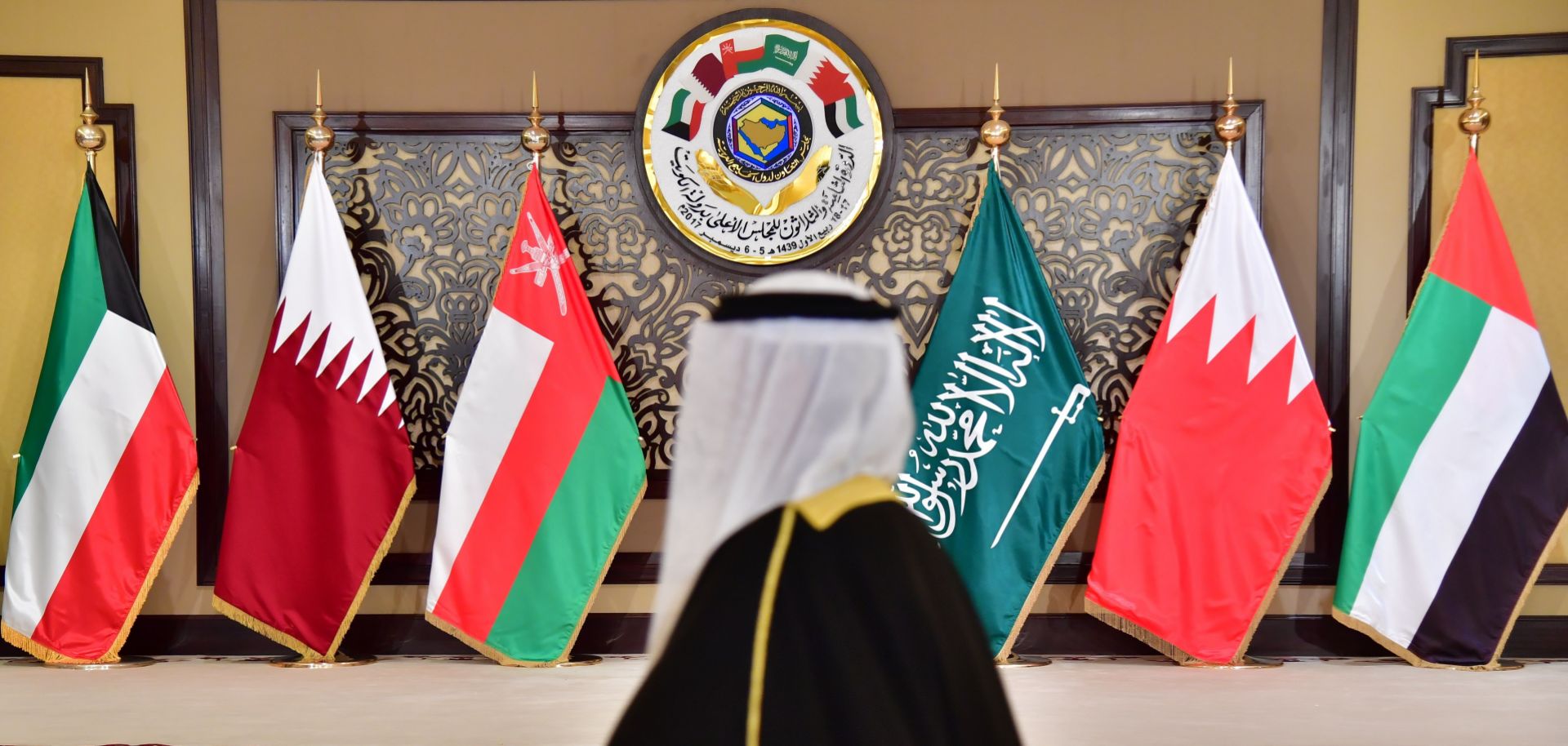
A man walks past the flags of the countries attending the Gulf Cooperation Council (GCC) summit in Kuwait City, Kuwait, on Dec. 5, 2017.
Oman’s proposal to adopt a personal income tax for the wealthy in 2022 underscores the growing shift taking place within the Arab Gulf states to reduce their heavy reliance on oil and gas revenue. On Nov. 1, Oman’s finance ministry published details on its 2020-2024 economic plan, which aims to decrease the country’s fiscal deficit down to 1.7 percent of GDP by 2024. Specifically, the plan seeks to improve Oman’s pandemic-battered fiscal balance by reducing government expenditures and boosting non-oil revenue through the new income tax, among other measures. While personal income taxes have long been politically and culturally unpalatable in the Arab Gulf, popular attitudes are shifting as governments experiment with such revenue-generating reforms. Oman’s experience introducing a new income tax will thus become a test case for what is possible in the other Gulf Cooperation Council (GCC) states.
- The details of the proposed initiative are still under review, suggesting ongoing policy debate over tax rates and who will be taxed.
- Other notable measures in Oman’s medium-term economic plan include the goal of increasing non-oil revenue to 35 percent of total government revenue by 2024 (non-oil revenue accounted for 28 percent of Oman’s total revenue last year).
- Officials are also discussing visa restrictions for foreign workers and introducing early retirement for public sector workers, which would help reduce the government’s social spending and public wage bill. But Oman is otherwise hoping to leave the country’s popular subsidies and social programs largely intact in order to reduce the risk of public backlash and unrest.
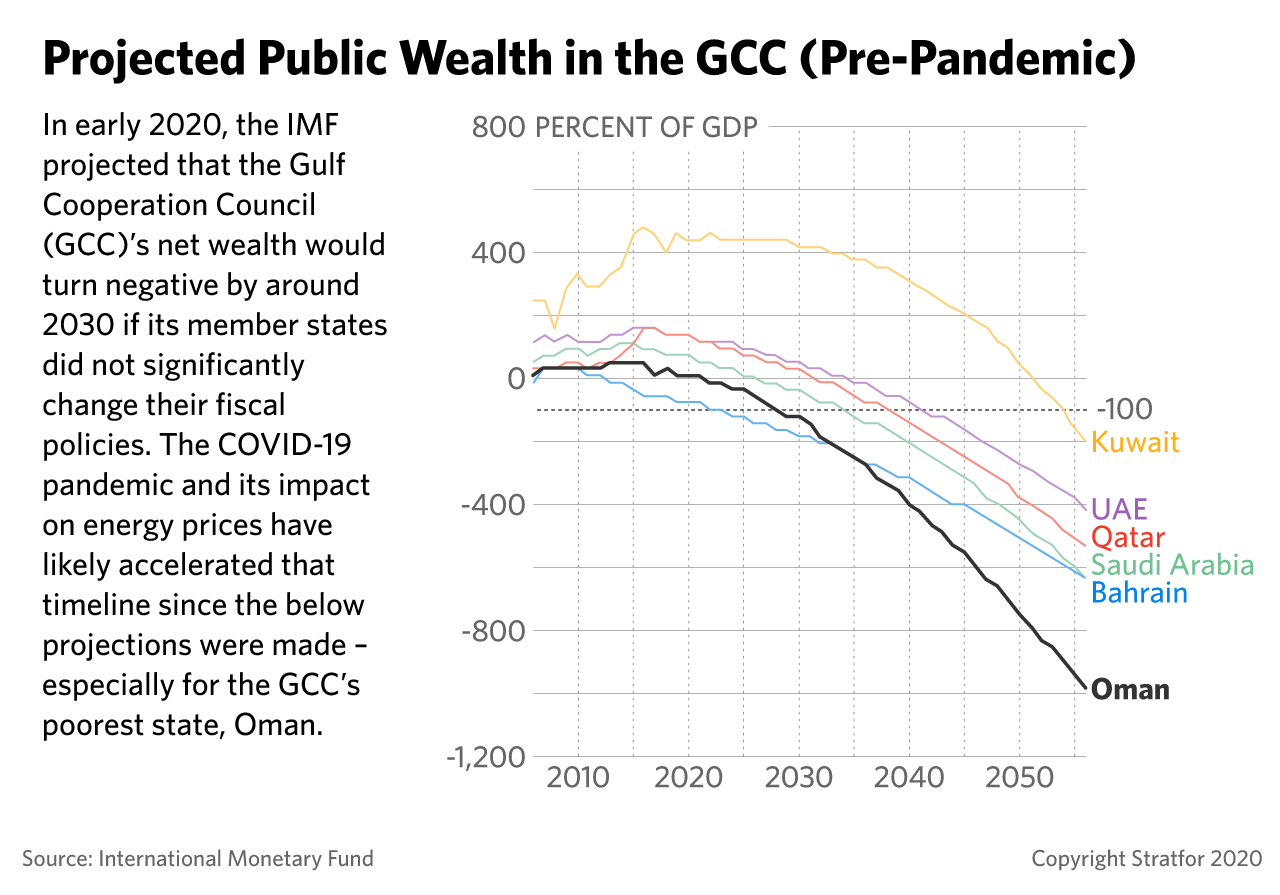
Compared with his predecessor, Oman’s new sultan appears more willing to pursue and implement long-delayed fiscal reforms. Oman’s Sultan Haitham, who took power in January, appears to recognize that the country’s growing financial demands will require Muscat to enact overdue policy reforms that its GCC neighbors have already considered. While other GCC states face similar constraints, Oman’s finances have been disproportionately impacted by low oil prices since 2014 due to its low level of oil and gas production per capita, as well as its smaller financial reserves and sovereign wealth funds.
- The International Monetary Fund (IMF) now expects Oman’s economy to shrink by 10 percent this year, the largest among its GCC neighbors.
- S&P Global Ratings (S&P) has also cut Oman's sovereign rating twice this year, as falling revenue forced the country to take out a significant amount of debt. Oman saw its government debt increase to 78.3% of GDP this year, which could increase further to 85.8% of GDP in 2021, according to the IMF.
- According to both S&P and IMF projections, Oman’s fiscal deficit could hit 18.3 percent of GDP — a sharp increase from its 7.1 percent deficit last year.
- Compared with its GCC peers, Oman has been among the slowest to impose a value-added tax (VAT), which the government recently announced would be introduced in April 2021.
Oman and Bahrain face some of the most urgent economic reform timelines because they lack the substantial oil and gas reserves of their neighbors. But other GCC states will probably also introduce similar taxes in the coming years as their dependence on energy revenue increasingly becomes a liability.
- International financial institutions, including the IMF, and global consulting firms have repeatedly advised the GCC states to introduce more taxes to generate additional non-oil revenue and reduce state expenditures.
- In February, the IMF also published a study on fiscal sustainability that underscored how Oman, Bahrain and Saudi Arabia are the most vulnerable to oil price fluctuations compared with Kuwait, the United Arab Emirates and Qatar, which have stronger financial positions.
GCC leaders will also be watching Omanis’ public reaction to these proposals to gauge their own options and local tolerances for implementing an income tax. Thus far, the reaction has been muted. But given the sensitivity around taxation, it is likely that between now and the proposed implementation date in 2022, Omani citizens will air some grievances via informal channels like social media. Oman’s weakening fiscal position will require some new revenue-generating measures, lowering the likelihood of a cancellation of the proposed tax. Modifying it and designing it with public feedback in mind, however, would track with traditional GCC fiscal policy structuring.
- Tax schemes in the Arab Gulf states have historically been generous to individual workers and corporations. For this reason, tax policy reform remains a controversial subject in the GCC, where governments have long offered substantial oil-funded subsidies and benefits in lieu of political representation.
