
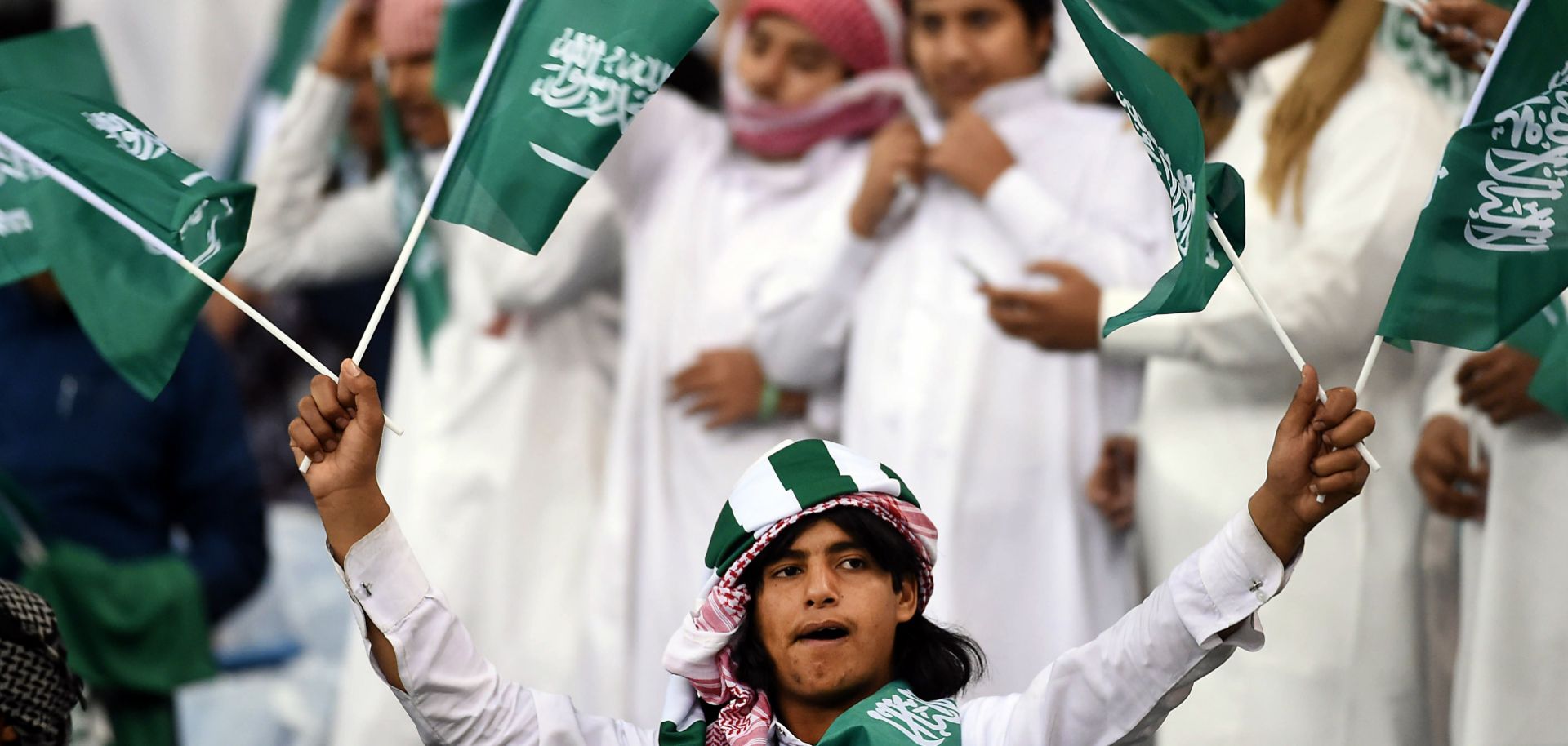
Fans of the Saudi national football team cheer during a match against Qatar at the King Fahad International Stadium in Riyadh, Saudi Arabia, on Nov. 26, 2014.
New survey data suggests that Saudi Arabia’s citizens remain politically aligned with and supportive of the government, though that support may quickly dissipate as Riyadh makes difficult decisions on economic restructuring. The Arab Opinion Index, a survey compiled by the Doha Institute in Qatar, gives rare insight into regional social and political trends in the Middle East. For Saudi Arabia, the latest survey findings reveal a population largely content with their economic and political situations. Saudis’ economic well-being, however, will be undercut as pandemic-related losses of oil revenue and the arrival of peak oil demand force their government to make deeper cuts to crucial social programs, creating pockets of unrest across the kingdom.
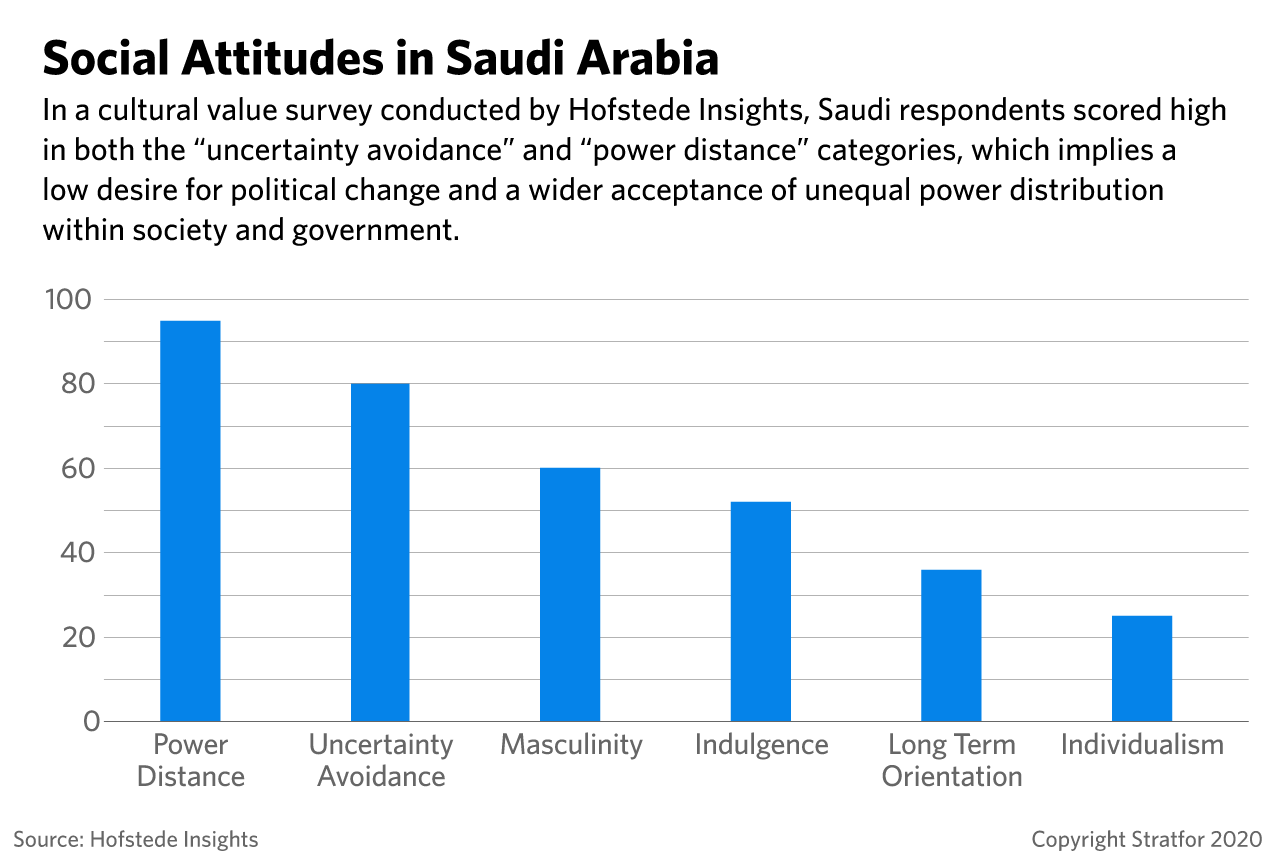
Saudi social and cultural attitudes remain overwhelmingly conservative and largely averse to social and political change, which has long helped stabilize the kingdom’s domestic front. Saudis maintain positive attitudes toward the economy, despite years of high unemployment, new taxes and subsidy cuts. They also show an aversion to regional revolutionary change, suggesting their own attitudes toward radical politics remain hostile.
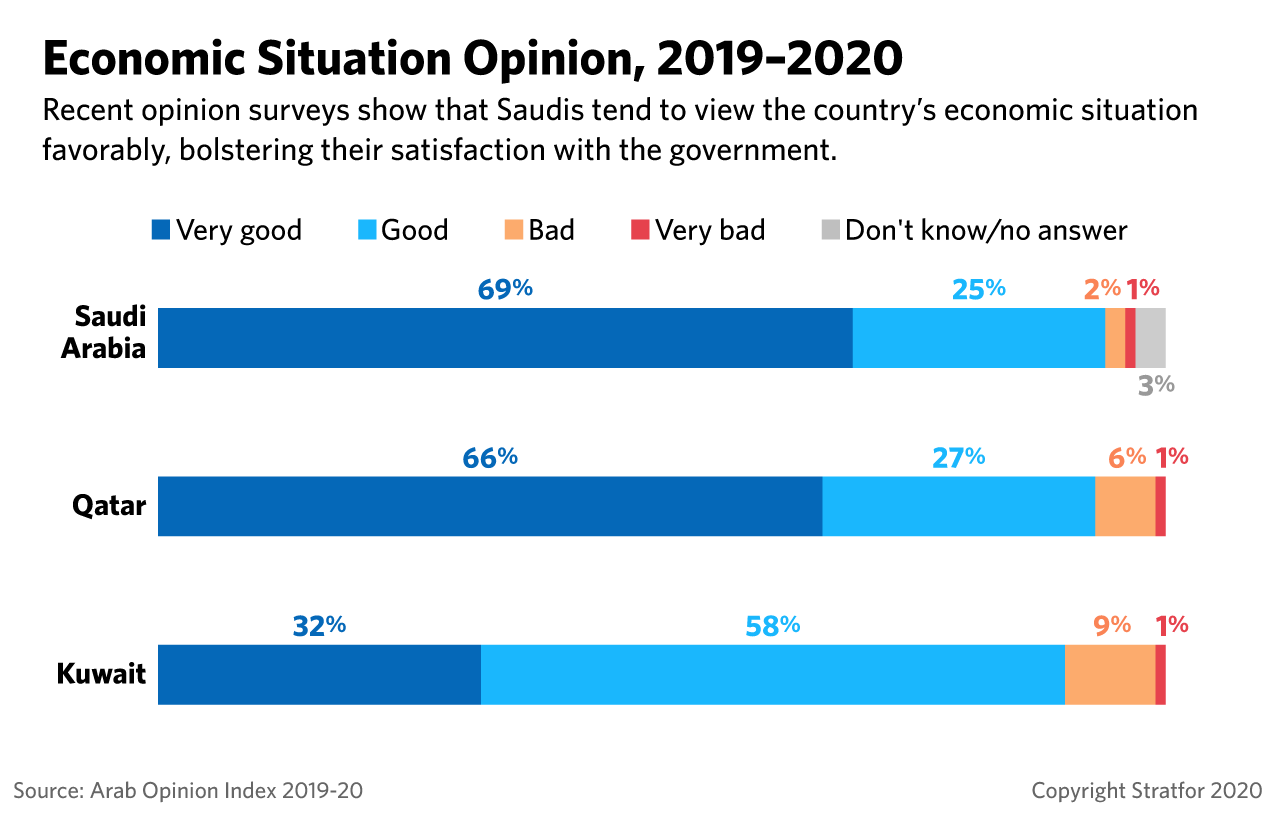
- The 2019-20 Arab Opinion Index shows that even with the pandemic’s economic impacts and subsidy cuts, Saudis overwhelmingly still believe their economic situation is “Good” (25%) or “Very Good” (69 percent). This is despite the kingdom’s rising unemployment rate among native-born Saudis. At 11.8 percent, Saudi Arabia’s national (non-foreign) unemployment rate was already high in the first quarter of 2020. But as the COVID-19 crisis hit, national unemployment increased to 15.4 percent in the second quarter.
- The survey also shows that many Saudis oppose the regional revolutions in Algeria and Sudan. Only 24 percent of Saudis supported popular protests in Sudan, with even less (18 percent) supporting those in Algeria. This is reflective of popular attitudes toward revolution in general, as Saudis were also unsupportive of many of the protests during the Arab Spring.
- Saudi responses to the survey also show a cultural aversion to publicize disputes, in particular political ones. 64 percent of Saudi respondents said they never used social media to engage in discussions on social issues. This is despite Saudis’ high internet use at around 93 percent.
The COVID-19 pandemic and subsequent drops in global oil demand have further harmed the kingdom’s ability to meet its budgetary needs through traditional sources of revenue. Saudi Arabia’s high breakeven oil price already strained its budget, and Riyadh’s ability to borrow cheaply will also be challenged unless it embarks on spending restructuring that improves its creditworthiness.
- Saudi Arabia’s national budget assumes global oil prices remaining near $50 per barrel. But this falls short of the International Monetary Fund (IMF)’s calculated breakeven price of $76 per barrel this year, and $66 next year — indicating that Riyadh intends on further cuts to help bring down its breakeven price for its budget.
- In May, Moody’s Investors Service became the first major credit agency to cut Saudi Arabia’s credit rating, citing uncertainty over whether the kingdom’s ability to pay back loans due to its borrowing patterns and small tax base. Further credit downgrades from both Moody’s and other rating agencies would raise borrowing costs, increasing pressure on the Saudi budget.
- The IMF expects Saudi Arabia’s GDP to decrease by 6.8 percent this year, and return to only 3.1 percent growth in 2021. This could spur further cuts as non-oil revenue fails to meet growth projections.
- More broadly, Saudi Arabia will be increasingly having to operate in a “post-oil” environment, with some large energy companies, including BP, already suggesting that the global economy has reached peak oil demand.
Sentiment shifts against the monarchy could develop as spending cuts fundamentally reshape the Saudis’ lifestyles and relationship with their government. Saudis' still-positive outlook despite the COVID-19 crisis, as reflected in the Arab Opinion Index, is likely partially due to the fact that the kingdom’s spending cuts to-date have yet to severely impact the security of state jobs, which have not declined substantially in terms of total numbers of employed Saudis. Any cuts to public sector jobs and wages, however, would force more Saudi nationals to enter the private sector, in which many do not have the necessary job skills. As a result, Saudis could increasingly become critical of reform policies and change their views of both the economy and political system.
Should popular support falter, the Saudi monarchy has few tools beyond direct repression to manage the population. Riyadh has historically used its security forces, influence over the labor market, control of the courts and domination over the media to stymy dissent and drive it underground. These tools have proven most effective in quelling dissent among minority and regional groups who lay on the outskirts of Saudi society. Popular frustration with new economic reforms is also most likely to manifest within these more disenfranchised groups first. However, Saudi Arabia’s security apparatus would struggle to contain dissent that spreads to large cities due to their population density and influence with the state.
- Saudi Arabia’s more marginalized populations have long histories of dissent and security issues. This includes lower-income populations in large cities and the Shiite population in the Eastern Province, as well as the more geographically isolated residents of far-flung provinces such as Asir, Tabuk, and Bahah. But with less economic and social power, these groups do not threaten the centralized monarchy, whose power is rooted in Riyadh, Mecca, Medina and Dammam.
- Large cities are home to the bulk of the kingdom’s middle- and upper classes, and often have more advanced non-oil sectors that provide greater economic opportunities. However, backlash against economic reforms in these cities is still possible, as even their wealthier residents still rely on the state to provide a generous social safety net that buffers them from downturns in the non-oil sector.
