
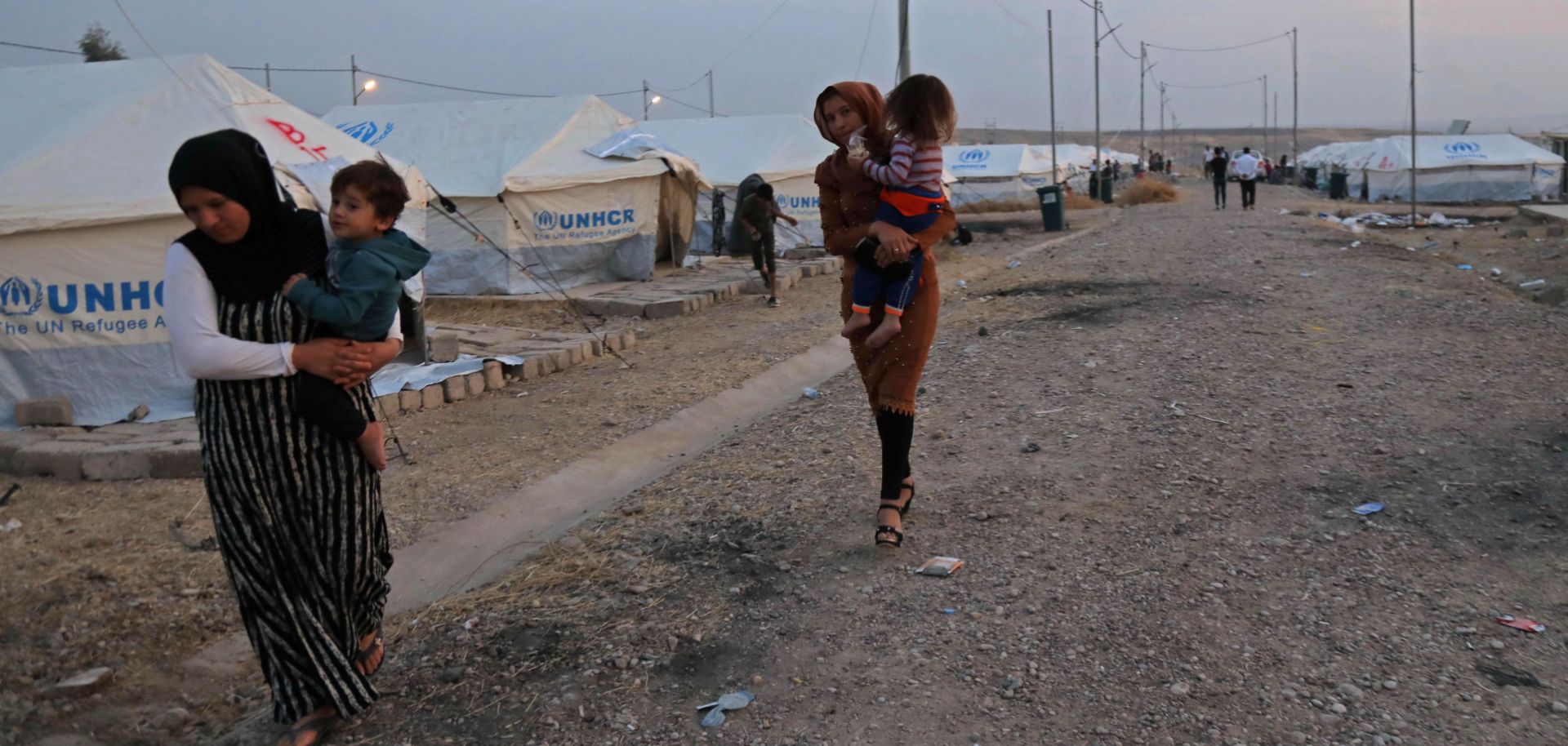
Syrian refugees walk outside a tent at a camp near the Iraqi Kurdish town of Bardarash on Oct. 18, 2019.
Reductions in funding for multilateral aid due to the economic fallout from COVID-19 are impacting the fight against the epidemic in conflict zones such as Yemen, raising the prospect of migration flows and renewed fighting, while increasing pressure on private aid organizations to fund humanitarian programs. Funding for multilateral humanitarian aid is dwindling as donor countries increasingly turn inward to solve their own COVID-19 crises at home. Donor countries are providing pandemic relief in various ways, including debt relief, financial swaps and bilateral aid. But global economic contractions, estimated to hover around 7 percent this year, are reducing aid contributions to the United Nations and other institutions, creating severe systemic funding gaps.
- The pandemic will negatively impact every country across the socioeconomic spectrum, but developing economies and emerging markets will be the hardest hit. According to the World Bank, developing economies as a whole will see their first contraction in 60 years this year due to COVID-19.
- The United Nations' initial special COVID-19 fundraising request for developing countries only netted $1 billion of the $2 billion it requested back in April 2020. The organization recently upped its request to almost $7 billion in light of the severity of the global need (UN), but as of mid-June, only a quarter of that request had been met.
- In Yemen, donor countries have so far only fulfilled $698 million of the $4 billion worth of aid they pledged last year to support U.N. humanitarian efforts. Without immediate funding replenishment, the United Nations said it would be forced to halt 75 percent of its existing programs in the country.
- In April, the Organization for Economic Cooperation and Development (OECD) said over 90 countries had requested short-term COVID-19 funding from the International Monetary Fund. This is double the amount of funding requested in the wake of the 2008-2009 global financial crisis, reflecting the scale and speed to which the pandemic has exacerbated traditional aid sources.
Funding deficits will deepen impoverished countries' dependencies on foreign aid well beyond the current COVID-19 crisis. Pandemic-related drops in global demand, combined with the loss of remittances and aid from developed countries, will exacerbate humanitarian disasters in aid-dependent countries. The outbreak will also further deteriorate these countries' already weak healthcare systems, while increasing unemployment and poverty levels.
- In Latin America, the Organization for Economic Co-operation and Development (OECD) has warned the pandemic could force another 30 million people into poverty.
- In Yemen, the United Nations warned that the COVID-19 outbreak could result in the "complete collapse" of the country's healthcare system.
Aggravated humanitarian crises could increase conflicts and migration strain in and around aid-dependent countries if resources become too scarce. Many geopolitical conflicts are, at their core, a battle over dwindling resources that will dwindle further thanks to COVID-19. Areas with the worst humanitarian crises, such as those in the Middle East, sub-Saharan Africa and Latin America, are already the main sources of refugee and migrant crises that require other regional and global countries to respond politically and economically. Increasingly dire living situations due to the COVID-19 crisis, combined with worldwide border closures to curb the spread of virus, will alter migration patterns to and from the world's weaker and poorer states.
- The U.N. refugee agency (UNHCR) recently added $30 million to its standing $97 million request for multilateral aid to the Sahel region of sub-Saharan Africa.
- The governments in the Sahel have reported a surge of violence since the beginning of the pandemic, forcing more than one million refugees and internally displaced people (IDPs) to flee their homes.
The global community had already recognized the growing role played by the private sector in offsetting funding gaps for the education, infrastructure, health and sanitation milestones outlined in the United Nations' sustainable development framework. Even with both private and public sectors struggling amid COVID-19, and existing institutions pushed to the brink, new innovations for development and aid might be forced into existence, and new partnerships with private organizations will be forged.
