
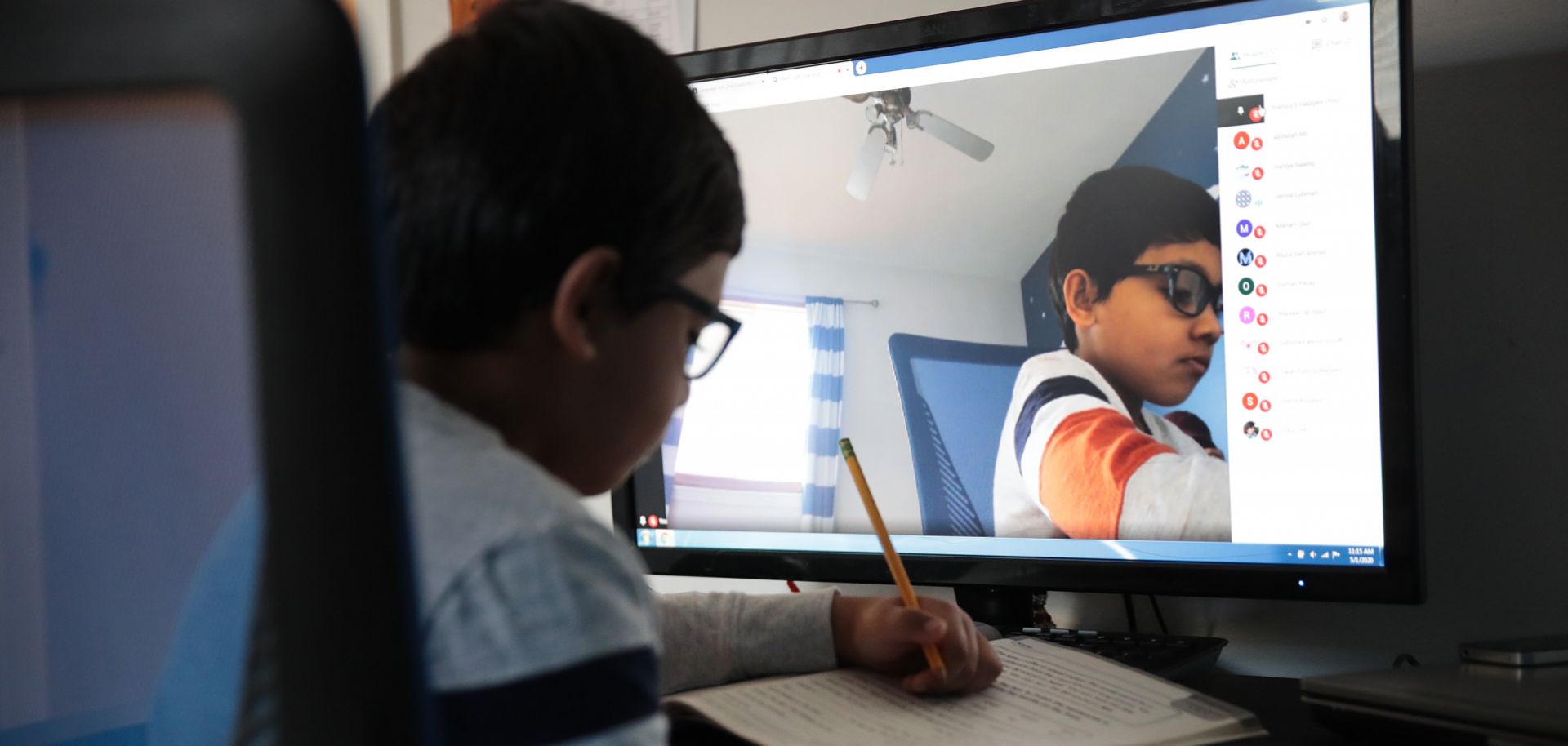
Seven-year-old Hamza Haqqani uses a computer at his home in Bartlett, Illinois, to participate in an online lesson with his teacher and classmates on May 1, 2020.
Since schools began shutting down to curb the spread of COVID-19 in the United States, distance learning has become an increasingly essential tool for the U.S. primary and secondary education sector. But for the companies selling those technologies, uneven financial resources and inconsistent curriculum standards across America's 13,506 school districts will preclude any national "one-size-fits-all" approach to the U.S. market. Instead, companies will need to design flexible and highly customized products and instructional content in order to seize the opportunity at hand, and become a mainstay of classrooms across the country.
With no concrete end in sight to the U.S. outbreak of COVID-19, containment measures are likely to impact the 2020-21 school year, resulting in increasing demands for tools to support remote learning. Decisions on distance learning policies will be decided by this summer and are most likely to assume there will be no normalization of school through 2021. State, district and school policies, including technology purchases, are also typically crafted on 12-month timelines, meaning decisions made at the beginning of the year will probably remain in place throughout the year.
- In March and April 2020, 48 states and Washington D.C. closed their schools in response to COVID-19, forcing most of the country's 56.6 million public, private, and charter school students to pivot to distance learning in order to continue classes through the remainder of the school year.
- To keep their families and children safe from COVID-19, many parents will demand schools remain online. A May 19 poll conducted by Politico found that 41 percent of parents still think it's a bad idea to reopen schools back to normal levels in the fall of 2020.
- With no national strategy to contain the COVID-19 outbreak in the United States, a growing number of Americans across the country are also worried about a second wave of infections. 75 percent of New Yorkers, 77.6 percent of Floridians and 78 percent of Texans surveyed in a recent Civics Analytics poll said they were "highly concerned" COVID-19 will rebound without general social distancing mandate.
- The Center for Disease and Control (CDC)'s social distancing guidelines for 2020-21 includes recommendations for schools, which will not only increase concern among parents, but could potentially increase legal liabilities for school districts that ignore them.
- Some states with activist governors and more centralized educational systems, such as New York, New Jersey and Pennsylvania, will be willing to impose stateside social distancing mandates. Other states such as Texas and Florida will allow school districts to implement state and CDC recommendations as they see fit, but will still feel the parental and legal pressure to at least have some mandates in place to curb the spread of COVID-19, particularly in major cities.
Distance learning and their supporting technologies have a chance to become permanent features of the U.S. education system, which has long grappled with mismatches between a "one-size-fits-all" operational and administrative approach to students, and the research-backed, best-practice approach that favors individualized instruction and different start times.
- Distance learning technology may help finally move the U.S. education system closer toward individualized instruction by expanding schools' capacity to be more flexible towards curriculum and start times.
- Such a shift would increase the buy-in for these technologies from parents, teachers, students and administrators, making them less likely to be abandoned once the pandemic passes.
Examples of distance learning systems include:
- Custom-built test prep software, such as USA Test Prep, designed to prepare students for national and statewide end-of-year exams.
- Teleconferencing software, such as Zoom, to continue classes and group presentations from home.
- Social media software, such as SeeSaw and Flip Grid, to facilitate student-teacher and parent-teacher communication.
- Online platforms, such as Khan Academy, that offer interactive lessons and videos for specific subjects.
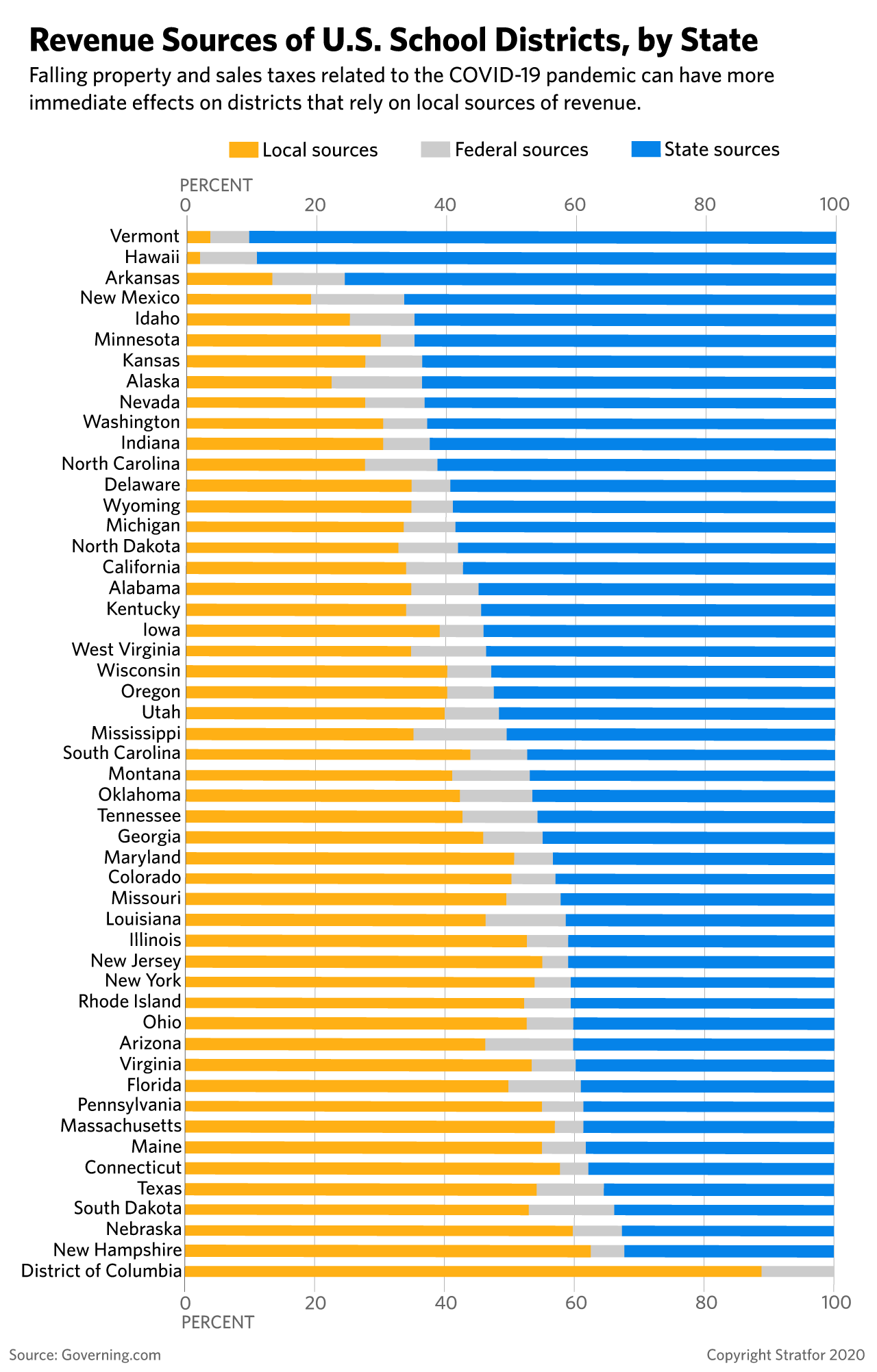
Budgetary pressure, however, will likely deter school districts from purchasing distance learning technologies until it is clear another federal bailout will include state budgets. With the economic fallout from the COVID-19 pandemic cutting into tax revenue, many states and cities across the United States are facing budget shortfalls. Poorer districts that rely heavily on local and state revenues will thus need a larger bailout to afford these technologies.
- New York City may lose up to $3.4 billion in school spending in 2021. California is also already considering a $19 billion education budget cut, while Georgia's governor has warned of up to a 14 percent cut in education spending in July.
- In states where school districts derive more than half of their budgets from local tax revenue, such as Texas, New York and Vermont, wealthier localities will be better able to keep higher levels of funding than poorer zones.
- In states where state (not local) spending makes up the majority of education budgets, such as Vermont, Minnesota and Hawaii, districts will have less of a wealth divide constraining purchases of learning technologies.
Given the diversity of curriculum content throughout America's education system, the most successful educational technology will be able to deliver differentiated content to meet the vast array of state and local education needs. Different state testing regimes will also mean that distance learning technology will need to have built-in flexibility to ensure they can meet the varying testing and curriculum requirements of U.S. schools.
- 35 states still use Common Core, the national curriculum framework that was introduced in 2010. In these states, Common Core often continues to influence the statewide tests high school students need to pass in order to earn their diplomas.
- Some educational technology will be able to specialize in niche markets, but will still need exact curriculum alignment to be successful in states that have not adopted Common Core, including Texas, Virginia and Nebraska.
