
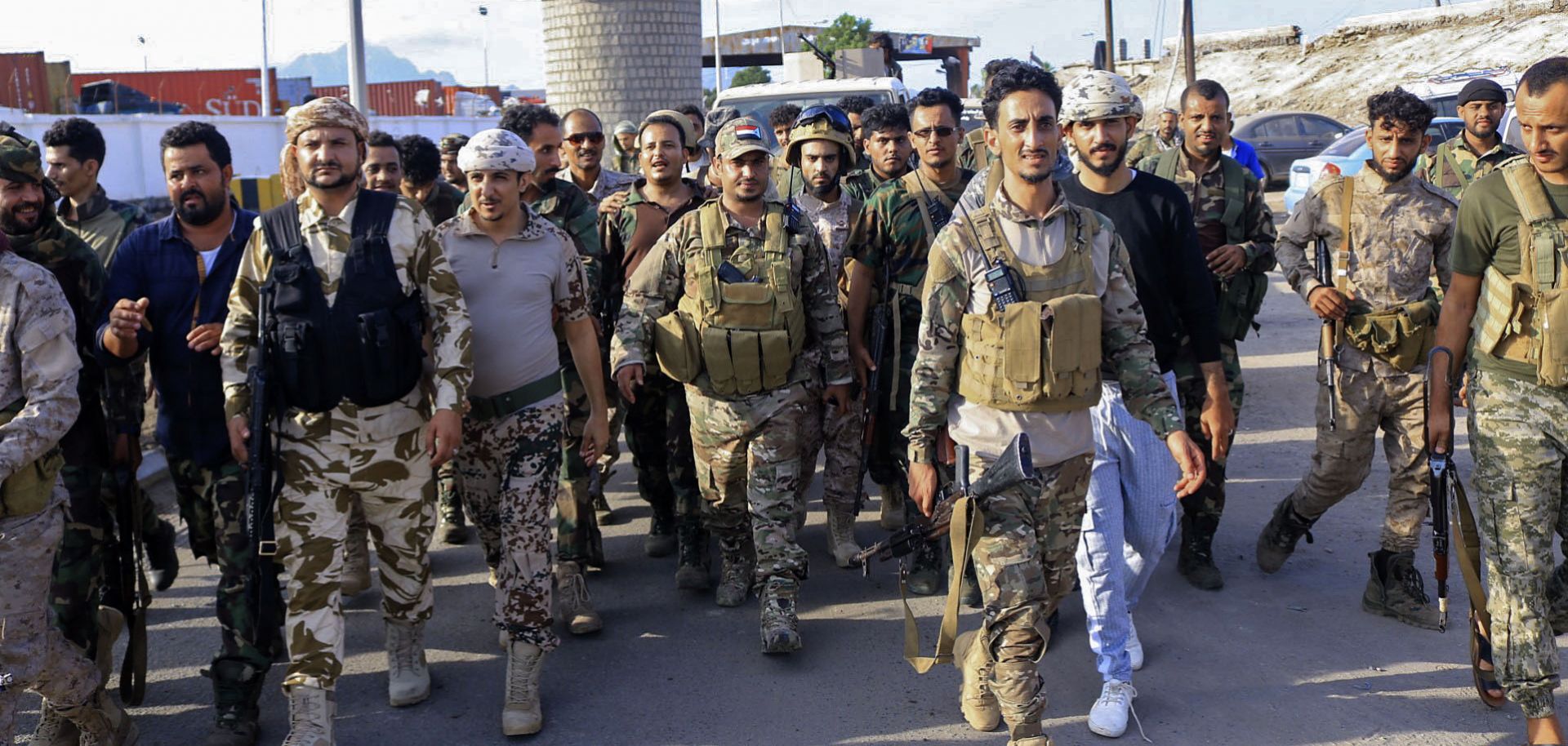
Fighters with Yemen's separatist Southern Transitional Council (STC) deploy in the city of Aden on April 26, 2020, after declaring self-rule of the country's south.
Separatists in southern Yemen are inching ever closer to their goal of restoring an independent state. On April 29, the Southern Transitional Council (STC) declared emergency self-rule in the country's provisional capital of Aden, officially taking control from Yemen's U.N.-recognized government of President Abd Rabboh Mansour Hadi. As it takes further steps toward succession, the STC will have to increasingly compete with other Yemeni factions in the region, along with Hadi's Saudi-backed forces. The resulting uptick in instability will risk undermining regional efforts to stem the influence of both Houthi rebels and jihadist groups in the country.
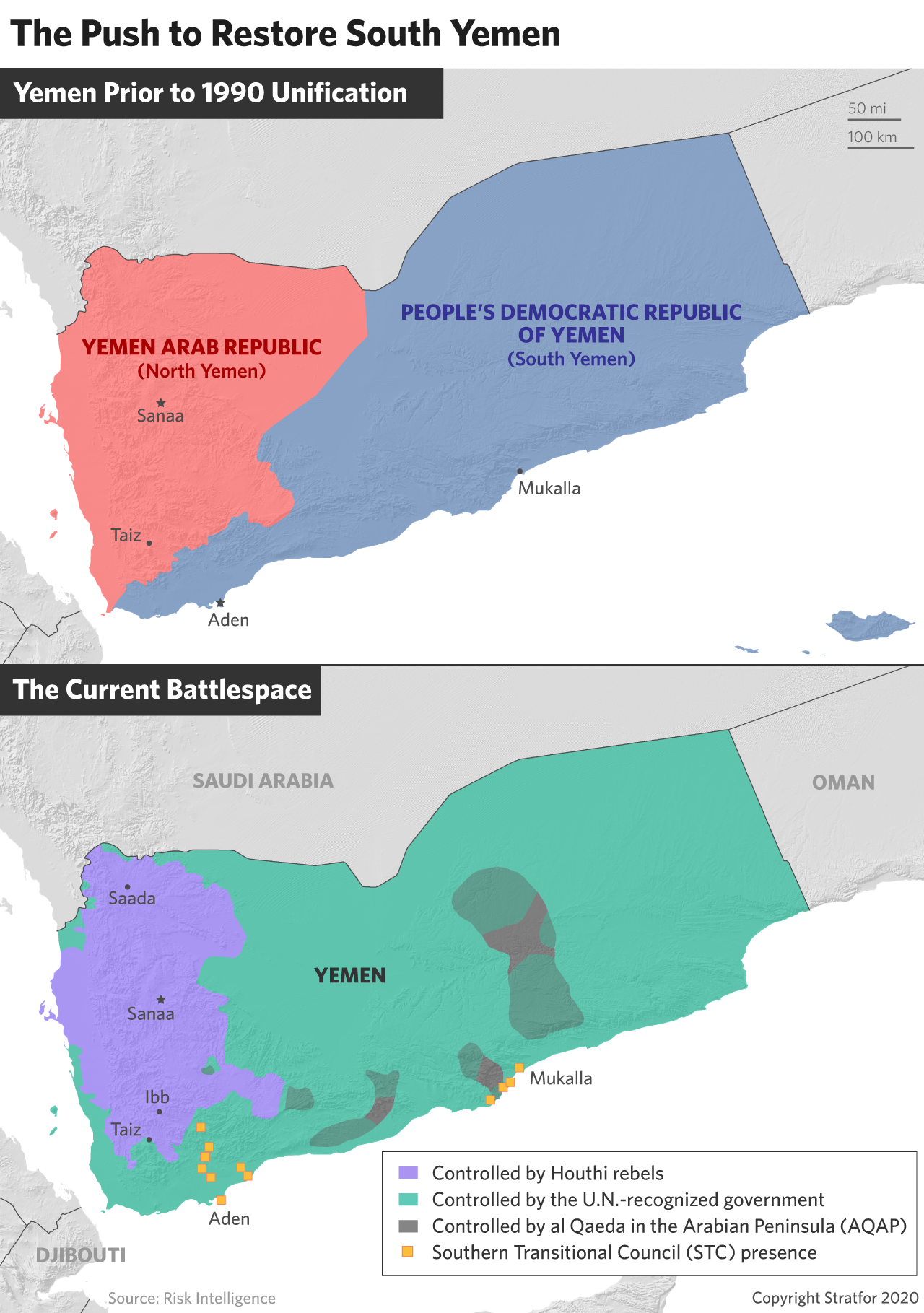
Despite its recent advancements, six of the eight provinces in southern Yemen have yet to accept the STC’s declaration of power.
- The group’s control over the region’s coastal populations make up the majority of southern Yemen, but the STC still faces significant resistance from tribes, officials and rival factions in the provinces that make up southern Yemen’s desert interior, such as Hadramawt and al-Mahra.
- These inland populations have long-standing connections to Saudi Arabia and Oman, both of whom oppose the return of an independent South Yemen.
Saudi Arabia and the international community are opposed to secession, but are unlikely to stop the process.
- Recent statements from both Saudi and U.S. government officials indicate they will not take measures beyond diplomatic maneuvers to block the STC’s push for independence.
The United Arab Emirates will continue to tacitly back the STC in its bid to create a reliable client state in South Yemen.
- The United Arab Emirates and Saudi Arabia have worked together in the fight against Iran-backed Houthi rebels in Yemen. But over the past year, Abu Dhabi’s strategy has begun to focus more on bolstering its influence over the STC, driving a rift between Riyadh and its allies within the Yemeni government.
- Saudi Arabia, however, ultimately values Abu Dhabi’s energy ties and support of wider regional efforts against Iran above its strict cooperation in Yemen.
- The United Arab Emirates thus will not face significant international or regional blowback for continuing to support the STC.
The resulting new layer of disorder in South Yemen will undercut Saudi and U.N. regional peace efforts.
- By weakening the Yemeni government, continued STC gains will make any peace deal between the Hadi administration and Houthi rebels more reliant on the acquiescence of the secessionist group.
- This will complicate Saudi Arabia’s ability to mediate a resolution that enables it to successfully end their military intervention in Yemen.
The increased instability will also jeopardize the U.S.-backed counterterrorism efforts in the country by granting jihadist more space to recruit, organize and attack.
- The STC is a potent partner in regional counterterrorism efforts, but the group’s current focus on state-building and its rivalry with President Hadi will lessen its ability to deploy power against al Qaeda and the Islamic State.
- This will increase the need for additional U.S. involvement to prevent these groups from exploiting the STC’s increasing pivot to intra-Yemeni contests.
