
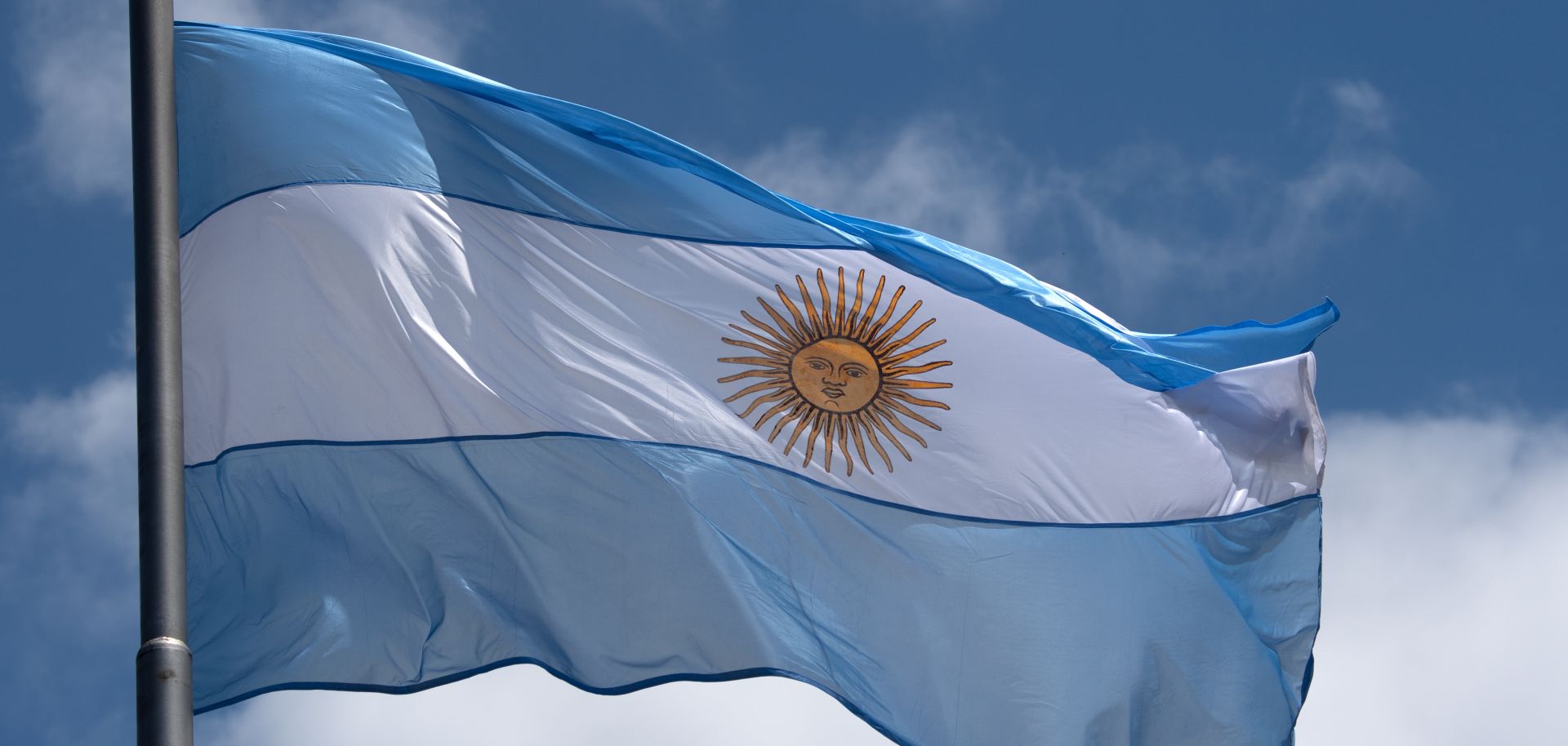
The national flag of Argentina flies above Avenida 9 de Julio, one of the major arteries of Buenos Aires, on Nov. 28, 2018.
What Happened
On April 24, Argentina announced it was withdrawing from ongoing free trade negotiations with the Common Market of the South (Mercosur) in order to focus on its unfolding COVID-19 crisis and the subsequent economic fallout at home. The Argentine government said its decision would not affect the already negotiated, but not yet ratified, Mercosur agreements with the European Union and the European Free Trade Association (EFTA).
The governments of Brazil, Uruguay and Paraguay — Mercosur's remaining members — have lamented Argentina's decision and have since announced their intention to move forward with the bloc's current free trade negotiations with South Korea, Singapore, Lebanon, Canada and India. On April 27, Brazil's finance minister Paulo Guedes offered more combative rhetoric, indicating that Argentina was acting out of desperation.
Why It Matters
Argentina has not abandoned Mercosur, yet, and it did not explicitly veto the pursuit of the current negotiations with other countries. But given the trade bloc's internal rule to approve all deals unanimously, its withdrawal from current trade talks will severely hamper the ability of the other three Mercosur nations to engage in credible and successful negotiations. The decision also increases uncertainty over whether Argentina's Congress would ratify the Mercosur deals with the European Union and the EFTA, which could provoke the collapse of the hard-fought agreements. Final ratification of the EU-Mercosur deal, which was signed in June 2019, has never been a sure thing, but the main risk of rejection had previously stemmed from European nations with dissatisfied agricultural constituents, as well as external factors such as Brazil's climate change policies.
Argentina's exit from negotiations also indicates a return to a protectionist stance in Buenos Aires, as well as Mercosur more broadly. The South American bloc has traditionally focused inward, developing markets and trade within the bloc rather than looking to expand ties with other regional blocs or individual nations. Hence, Mercosur's landmark agreement with the European Union, as well as its deal with the smaller EFTA, had signaled a move to open up trade with the almost 300 million people who make up the large Southern Cone market. The recent pursuit of negotiations with South Korea, Singapore, Lebanon, Canada and India had then pushed the bloc further outward.
In recent years, a window to move towards this more outward-looking approach opened as the political strategy of Mercosur's two largest players — Brazil and Argentina — aligned in favor of more pro-business, pro-trade policies. But the unseating of Argentina's former right-wing president, Mauricio Macri, in October 2019 has since increased the risk of a turn toward more protectionist policies under his leftist successor, Alberto Fernandez. Indeed, during the presidential campaign, Fernandez and his allies questioned whether the EU-Mercosur trade agreement benefitted Argentina. And with Argentina's withdrawal from trade talks, this political shift inward has started to materialize.
What's Next
Trade talks already often take a long time, but the COVID-19 pandemic and subsequent global recession might further lengthen any negotiation process. With this in mind, the other Mercosur nations might allow Argentina to free-ride the negotiations and hope that a different administration with a more pro-trade outlook is in place by the time all is said and done. However, the bloc will need to remain intact to see a political change in Argentina.
On April 27, Fernandez doubted the long-term viability of the trade bloc on the basis of ideological differences and, in his view, the violation of Mercosur rules by other countries "trying to pursue unilateral deals." The president's statement calls into question the guaranteed continuation of the almost 30-year-old commercial bloc, which will only be further complicated as the differing ideologies harbored by its members all try to cope with a large global recession caused by the COVID-19 crisis.
